2004-34 Deferred Revenue: Historical Rule and Current §451(c) Guide
Listen to article
14:16
2004-34 deferred revenue refers to Rev. Proc. 2004-34, the IRS procedure that let accrual-method taxpayers defer advance payments to the next succeeding taxable year, to the extent the payments were not recognized in revenues (or earned) in the year of receipt. It no longer governs current filings. Final regulations under Treas. Reg. §1.451-8 apply to taxable years beginning on or after January 1, 2021. This guide explains the historical rule, the current §451(c) framework and a hypothetical book-to-tax reconciliation. It is educational content, not taxpayer-specific filing advice.

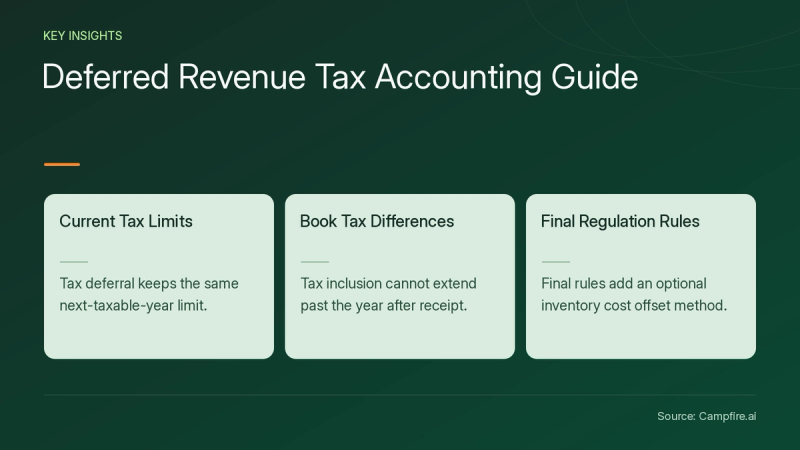
Key Takeaways
- Rev. Proc. 2004-34 limited tax deferral of qualifying advance payments to one year, with a narrow exception for short taxable years of 92 days or less.
- Current rules under §451(c) and §1.451-8 keep the same next-taxable-year limit for taxable years beginning on or after January 1, 2021.
- Book deferred revenue under ASC 606 can extend for years, but tax inclusion of a qualifying advance payment cannot pass the year after receipt.
- The final regulations add rules the 2004 procedure did not contain, including eligible gift card sales and an optional advance payment cost offset method for inventory.
- Teams need a receipt-year schedule that ties each payment to book revenue, tax inclusion and remaining balances.
What did Rev. Proc. 2004-34 allow?
Rev. Proc. 2004-34 allowed a limited one-year deferral of advance payments for taxpayers using an overall accrual method. According to the official text of Rev. Proc. 2004-34[c1], it expanded the older Rev. Proc. 71-21 beyond services while keeping the one-year limit.
- Two methods: the Full Inclusion Method (include everything in the year of receipt) and the Deferral Method (include the AFS-recognized or earned portion now, the rest next year).
- Eligible payments: services, goods, intellectual property, software, ancillary warranties, subscriptions, memberships and combinations of these.
- Exclusions: most rent, insurance premiums under Subchapter L, financial instruments, payments under §83 and certain withholding-related payments.
- AFS priority: SEC filings first, then certified audited statements, then statements required by a government agency.
- Effective date: taxable years ending on or after May 6, 2004.
- Method changes: Form 3115, using historical automatic change numbers 83 (Full Inclusion) and 84 (Deferral).
The procedure's Example 2 shows the core limit. A 2-year lessons contract recognized 1/12, 6/12 and 5/12 in financial statements over three years. For tax, the taxpayer included 1/12 in year one and the remaining 11/12 in year two.
What replaced Rev. Proc. 2004-34?
IRC §451(c), as amended by the Tax Cuts and Jobs Act on December 22, 2017, and the final regulations in §1.451-8 replaced it. Rev. Proc. 2021-34[c2] explains that Notice 2018-35 let taxpayers keep relying on Rev. Proc. 2004-34 until new guidance applied, and that notice is obsolete for taxable years beginning on or after January 1, 2021.
The eCFR text of §1.451-8[c3] applies the rules to taxable years beginning on or after January 1, 2021. Earlier application was permitted only if applied in its entirety and consistently. Rev. Proc. 2021-34 also made the old advance-payment automatic change in section 16.07 of Rev. Proc. 2019-43 unavailable for years of change beginning on or after that date. Procedural lists are updated periodically, so confirm the current automatic change section with a tax adviser before filing.
| Topic | Rev. Proc. 2004-34 | §451(c) and §1.451-8 |
|---|---|---|
| Applicable period | Rev. Proc. 2004-34Taxable years ending on or after May 6, 2004; reliance ended for years beginning on or after Jan. 1, 2021 | §451(c) and §1.451-8Taxable years beginning on or after Jan. 1, 2021 |
| Deferral limit | Rev. Proc. 2004-34Next succeeding taxable year | §451(c) and §1.451-8Next succeeding taxable year |
| Taxpayers with an AFS | Rev. Proc. 2004-34Include to the extent recognized in AFS revenues | §451(c) and §1.451-8Include to the extent taken into account as AFS revenue, with §1.451-3(b)(2) adjustments |
| Taxpayers without an AFS | Rev. Proc. 2004-34Include to the extent earned; statistical, ratable or other approved basis | §451(c) and §1.451-8Non-AFS deferral method; earned under the all events test; statistical or straight-line fallback |
| Gift cards | Rev. Proc. 2004-34Deferral only if AFS recognition is determinable | §451(c) and §1.451-8"Eligible gift card sale" listed as a qualifying item |
| Multiple obligations | Rev. Proc. 2004-34Allocation based on objective criteria | §451(c) and §1.451-8Follow AFS allocation (AFS taxpayers); objective criteria (non-AFS) |
| Inventory cost offset | Rev. Proc. 2004-34No cost offset method in the procedure | §451(c) and §1.451-8Optional advance payment cost offset method, §1.451-8(e) |
| Short taxable year | Rev. Proc. 2004-3492 days or less | §451(c) and §1.451-892 days or less |
How do book and tax schedules differ for one payment?
Book revenue follows the contract term, while tax inclusion of a qualifying advance payment stops at the year after receipt. The hypothetical below assumes a calendar-year accrual taxpayer with an AFS, a qualifying advance payment, valid use of the §1.451-8(c) deferral method, ratable AFS revenue and no special adjustments. These are constructed figures, not customer results.


Hypothetical facts: $240,000 received October 1, 2025, for 24 months of services.
| Year | Book revenue | Tax inclusion | Annual difference (tax minus book) | Book deferred revenue at year-end |
|---|---|---|---|---|
| 2025 | Book revenue$30,000 | Tax inclusion$30,000 | Annual difference (tax minus book)$0 | Book deferred revenue at year-end$210,000 |
| 2026 | Book revenue$120,000 | Tax inclusion$210,000 | Annual difference (tax minus book)+$90,000 | Book deferred revenue at year-end$90,000 |
| 2027 | Book revenue$90,000 | Tax inclusion$0 | Annual difference (tax minus book)-$90,000 | Book deferred revenue at year-end$0 |
| Total | Book revenue$240,000 | Tax inclusion$240,000 | Annual difference (tax minus book)$0 | Book deferred revenue at year-endn/a |
Which journal entries support the book side?
- October 1, 2025: Debit Cash $240,000; Credit Deferred Revenue $240,000.
- December 31, 2025: Debit Deferred Revenue $30,000; Credit Revenue $30,000.
- 2026 monthly entries totaling $120,000; 2027 entries totaling $90,000.
At the end of 2026, $90,000 of book deferred revenue has already been taxed. That timing difference belongs in the income tax provision review. The regulation's own example follows the same logic: a $100 payment allocated $80/$20 across two performance obligations produced $30 of 2021 income and $70 in 2022, even though some AFS revenue fell in 2023.
How should finance teams build the reconciliation?
Build a receipt-year cohort schedule that links every advance payment to its book recognition and tax inclusion. Each cohort should fully clear tax inclusion by the end of the next taxable year, unless an exception applies.
- Identify payments: confirm each payment fits a §1.451-8(a)(1) category and is not excluded.
- Assign a cohort: tag the receipt date and taxable year of receipt.
- Pull AFS revenue: record revenue taken into account through year-end, including allocations across performance obligations.
- Calculate inclusion: year one equals AFS revenue recognized; year two equals the remainder.
- Flag exceptions: short years, acceleration events, write-downs, refunds and credit notes go to tax review, not automatic netting.
- Approve: a preparer builds the schedule and a reviewer signs off against source records.
Useful fields include transaction ID, contract reference, receipt date, cohort year, amount, classification rationale, book revenue by year, prior tax inclusions and remaining balance. For related reading on contract-level schedules, see Campfire's overview of revenue recognition and deferred revenue automation.


The tax schedule should tie back to the general ledger each close. Campfire's page on general ledger, journal entries and close checklists covers related close concepts.
Which exceptions change the timing?
Short taxable years, acceleration events, purchase accounting write-downs and inventory cost offsets can all change when an advance payment is included.
- Short years: if the next taxable year is 92 days or less, include the AFS-recognized portion in the short year and the rest in the following year.
- Acceleration: include all remaining advance payments if the taxpayer ceases to exist outside a §381(a) transaction, or to the extent the obligation is satisfied or ends. In the regulation's travel agent example, the commission was taxable when the ticket was delivered.
- Write-downs: a deferred revenue write-down in purchase accounting is treated as AFS revenue in the year it occurs.
- Cost offset: under §1.451-8(e), inventory sellers may reduce an advance payment inventory inclusion amount by the cost of goods in progress, item by item and never below zero. In the regulation's example, a $40x payment less a $10x offset produced $30x of income in 2022. It does not apply to eligible gift cards or reward points.
- Specified goods: certain payments received more than one year before the contractual delivery year are excluded unless the taxpayer elects the §1.451-8(f) method.
Practitioner commentary such as The Tax Adviser's coverage of the final regulations can help frame these questions with your adviser.
Conclusion
Rev. Proc. 2004-34 still explains where the one-year deferral rule came from, but §451(c) and §1.451-8 govern taxable years beginning on or after January 1, 2021. The practical work is operational: classify payments, track receipt-year cohorts, reconcile book and tax schedules and route exceptions to a reviewer. Keep the authority map dated and confirm current method change procedures before any filing. When your team is ready to tie deferred revenue schedules to a clean ledger, get started with Campfire.
FAQ
Is Rev. Proc. 2004-34 still valid?
Rev. Proc. 2004-34 is not the governing authority for taxable years beginning on or after January 1, 2021, when the final §1.451-8 regulations apply. Rev. Proc. 2021-34 states that Notice 2018-35, which permitted continued reliance on Rev. Proc. 2004-34, is obsolete for those years. The procedure remains useful as historical background.
Can tax deferral of an advance payment exceed one year?
Generally no, because both Rev. Proc. 2004-34 and §1.451-8 require the remaining portion to be included in the taxable year after receipt. The main exception is a next taxable year of 92 days or less, where the balance not recognized in that short year moves to the following year. Installments received in later years start their own one-year clock.
Can a business without an applicable financial statement defer advance payments?
Yes, a taxpayer without an AFS may elect the non-AFS deferral method if it can determine the extent to which each payment is earned in the year of receipt. If it cannot, §1.451-8(d) allows a statistical basis with adequate data or a straight-line basis for fixed-term agreements when ratable earning is reasonable to anticipate.
Is Form 3115 required to use the §451(c) deferral method?
It depends on whether using the method is an adoption or a change. Under §1.451-8(g), the election is made by filing a return that reflects the deferral method, but if that changes an existing method of accounting, the taxpayer must obtain consent under §1.446-1(e) and follow the applicable procedures, which typically involve Form 3115. Confirm current eligibility and change numbers with a tax adviser.
Sources
- [c1] Microsoft Word - RP-04-34.doc — irs.gov. Accessed November 10, 2026.
- [c2] Rev. Proc. 2021-34 — irs.gov. Accessed November 10, 2026.
- [c3] eCFR :: 26 CFR 1.451-8 -- Advance payments for goods, services, and certain other items. — ecfr.gov. Accessed November 10, 2026.