401k Chart of Accounts: How to Categorize Deferrals, Match and Fees
Listen to article
10:53
A 401k chart of accounts is the set of general ledger accounts an employer uses to record retirement plan activity. It typically includes liability accounts for employee deferrals withheld from pay, a payable for employer contributions, an expense account for the employer match and an expense account for employer-paid plan fees. Employee deferrals are liabilities, not expenses. Only the employer's own contributions and fees hit the income statement.
This guide covers the employer's books, meaning payroll accounting for the plan sponsor. The retirement plan's own financial statements, which track trust assets and participant balances, are a separate reporting entity and are not covered here.

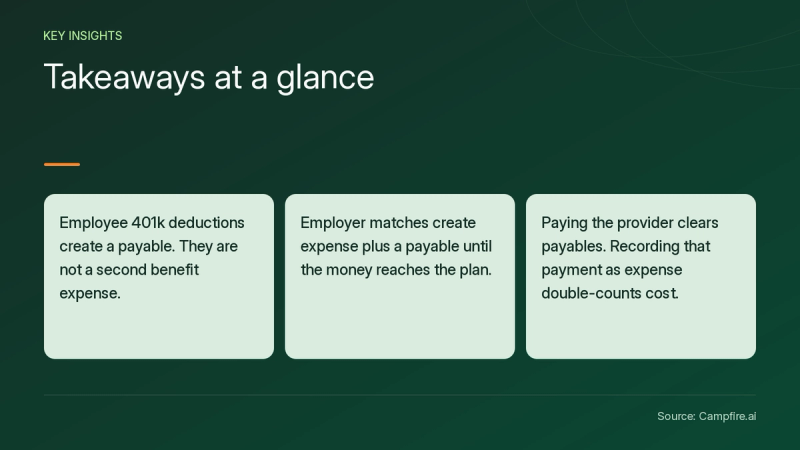
Key Takeaways
- Employee 401k deductions create a payable. They are not a second benefit expense.
- Employer matches create expense plus a payable until the money reaches the plan.
- Paying the provider clears payables. Recording that payment as expense double-counts cost.
- Separate Roth and traditional detail in payroll records, and add GL subaccounts if they help reconciliation.
- A zero liability balance does not prove deposits were timely. Track payroll dates against deposit dates.
What Accounts Belong in a 401k Chart of Accounts?
A practical 401k chart of accounts needs three to six accounts: payables for each employee contribution type, an employer contribution payable, an employer contribution expense and a plan fee expense. Account structures published by practitioners, such as this chart of accounts blueprint[c1], follow the same pattern of balance sheet liabilities paired with income statement expenses.
| Account (illustrative number) | Type | What posts here | Payroll item mapped |
|---|---|---|---|
| 2210 Traditional 401k Deferrals Payable | TypeCurrent liability | What posts herePretax employee deductions | Payroll item mapped401k employee deduction |
| 2220 Roth 401k Deferrals Payable | TypeCurrent liability | What posts hereAfter-tax Roth deductions, including Roth catch-ups | Payroll item mappedRoth 401k deduction |
| 2230 Employer 401k Contributions Payable | TypeCurrent liability | What posts hereAccrued match or nonelective contributions | Payroll item mappedEmployer match liability |
| 2240 401k Loan Repayments Payable (optional) | TypeCurrent liability | What posts hereParticipant loan repayments withheld | Payroll item mapped401k loan deduction |
| 6110 Employer 401k Contribution Expense | TypeOperating expense | What posts hereEmployer match and profit-sharing cost | Payroll item mappedEmployer match expense |
| 6120 Retirement Plan Administration Fees | TypeOperating expense | What posts hereEmployer-paid recordkeeping and admin fees | Payroll item mappedNot a payroll item |
Note: Account numbers are illustrative. Numbering and subaccount depth are design choices, not regulatory requirements.
Keep these accounts consistent across entities so consolidated reporting rolls up cleanly. A general ledger with multi-entity consolidation and close checklists makes it easier to enforce one retirement account structure company-wide.
How Do You Record 401k Contributions in the General Ledger?
You record 401k contributions in three steps: withhold employee deferrals at payroll, accrue the employer match, then clear both payables when you remit to the plan. The example below uses invented amounts and omits taxes and other deductions for simplicity. For full payroll entries, see this payroll journal entry walkthrough[c2].
Step 1: Record payroll and employee deferrals
| Account | Debit | Credit |
|---|---|---|
| Wages Expense | Debit$10,000 | Credit |
| 2210 Traditional 401k Deferrals Payable | Debit | Credit$600 |
| 2220 Roth 401k Deferrals Payable | Debit | Credit$200 |
| Cash (net pay) | Debit | Credit$9,200 |
Step 2: Accrue the employer match
| Account | Debit | Credit |
|---|---|---|
| 6110 Employer 401k Contribution Expense | Debit$400 | Credit |
| 2230 Employer 401k Contributions Payable | Debit | Credit$400 |
Step 3: Remit to the plan provider
| Account | Debit | Credit |
|---|---|---|
| 2210 Traditional 401k Deferrals Payable | Debit$600 | Credit |
| 2220 Roth 401k Deferrals Payable | Debit$200 | Credit |
| 2230 Employer 401k Contributions Payable | Debit$400 | Credit |
| Cash | Debit | Credit$1,200 |
Total expense is $10,400: wages plus the match. The $1,200 remittance adds no expense because it settles liabilities already recorded. At period end, accrue any match earned but not yet run through payroll, as covered in this guide to 401k employer match accruals[c3].


Is a 401k Payment to the Provider an Expense or a Liability?
A 401k payment to the provider is usually a liability settlement, not an expense. The common mistake is categorizing the bank debit as "401k Expense" when payroll already posted the deductions and match. Use this decision path for each provider debit:
- Pull the provider's split report. Get traditional, Roth, employer and loan amounts for the debit.
- Match to existing payables. If payroll posted the liabilities, match the debit against them. Do not create a new expense.
- Separate fees. If the debit includes employer-paid admin fees, post that portion to 6120.
- Investigate residuals. A leftover payable balance often signals a payroll cutoff difference, a failed remittance or a mapping error.
Bank matching and duplicate detection catch this error early. Campfire's bank matching and duplicate detection with review and audit trails flags provider debits that would otherwise post as a second expense.
How Should You Track Roth and Catch-Up Contributions?
Track Roth and traditional contributions as separate sources in payroll, and mirror that split in the GL when it improves reconciliation. The tax treatment lives in payroll codes. Separate GL subaccounts are a control choice that makes provider splits easier to tie out.
Roth tracking matters more in 2026. Under SECURE 2.0, affected higher earners must make catch-up contributions on a Roth basis. Payroll must classify those dollars correctly before they reach the ledger. Confirm current deferral and catch-up limits on the IRS contributions page[c4] each year.
Test these items whenever plan rules or limits change:


- Employee eligibility data (age, prior-year wages) drives the right contribution code
- Each payroll code maps to the correct liability account
- The provider file labels Roth and pretax dollars consistently with payroll
- Limits are enforced at the participant level, since GL totals cannot catch individual overages
Contribution volume can also shift quickly. In its 2026 How America Saves release, Vanguard reported that participation averaged 94% in automatic-enrollment plans versus 64% in voluntary-enrollment plans[c5] within its sample. Higher participation means larger match accruals and more remittance volume to reconcile.
Does a Zero 401k Liability Balance Prove Timely Deposits?
No. A zero balance proves the payables cleared, not that contributions reached the plan on time. Employee deferrals must be deposited as soon as they can reasonably be segregated. For plans with fewer than 100 participants, the DOL offers a 7-business-day safe harbor[c6] for depositing withheld deferrals.
Contribution testing is a recurring weak spot in plan audits, as the DOL's audit quality study[c7] highlighted. Build a monthly 401k close that tests timing and balances:
| Close step | Evidence to retain | Owner |
|---|---|---|
| Liability rollforward by account | Evidence to retainOpening balance, payroll credits, remittance debits, ending balance | OwnerStaff accountant |
| Deposit timing test | Evidence to retainPayroll date vs. bank settlement date for each run | OwnerPayroll lead |
| Provider tie-out | Evidence to retainRecordkeeper confirmation by source | OwnerStaff accountant |
| Exception log | Evidence to retainLate or failed remittances, cutoff items, corrections | OwnerController |
| Review sign-off | Evidence to retainReviewer name and date | OwnerController |
Escalate any late deposit immediately to the plan administrator and benefits counsel. Correction programs exist, but they are not permission to delay remittances.
Conclusion
A clean 401k chart of accounts separates employee money from employer cost. Employee deferrals are payables, employer matches are expense plus a payable, and provider payments clear those liabilities. Add Roth and traditional detail where it simplifies tie-outs, and pair every liability rollforward with deposit-date evidence. Start by mapping each payroll item to the account table above, then run the close checklist next month, and when you want ledger, bank matching and close workflows in one place, get started with Campfire.
FAQ
Is a 401k employee contribution an expense for the employer?
No, an employee 401k contribution is not an employer expense. The full gross wage is already recorded as wages expense, and the deferral portion is credited to a liability account until the employer remits it to the plan.
Should Roth and traditional 401k deferrals use separate GL accounts?
Separate GL accounts for Roth and traditional deferrals are optional but useful. Payroll must track the two sources separately for tax purposes, and mirroring that split in the ledger makes it easier to reconcile provider debits that report each source.
How do I categorize a 401k provider bank debit?
Categorize a 401k provider bank debit against the payables that payroll already recorded, using the provider's split report to allocate traditional, Roth, employer and loan amounts. Post any employer-paid administration fee included in the debit to a separate fee expense account.
Where do employer-paid 401k plan fees go in the chart of accounts?
Employer-paid 401k plan fees go to an operating expense account such as Retirement Plan Administration Fees. Keep them separate from employer contribution expense so retirement benefit cost and plan overhead remain visible in management reporting.
Sources
- [c1] researchgate.net — researchgate.net. Accessed November 7, 2026.
- [c2] rippling.com — rippling.com. Accessed November 7, 2026.
- [c3] glencoyne.com — glencoyne.com. Accessed November 7, 2026.
- [c4] irs.gov — irs.gov. Accessed November 7, 2026.
- [c5] vanguard.com — corporate.vanguard.com. Accessed November 7, 2026.
- [c6] kmco.com — kmco.com. Accessed November 7, 2026.
- [c7] journalofaccountancy.com — journalofaccountancy.com. Accessed November 7, 2026.