501(c)(3) Financial Reporting Requirements: Forms, Audits and Disclosure
Listen to article
11:51
501(c)(3) financial reporting requirements consist of four separate obligations: an annual IRS Form 990-series return, financial statements prepared under applicable accounting standards, any audits triggered by federal, state or contract rules, and public disclosure of key filings. Which ones apply depends on your classification, gross receipts, total assets, federal spending and state of operation. Tax-exempt status alone does not settle the question. This guide shows how to identify each requirement, produce reliable numbers and file on time.

Key Takeaways
- Form selection depends on gross receipts, total assets and classification. Private foundations file Form 990-PF regardless of size.
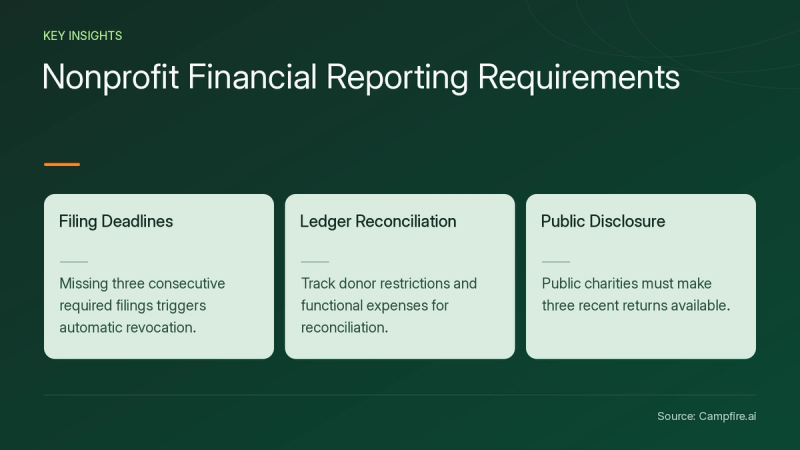
- Form 990, 990-EZ and 990-PF are due on the 15th day of the fifth month after year-end. Missing three consecutive years of required filings triggers automatic revocation.
- GAAP statements and Form 990 are separate obligations. Track donor restrictions and functional expenses in the ledger so both reconcile.
- The federal Single Audit threshold is $1,000,000 in federal awards expended for fiscal years beginning on or after October 1, 2024. State and contract audit rules apply separately.
- Public charities must make their three most recent returns available, generally without donor identities.
Which Form 990 Does a 501(c)(3) File?
A 501(c)(3) files Form 990-N, 990-EZ, 990 or 990-PF based on its gross receipts, year-end assets and classification, according to the IRS Form 990-series filing guide. Confirm your classification first, because churches and certain supporting organizations have different rules.
| Return | Who files | Threshold |
|---|---|---|
| Form 990-N (e-Postcard) | Who filesSmall eligible organizations | ThresholdGross receipts normally $50,000 or less |
| Form 990-EZ | Who filesMid-size public charities | ThresholdReceipts under $200,000 AND year-end assets under $500,000 |
| Form 990 | Who filesLarger public charities | ThresholdReceipts of $200,000 or more OR assets of $500,000 or more |
| Form 990-PF | Who filesPrivate foundations | ThresholdRequired regardless of size |
| Form 990-T | Who filesAny exempt organization with unrelated business income | Threshold$1,000 or more of gross unrelated business income |
"Normally" matters for Form 990-N. For organizations at least three years old, the $50,000 test generally uses average gross receipts over the three preceding tax years, including the filing year. Younger organizations follow separate tests.
What does a worked example look like?
A public charity with $180,000 in receipts and $520,000 in year-end assets must file the full Form 990. Its receipts fall below $200,000, but Form 990-EZ requires both tests to be met. The asset balance alone disqualifies it.
Form 990-T is filed in addition to the annual return, and the trigger is gross income, not net profit. Separately tag potentially unrelated activities, such as advertising sales, and their attributable expenses.
When are returns due?
Forms 990, 990-EZ and 990-PF are due on the 15th day of the fifth month after fiscal year-end: May 15 for calendar-year organizations and November 15 for a June 30 year-end. Form 8868 provides a six-month extension, but Form 990-N cannot be extended. Under the IRS automatic revocation rule[c1], three consecutive years of missed returns or notices revokes exemption. Analysis of IRS data by Beacon Nonprofit[c2] found 830,790 revocations since 2010. Of those, 84.2% had no reinstatement date on record.
Which Financial Statements Does a 501(c)(3) Need?
Nonprofits following U.S. GAAP (ASC 958) present a statement of financial position, a statement of activities, a statement of cash flows, an analysis of expenses by nature and function, and liquidity disclosures. The expense analysis can appear as a separate statement, within the statement of activities or in the notes, per FASB ASU 2016-14. The IRS does not require ASC 958 reporting for Form 990, so your audited statements and tax return will differ and need a reconciliation.


How should net assets be classified?
GAAP uses two net asset classes: with donor restrictions and without donor restrictions. Board designations are internal decisions and stay in the "without donor restrictions" class. Tag every gift with its restriction status at entry, then track releases as restrictions are satisfied. A general ledger with structured reporting and close checklists lets you carry these dimensions from transaction coding through to the statements.
How do you allocate shared expenses?
Allocate shared costs to program services, management and general, and fundraising using a documented, supportable basis such as time records or square footage. The hypothetical example below uses illustrative percentages, not an IRS safe harbor.
| Function | Allocation | Amount of $10,000 shared rent |
|---|---|---|
| Program services | Allocation60% | Amount of $10,000 shared rent$6,000 |
| Management and general | Allocation25% | Amount of $10,000 shared rent$2,500 |
| Fundraising | Allocation15% | Amount of $10,000 shared rent$1,500 |
Keep the workpaper, the allocation basis and reviewer sign-off together. The same allocations feed the GAAP functional expense analysis and Form 990 Part IX.
When Is a 501(c)(3) Audit Required?
A federal single audit or, when eligible, a program-specific audit is required when a nonprofit expends $1,000,000 or more in federal awards in a fiscal year beginning on or after October 1, 2024, as confirmed in the 2025 OMB Compliance Supplement[c3]. The prior threshold was $750,000. The test measures federal awards expended, not total revenue, awards signed or cash received.
- Calendar-year organization: the $1,000,000 threshold applies starting with the fiscal year beginning January 1, 2025.
- July 1 fiscal year: the year beginning July 1, 2024 stays under the $750,000 threshold.
The IRS does not require an audit to file Form 990. State and contract rules apply separately. For example, California's Guide for Charities describes a $2,000,000 gross-revenue audit threshold for covered charities, with specified government funding excluded. Do not apply that threshold elsewhere. Keep an audit matrix listing each jurisdiction, funder and contract with its own trigger.


What Must a 501(c)(3) Disclose to the Public?
A 501(c)(3) must make its exemption application and its annual returns available for public inspection, according to the IRS Form 990 instructions. Each return stays available for three years from the later of its due date (including extensions) or its actual filing date. Form 990-T is also subject to disclosure.
The public copy may differ from the IRS submission. Public charities generally need not disclose donor names and addresses on Schedule B, while private foundation Schedule B information is public. Build a public-copy workflow:
- Generate the public copy from the final accepted return.
- Have a second reviewer confirm donor redactions on Schedule B.
- Version-control the file and log the posting date.
- Assign an owner for in-person and written requests.
How Should Finance Teams Run the Close-to-Filing Process?
Run annual reporting as a scheduled process with named owners for coding, reconciliation, preparation, review and submission. Clear handoffs to outside accountants prevent missed extensions and unreviewed returns.
| Step | Owner | Evidence retained |
|---|---|---|
| Confirm classification and form eligibility | OwnerController | Evidence retainedReceipts and asset test workpaper |
| Reconcile cash, restricted funds and federal expenditures | OwnerAccounting manager | Evidence retainedSigned reconciliations, expenditure ledger |
| Finalize functional allocations | OwnerController | Evidence retainedAllocation workpaper and basis |
| Reconcile GAAP statements to Form 990 | OwnerOutside CPA or CFO | Evidence retainedReconciliation schedule |
| Extension checkpoint (Form 8868) | OwnerFiling owner | Evidence retainedFiled extension confirmation |
| Board review, submission and archive | OwnerCFO, treasurer | Evidence retainedIRS acceptance and public copy |
Monthly management reporting is a recommended practice, not an IRS mandate, but it reduces year-end surprises. The Nonprofit Finance Fund's 2025 survey of 2,206 nonprofits found 36% ran an operating deficit, as summarized by Independent Sector[c4]. A monthly package with budget-to-actual variances, restricted balances and a cash forecast keeps boards informed. AI accounting agents for variance analysis and board reporting can prepare these drafts, with accountants reviewing and approving each proposed action.
Conclusion
501(c)(3) financial reporting works best when you separate each obligation by its trigger. Confirm your Form 990 type from receipts, assets and classification. Keep restrictions and functional expenses in the ledger so GAAP statements and tax returns reconcile. Test federal expenditures, state rules and contract terms independently for audits, and control the public copy before disclosure. To turn this checklist into a repeatable close and reporting workflow, get started with Campfire.
FAQ
Does a 501(c)(3) have to file a tax return every year?
Yes, most 501(c)(3) organizations must file a Form 990-series return or the Form 990-N e-Postcard annually, though churches and certain other organizations are excepted. Failing to file required returns for three consecutive years automatically revokes tax-exempt status.
Does the IRS require a 501(c)(3) to have an audited financial statement?
No, the IRS does not require an independent audit to file Form 990. Audits are triggered separately by federal award spending of $1,000,000 or more for fiscal years beginning on or after October 1, 2024, by state charity rules or by grant and contract terms.
Can a 501(c)(3) file Form 990-EZ if receipts are under $200,000?
Only if year-end total assets are also under $500,000. An organization with $180,000 in receipts but $520,000 in assets must file the full Form 990 because Form 990-EZ requires both thresholds to be met.
Are donor names on Form 990 public?
For public charities, donor names and addresses on Schedule B generally do not need to be disclosed in the public copy. Private foundation Schedule B information is public, so redaction review should reflect your classification.
Sources
- [c1] irs.gov — irs.gov. Accessed November 7, 2026.
- [c2] beaconnonprofit.com — beaconnonprofit.com. Accessed November 7, 2026.
- [c3] fac.gov — fac.gov. Accessed November 7, 2026.
- [c4] healthysector.org — healthysector.org. Accessed November 7, 2026.