ASC 606 Revenue Recognition Criteria: Checklist and Worked Example
Listen to article
14:16
ASC 606 revenue recognition criteria are the five conditions in ASC 606-10-25-1 that an arrangement must meet before it is accounted for as a contract with a customer: approval and commitment, identifiable rights, identifiable payment terms, commercial substance, and probable collection. Once those gates are passed, the five-step model determines how much revenue to recognize and when. The core principle, set out in FASB Accounting Standards Update 2014-09[c1], is to recognize revenue that depicts the transfer of promised goods or services in an amount reflecting the consideration the entity expects to be entitled to.
This guide separates the contract eligibility test from the timing test. It then works through a hypothetical mid-contract upgrade, from changed terms to journal entries.

Key Takeaways
- The five contract criteria and the five steps are different tests. The criteria decide whether a contract exists. The steps decide how much to recognize and when (ASU 2014-09[c1]).
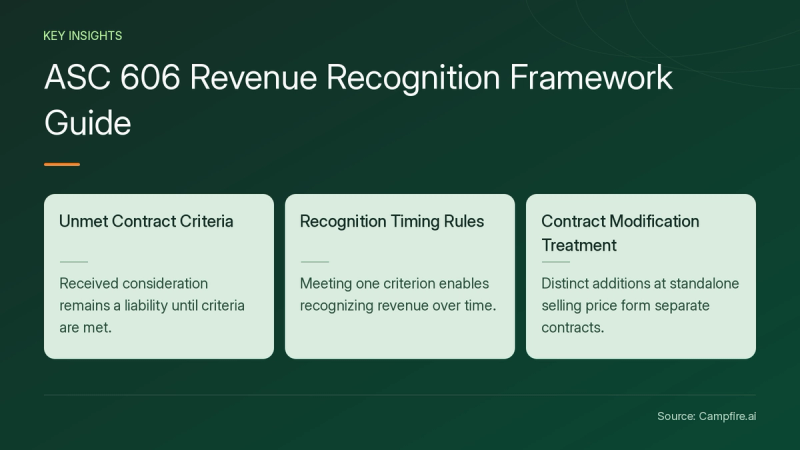
- All five contract criteria must be met. If any fails, consideration received is a liability until a 25-7 event occurs or the criteria are later met (ASU 2016-12[c2]).
- Revenue is recognized over time if any one of the three ASC 606-10-25-27 criteria is met. Otherwise it is recognized at a point in time (ASU 2014-09[c1]).
- A modification adding distinct goods or services priced at standalone selling price (SSP) is a separate contract. If it is not separate and the remaining services are distinct, treat it as a termination and new contract. If they are not distinct, use a cumulative catch-up (ASU 2014-09[c1]).
- Link every conclusion to a contract clause, evidence, a preparer and a reviewer.
What Are the Five ASC 606 Revenue Recognition Criteria?
The five criteria in ASC 606-10-25-1 are mandatory conditions, and an arrangement is accounted for as a contract only when all five are met, as the codified text in ASU 2014-09[c1] states.
| Criterion | What it requires | Typical evidence |
|---|---|---|
| 1. Approval and commitment | What it requiresParties approved the contract (in writing, orally or by customary practice) and are committed to perform | Typical evidenceSigned order form, MSA, executed SOW |
| 2. Identifiable rights | What it requiresEach party's rights to the goods or services can be identified | Typical evidenceScope, deliverables, service description |
| 3. Identifiable payment terms | What it requiresPayment terms for the goods or services can be identified | Typical evidencePricing schedule, invoice terms |
| 4. Commercial substance | What it requiresRisk, timing or amount of future cash flows is expected to change | Typical evidenceDeal rationale and expected cash flows |
| 5. Probable collection | What it requiresCollection of substantially all consideration for goods or services that will be transferred is probable | Typical evidenceCredit review, payment history, payment terms |
The collectibility test considers only the customer's ability and intention to pay. ASU 2016-12[c2] clarified that it covers substantially all consideration for goods or services that will be transferred, and that terms like advance payment or stopping service on nonpayment can mitigate credit risk. Topic 606 defines probable as "likely to occur," a qualitative threshold, so document the credit assessment rather than a percentage rule of thumb.
Contracts that pass at inception are not reassessed unless there is an indication of a significant change in facts and circumstances, such as a significant deterioration in the customer's ability to pay (ASC 606-10-25-5 in ASU 2014-09[c1]).
How Do the Five Criteria Differ From the Five-Step Model?
The five criteria are the gate within Step 1, while the five steps are the full recognition process described in ASU 2014-09[c1].
| Step | Question answered | Key test |
|---|---|---|
| 1. Identify the contract | Question answeredDoes an ASC 606 contract exist? | Key testAll five 25-1 criteria |
| 2. Identify performance obligations | Question answeredWhat distinct promises exist? | Key testCapable of being distinct and distinct within the context of the contract |
| 3. Determine transaction price | Question answeredHow much consideration is expected? | Key testFixed and variable amounts, with constraint |
| 4. Allocate the price | Question answeredHow much goes to each obligation? | Key testRelative SSP |
| 5. Recognize revenue | Question answeredWhen is each obligation satisfied? | Key testOver time or point in time |
Software can carry these steps from contract to entry. Campfire's ASC 606 revenue automation handles allocations, performance obligations and journal entries based on a company's own revenue policy, including contract modifications and SSP. The accounting judgments still belong to the team.


When Can Revenue Be Recognized Over Time?
Revenue is recognized over time when any one of the three ASC 606-10-25-27 criteria in ASU 2014-09[c1] is met:
- Simultaneous receipt and consumption: the customer receives and consumes the benefit as the entity performs, as with a routine recurring service.
- Customer-controlled asset: performance creates or enhances an asset the customer controls as it is created or enhanced.
- No alternative use plus right to payment: the asset has no alternative use to the entity and the entity has an enforceable right to payment for performance completed to date. Both parts are required.
If none applies, the obligation is satisfied at a point in time. ASC 606-10-25-30 lists indicators of control transfer that "include, but are not limited to" the following:
- Present right to payment
- Legal title
- Physical possession
- Significant risks and rewards of ownership
- Customer acceptance
These are indicators to assess together, not mandatory conditions.
What Changes After a Mid-Contract Upgrade?
An upgrade is a contract modification, and its treatment depends on whether the added service is distinct and priced at SSP. The example below is hypothetical. Your conclusion depends on your contract terms and a technical review.


Hypothetical terms
- Original contract: 12-month service for $12,000, a single over-time obligation, paid upfront at signing.
- Upgrade at start of month 7: the customer adds an analytics module at $600 per month for 6 months ($3,600), paid upfront.
- Assumptions: the module is distinct, and $600 per month is its SSP.
Classification
The modification is a separate contract because scope increases by a distinct service and price increases by its SSP, meeting both conditions in ASC 606-10-25-12 (ASU 2014-09[c1]). The original schedule is untouched.
| Period | Base service | Module | Monthly revenue |
|---|---|---|---|
| Months 1-6 | Base service$1,000 | Module$0 | Monthly revenue$1,000 |
| Months 7-12 | Base service$1,000 | Module$600 | Monthly revenue$1,600 |
| Total | Base service$12,000 | Module$3,600 | Monthly revenue$15,600 |
Journal entries
| Date | Entry | Debit | Credit |
|---|---|---|---|
| Signing | EntryDr Cash / Cr Contract liability | Debit$12,000 | Credit$12,000 |
| Months 1-6, each | EntryDr Contract liability / Cr Revenue | Debit$1,000 | Credit$1,000 |
| Month 7 upgrade | EntryDr Cash / Cr Contract liability | Debit$3,600 | Credit$3,600 |
| Months 7-12, each | EntryDr Contract liability / Cr Revenue | Debit$1,600 | Credit$1,600 |
How changed assumptions alter treatment
When a modification is not a separate contract, ASC 606-10-25-13 in ASU 2014-09[c1] directs the treatment of the remaining goods or services. Note that 25-12(b) permits SSP adjustments for the circumstances of the contract, such as avoided selling costs, so a lower price does not automatically fail the test.
- Discounted add-on ($400 per month, still distinct, not reflecting SSP): treat it as a termination of the old contract and creation of a new one. Remaining consideration is $6,000 unrecognized base plus $2,400 module, or $8,400. Allocating by relative SSP ($6,000 base, $3,600 module) gives $5,250 to the base and $3,150 to the module, or $1,400 per month for months 7-12.
- Not distinct: account for the change as part of the existing contract, with a cumulative catch-up adjustment to revenue at the modification date.
How Should You Document a Recognition Conclusion?
Document each conclusion by mapping every criterion to a contract clause, evidence, a decision and named sign-offs. Revenue remains a hot topic of SEC comment letters, according to Deloitte's revenue roadmap[c3], so judgment areas need a reviewable trail. The owners below are a suggested workflow, not a standard requirement.
| Checklist item | Contract clause | Evidence | Conclusion | Suggested owner |
|---|---|---|---|---|
| Five 25-1 criteria met | Contract clauseOrder form, MSA | EvidenceSignatures, credit review | ConclusionContract exists: Yes/No | Suggested ownerRevenue accountant |
| Distinct obligations | Contract clauseScope section | EvidenceProduct description | ConclusionList of obligations | Suggested ownerRevenue accountant |
| Transaction price and constraint | Contract clausePricing, discounts, refunds | EvidenceEstimate support | ConclusionAmount | Suggested ownerRevenue accountant |
| SSP allocation | Contract clausePrice list | EvidenceSSP study | ConclusionAllocation table | Suggested ownerRevenue Accounting Manager |
| Timing (25-27 or 25-30) | Contract clauseDelivery, payment rights | EvidenceCriterion met or indicators | ConclusionOver time or point in time | Suggested ownerController review |
| Modifications | Contract clauseAmendment | EvidenceDistinctness and SSP test | ConclusionSeparate, prospective or catch-up | Suggested ownerController approval |
Close the loop by posting the resulting entries and tying them to your month-end checklist. Campfire's core accounting and close checklists keep the general ledger, journal entries and close tasks in one place.
Conclusion
The ASC 606 revenue recognition criteria answer one question: does a contract exist? The five-step model then sets the amount and timing. Keep three distinctions clear:
- All five contract criteria are required.
- Any one over-time criterion is enough.
- Point-in-time indicators are assessed together, not treated as mandatory conditions.
For modifications, test distinctness and SSP before choosing separate-contract, prospective or catch-up treatment, then record the conclusion in a checklist a Controller can sign off. To move these schedules, modifications and entries out of spreadsheets, get started with Campfire.
FAQ
What are the five revenue recognition criteria under ASC 606?
The five revenue recognition criteria under ASC 606-10-25-1 are approval and commitment, identifiable rights, identifiable payment terms, commercial substance, and probable collection, and all five must be met for an arrangement to be accounted for as a contract, as set out in ASU 2014-09[c1].
What happens if a contract fails the collectibility criterion?
If collectibility is not probable, no ASC 606 contract exists, and consideration received is recorded as a liability measured at the amount received. Under ASU 2016-12[c2], it becomes revenue only when the entity has no remaining obligations and has received substantially all nonrefundable consideration, the contract is terminated with nonrefundable consideration, or the entity has transferred control, stopped transferring goods or services and holds nonrefundable consideration. The entity also continues to assess whether the criteria are later met.
Do all three over-time criteria need to be met?
No, meeting any one of the three ASC 606-10-25-27 criteria supports over-time recognition, but the third criterion has two required parts: the asset must have no alternative use to the entity and the entity must have an enforceable right to payment for performance completed to date, per ASU 2014-09[c1].
Is billing the same as revenue under ASC 606?
No, billing follows the contract's invoicing terms while revenue follows the transfer of control, and a payment received before performance is presented as a contract liability under ASU 2014-09[c1]. In the hypothetical example, $12,000 is billed upfront but recognized at $1,000 per month, with the difference held in a contract liability until the service is delivered.
Sources
- [c1] ASU 6x9 Final Template — storage.fasb.org. Accessed November 9, 2026.
- [c2] Accounting Standards Update 2016-12 — storage.fasb.org. Accessed November 9, 2026.
- [c3] Revenue Recognition Methods: Five Steps | Deloitte US — deloitte.com. Accessed November 9, 2026.