941 Reconciliation to General Ledger: Steps, Example and Rollforward
Listen to article
12:59
A 941 reconciliation to the general ledger proves three things. GL wage expense, adjusted for accruals, equals paid wages for the quarter. Paid wages, adjusted for pretax deductions and wage caps, equal the taxable wage bases on Form 941. Payroll tax liability accounts roll forward to the taxes reported on Line 12 and the deposits reported on Line 13. Payroll-to-return checks stop at the register. This guide connects the return to your accrual-basis books, with a worked example and a correction decision table.

Key Takeaways
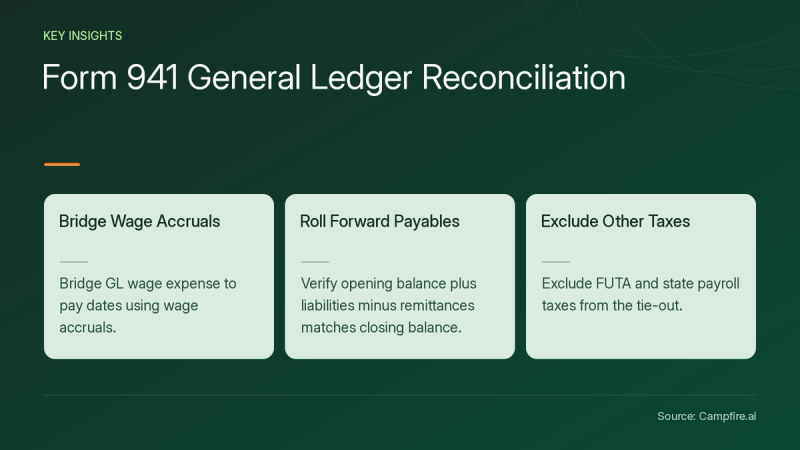
- Form 941 is driven by pay date. Accrual-basis GL wage expense is driven by work period. Bridge the two with opening and closing wage accruals.
- Build a separate bridge from paid wages to each taxable base: Line 2, Line 5a (Social Security) and Line 5c (Medicare).
- Roll forward federal payroll tax payable: opening balance plus quarter liabilities minus remittances should equal the closing balance.
- Exclude FUTA and state taxes from the 941 tie-out. They post to similar accounts but belong on other returns.
- Classify every difference as a timing item, a GL error or a return error before you correct anything.
What Does a 941 Reconciliation to the General Ledger Compare?
It compares specific GL accounts to the payroll register and to individual Form 941 lines. Payroll-only reconciliations skip the GL, so posting errors and accrual cutoffs go undetected. Teams that connect payroll and banking systems to the ledger through native integrations start with cleaner source data. The mapping still needs to be defined.
| GL Account | Payroll Source | Form 941 Line |
|---|---|---|
| Salaries and wages expense | Payroll SourceGross wages by pay date | Form 941 LineLine 2 (after bridge) |
| Federal income tax withheld payable | Payroll SourceFIT withheld per register | Form 941 LineLine 3 |
| Social Security payable (employee and employer) | Payroll SourceTaxable SS wages and tax | Form 941 LineLines 5a and 5b |
| Medicare payable (employee and employer) | Payroll SourceTaxable Medicare wages and tax | Form 941 LineLine 5c |
| Additional Medicare withheld | Payroll SourceWages over threshold, employee only | Form 941 LineLine 5d |
| Employer payroll tax expense (FICA only) | Payroll SourceEmployer FICA match | Form 941 LinePart of Line 5e |
| Cash / EFTPS clearing | Payroll SourceDeposit confirmations | Form 941 LineLine 13 |
Filter every report to the same EIN and calendar quarter before comparing totals.
Why Doesn't Form 941 Match Payroll Expense in the GL?
Form 941 rarely matches payroll expense because the return and the ledger measure different things. Four drivers explain most of the gap.
- Timing: The return counts wages by pay date. The GL records wages when earned. A March 31 accrual for wages paid in April sits in Q1 expense but Q2 on the return.
- Taxability: Pretax deductions such as 401(k) deferrals and Section 125 benefits reduce some wage bases but not GL gross wages.
- Who bears the tax: Employee withholding runs through liability accounts, not expense. Only the employer FICA match hits payroll tax expense.
- Scope: FUTA, state unemployment and state withholding often share GL accounts with federal taxes but never appear on Form 941.
How Do You Reconcile Form 941 to the General Ledger Step by Step?
Work from GL expense to paid wages, then to taxable bases, then to liabilities and deposits. Follow this sequence each quarter:


- Gather sources: GL detail for wage, tax expense and payable accounts. Also pull payroll registers by pay date, the draft Form 941, Schedule B if applicable and EFTPS or processor deposit confirmations.
- Bridge wages: GL wage expense plus opening accrued wages minus closing accrued wages equals wages paid in the quarter.
- Bridge taxable bases: Apply the deductions that affect each wage base separately. Apply the annual cap only to Social Security wages, using each employee’s year-to-date wages.
- Tie withholding: Credits to federal income tax payable for pay dates in the quarter should equal Line 3.
- Tie employer expense: Reconcile employer FICA to the employer share of Social Security and Medicare taxes on Lines 5a through 5c. Include tips when applicable. Additional Medicare tax on Line 5d has no employer match.
- Roll forward payables: Opening balance plus quarter liabilities minus remittances should equal the closing balance.
- Match deposits: Confirm Line 13 deposits reached the IRS. A processor withdrawal is not proof of an IRS deposit.
- Log exceptions: Record each unexplained difference with owner, root cause and resolution.
What Does a Worked 941-to-GL Example Look Like?
The illustrative Q1 example below bridges $412,000 of GL wage expense to every Form 941 wage line. The amounts are hypothetical and assume no taxable fringe benefits, tips, Additional Medicare tax, adjustments, or credits.
Wage Bridge
| Item | Amount |
|---|---|
| GL salaries and wages expense, Q1 | Amount$412,000 |
| Add: Dec 31 accrued wages paid in January | Amount$18,000 |
| Less: Mar 31 accrued wages paid in April | Amount($22,000) |
| Gross wages paid in Q1 | Amount$408,000 |
| Less: Section 125 deductions | Amount($12,000) |
| Medicare wages (Line 5c) | Amount$396,000 |
| Less: wages above Social Security cap | Amount($6,000) |
| Social Security wages (Line 5a) | Amount$390,000 |
| Medicare wages less 401(k) deferrals ($20,000) | Amount$376,000 (Line 2) |
Line 2 generally follows W-2 Box 1 treatment, so qualifying Section 125 deductions and traditional pretax 401(k) deferrals reduce that base. Roth deferrals do not reduce it. The Social Security cap applies per employee on year-to-date wages. Test it at the employee level, not as a flat percentage of total wages.
Payroll Tax Payable Rollforward
| Item | Amount |
|---|---|
| Opening balance (Q4 taxes deposited in January) | Amount$14,500 |
| Add: Federal income tax withheld (Line 3) | Amount$52,000 |
| Add: Employee and employer FICA (Line 5e) | Amount$59,844 |
| Less: EFTPS remittances made in Q1 | Amount($117,644) |
| Closing balance (March taxes due in April) | Amount$8,700 |
Q1 liabilities total $111,844, which ties to Line 12. Of the $117,644 remitted, $14,500 settled Q4. That leaves $103,144 for Q1. Add the $8,700 deposited in April, and Line 13 equals $111,844. Employer FICA of $29,922 should equal the FICA portion of payroll tax expense.
How Should You Resolve 941-to-GL Differences?
Classify each difference before correcting it, because the remedy depends on where the error lives. Never force a balance with an unsupported plug entry.


| Difference Type | Example | Remedy |
|---|---|---|
| Timing | ExampleAccrual or deposit straddles quarter end | RemedyDocument in the bridge. No entry or amended return needed. |
| GL posting error | ExampleEmployer FICA coded to wage expense | RemedyReclass journal entry in the GL. Return stays as filed. |
| Payroll setup error | ExampleDeduction code taxed incorrectly | RemedyFix the payroll code, then assess return impact. |
| Filed return error | ExampleLine 5a understated on a prior quarter | RemedyFile Form 941-X for the original quarter. Do not net it into the current 941. |
A GL-only mismatch does not change your tax liability. Deposit penalties depend on whether the correct tax reached the IRS on time, not on how the ledger was coded. Link each exception to its original period, posting date and resolution.
What Controls Keep the 941 Reconciliation Accurate?
Separate preparer and reviewer roles, require evidence for every reconciling item, and reconcile monthly instead of only at quarter end. A 2022 EY survey commissioned by Paycom found errors in about one in five payrolls reported by respondents and estimated an average cost of $291 per error.
Reviewer Checklist
- EIN and quarter filters are identical across GL, register and return.
- Opening accruals agree to the prior quarter's closing workpaper.
- Every bridge line has a source report attached.
- Deposit confirmations come from EFTPS or IRS records, not processor reports alone.
- Open exceptions have an owner and a target date before filing.
Monthly payroll reconciliation helps teams resolve differences before the quarter closes. AI accounting agents for accruals, transaction matching and variance analysis can prepare reconciliation inputs while accountants review and approve each proposed action.
Conclusion
A reliable 941 reconciliation to the general ledger rests on three tie-outs. Bridge GL wage expense to paid wages through accruals. Bridge paid wages to each taxable base. Roll forward payroll tax payables to Line 12 and verified Line 13 deposits. Classify differences as timing, GL or return errors before correcting them, and file Form 941-X only when the return itself was wrong. Build the bridge and rollforward into a repeatable quarterly workpaper with reviewer sign-off, and when you are ready to run that process on a connected ledger, get started with Campfire.
FAQ
Why does Form 941 differ from payroll expense in the general ledger?
Form 941 differs from GL payroll expense because the return reports wages by pay date, while accrual accounting records wages when earned. Pretax deductions also reduce taxable wage bases but not GL gross wages. Employee withholding sits in liability accounts rather than expense. FUTA and state taxes are recorded in the GL but excluded from Form 941.
Does a GL difference require filing Form 941-X?
A GL difference can reveal a filed wage or tax error that requires Form 941-X. Follow the IRS instructions for Form 941-X for return corrections. An error limited to Part 2 or Schedule B liability reporting follows a separate correction procedure. If the return was correct and the ledger was miscoded, fix the GL with a reclassification journal entry. Timing differences from accruals or quarter-end deposits need documentation, not an entry or an amended return.
How often should you reconcile Form 941 to the general ledger?
Reconcile payroll accounts to the GL monthly, then complete the full 941 tie-out each quarter before filing. Monthly reviews catch posting and deduction-code errors while they are small. The quarterly review confirms wage bases, liabilities and deposits. An annual check then ties the four quarterly 941s to Forms W-2 and W-3.
What should the payroll tax payable balance be at quarter end?
The federal payroll tax payable balance at quarter end reflects unpaid employee withholding and employer taxes. For an employer current on deposits, it typically consists of amounts due after quarter end. Investigate overdue amounts, deposits in transit, and posting errors separately.
Sources
- Form 941 — irs.gov.
- 2022 EY survey commissioned by Paycom — investors.paycom.com.
- IRS instructions for Form 941-X — irs.gov.