Accountability in Financial Reporting: Roles, Workflow and Examples
Listen to article
12:11
Accountability in financial reporting means that every number in the financial statements has a named owner who can show the source evidence, the review performed and how each exception was resolved. A signature alone does not establish accountability. It requires a repeatable workflow in which preparers, reviewers and approvers leave an evidence trail that another person can reproduce.
This guide covers who is accountable, how to structure a preparer, reviewer and approver workflow, and a hypothetical month-end accrual from start to finish. It also explains how to govern spreadsheets and automation, and which internal measures show whether accountability is working.

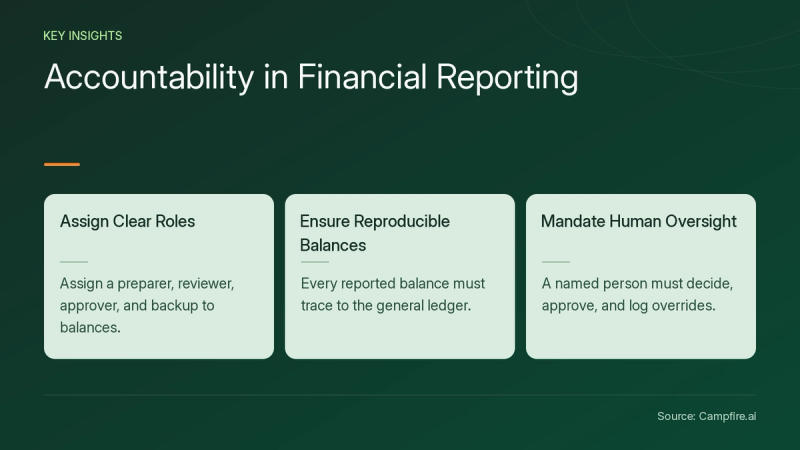
Key Takeaways
- Evidence proves accountability: source support, documented review criteria, exceptions and a conclusion. Sign-off alone does not.
- Assign a preparer, reviewer, approver and backup to every high-risk balance, estimate and manual journal entry.
- Every reported balance should trace to the general ledger, and another reviewer should be able to reproduce it.
- Automation can draft entries or flag issues, but a named person must still decide, approve and log any override.
- Track a small set of internal measures, such as on-time reviewed reconciliations and aged exceptions, to find weak points.
What Does Accountability in Financial Reporting Mean?
Accountability in financial reporting means a specific person must answer for each reported figure and show the evidence behind it. Work can be delegated. Accountability for the outcome stays with the person who delegated it.
The idea is built into public-sector reporting. The GASB states that its standards help government officials demonstrate accountability, including stewardship over public resources[c1]. U.S. federal financial management guidance lists OMB Circular A-123, titled Management Accountability and Control[c2], among its principal authoritative sources.
How Is Accountability Different From Responsibility?
Responsibility is the duty to perform a task, while accountability is the obligation to answer for its result. A staff accountant may prepare a reconciliation. The controller who approves it remains accountable for the balance it supports.
Who Is Accountable for the Financial Statements?
Management is accountable for preparing the financial statements and for the controls behind them. Other parties examine or oversee that work, but they do not take over management's accountability.
| Party | Accountable for | What they do not own |
|---|---|---|
| Management (CFO, controller) | Accountable forPreparing the statements, maintaining internal controls and resolving exceptions | What they do not ownThe auditor's conclusions |
| Audit committee or board | Accountable forOverseeing management and the external audit | What they do not ownDay-to-day preparation |
| External auditor | Accountable forAuditing the statements and reporting on the results | What they do not ownPreparing the numbers or designing controls |
| Standard setters | Accountable forIssuing accounting and financial reporting standards, such as the GASB for U.S. state and local governments | What they do not ownPreparing any entity's statements |
In U.S. federal agencies, for example, the CFO Act requires each agency CFO to maintain an accounting and financial management system that includes financial reporting and internal controls[c2]. Requirements differ by jurisdiction and entity type, so confirm which apply to you.
Your ledger should record who did what and when. A general ledger with approval workflows, granular permissions and audit trails captures ownership as the work happens, so it does not have to be rebuilt afterward.
How Do You Build a Preparer, Reviewer and Approver Workflow?
Build the workflow by assigning a named preparer, reviewer, approver and backup to each high-risk reporting item, then defining the evidence each role must retain. Start with judgment areas such as accruals, revenue cutoff, reserves and manual journal entries. These are where review and management override matter most.


| Role | Core action | Required evidence | Escalation trigger |
|---|---|---|---|
| Preparer | Core actionBuilds the entry or reconciliation from source data | Required evidenceSource documents, calculation and assumptions | Escalation triggerUnexplained difference above the set threshold |
| Reviewer | Core actionChallenges inputs and assumptions against review criteria | Required evidenceCriteria applied, questions raised, responses and conclusion | Escalation triggerDisagreement unresolved by the review deadline |
| Approver | Core actionAuthorizes posting within delegated authority | Required evidenceDated approval tied to the final version | Escalation triggerAmount exceeds approval limit |
| Backup reviewer | Core actionCovers absences and gives an independent second look | Required evidenceSame evidence standard as the primary reviewer | Escalation triggerPrimary reviewer is also the preparer |
Small teams often cannot fully segregate duties. Use compensating controls instead, such as a second-person review of entries above a set threshold and a periodic review of all manual journals by someone outside the close.
What Does Accountability Look Like in a Month-End Accrual?
In a month-end accrual, accountability looks like a traceable chain from source support to reconciliation, with an owner and dated record at each step. The walkthrough below is hypothetical.
- Source support: A contractor finished work in March but has not invoiced. The preparer collects the statement of work and the project manager's confirmation of hours.
- Preparation: The preparer calculates a $48,000 accrual (320 hours at $150) and records the basis for the rate.
- Challenge: The reviewer notices the contract caps monthly billing at $40,000 and asks whether the excess is billable or a change order.
- Exception: No one can confirm a change order before close. The $8,000 difference goes to the exception register with an owner and a resolution date.
- Approval and posting: The approver authorizes a $40,000 accrual and records why the remainder was excluded.
- Reconciliation: The accrued liabilities reconciliation ties to the ledger, with the open exception listed rather than buried.
- Closure: In April, the signed change order arrives. The owner records the resolution, and the reviewer confirms the adjustment.
An auditor or new team member can now reproduce the balance and see why it was set at $40,000.
How Should Spreadsheets and Automation Be Governed?
Govern spreadsheets and automation by requiring traceability to the ledger and a named human decision for every output that affects the statements. Neither tool removes the need for review.
How Do You Make Spreadsheet-Supported Reports Reproducible?
Make spreadsheet reports reproducible by tying every figure to the trial balance and keeping the reviewed version. Turn reporting complaints into a repeatable test:
- Build the report by entity and dimension.
- Pick one variance and drill down to the source transactions.
- Reconcile the report total to the trial balance.
- Record any step that still depends on a spreadsheet export or manual transformation.
- Use controlled templates, version names, restricted editing and formula checks for any spreadsheet that remains.
Does Automation Change Who Is Accountable?
No. Automation changes how work is prepared, but a named person stays accountable for approving the result. Flagging an anomaly is not the same as resolving it.


For AI-assisted work, keep a record of four things:
- the approved inputs
- the output the system generated
- the human decision
- the reason for any override
For example, Campfire's Ember AI assistant can draft journal entries, run flux analysis and flag missing accruals. Each of those outputs should still pass through your preparer, reviewer and approver workflow before it affects reported figures.
Pilot one workflow before expanding. Track false positives, missed exceptions, reviewer effort and rework, then decide whether to widen use.
How Do You Measure Accountability in Financial Reporting?
Measure accountability with a few internal metrics that show whether reviews happen on time and whether exceptions get closed. The measures below are suggestions for management, not industry benchmarks.
| Measure | Calculation | What it reveals |
|---|---|---|
| On-time reviewed reconciliations | CalculationReconciliations reviewed by deadline divided by reconciliations due | What it revealsReviewer capacity and close discipline |
| Aged exceptions | CalculationOpen exceptions grouped by 0-30, 31-60 and 60+ days | What it revealsWhether issues reach closure |
| Post-close adjustments | CalculationCount and value of entries booked after sign-off | What it revealsQuality of first-pass review |
| Repeat control failures | CalculationSame control failing in consecutive periods | What it revealsWhether fixes actually worked |
| Override log volume | CalculationOverrides of automated or standard outputs, with documented reasons | What it revealsWhere judgment departs from the system |
Review these measures after each close. A rising count of aged exceptions or repeat failures points to an owner, control or capacity gap that needs remediation and a follow-up check.
Conclusion
Accountability in financial reporting is an operating discipline, not a statement of intent. Name an owner for every high-risk number, define the evidence that proves review, send unresolved differences to an exception register with deadlines, and confirm that each fix holds.
Start small by piloting the full preparer, reviewer and approver workflow on one reconciliation during your next close, tracking on-time reviews and aged exceptions, and expanding to spreadsheets and automated outputs once it works; when you are ready to keep that evidence trail inside your ledger, get started with Campfire.
FAQ
What is the difference between accountability and responsibility in financial reporting?
Responsibility is the duty to perform a reporting task, such as preparing a reconciliation, while accountability is the obligation to answer for the result. Tasks can be delegated, but the manager who delegates them stays accountable for the outcome and must make sure the review evidence exists.
What evidence proves that a financial review actually happened?
A credible review record shows the inputs examined, the review criteria applied, the questions or exceptions raised, how each was investigated and the reviewer's dated conclusion. A sign-off with no record of what was checked does not show that the review was performed effectively.
Does an external audit make the auditor accountable for the financial statements?
No. Management remains accountable for preparing the financial statements and maintaining internal controls. The external auditor examines those statements and reports on the results, which does not transfer management's accountability for the underlying numbers.
How can a small finance team maintain accountability without full segregation of duties?
Small teams can use compensating controls, such as a second-person review for entries above a set threshold, a periodic review of all manual journals by someone outside the close, and a backup reviewer for each high-risk balance. Document these controls so reviewers and auditors can see how the risk is covered.
Does using AI in the close transfer accountability to the software?
No. AI can draft entries or flag issues, but a named person must still approve the result. Teams should log the approved inputs, the generated output, the human decision and the reason for any override, so accountability for each reported figure stays clear.
Sources
- [c1] About the GASB — gasb.org. Accessed November 11, 2026.
- [c2] 330 DM 2 Principal Authoritative Sources for Financial Policies and Accounting Standards — doi.gov. Accessed November 11, 2026.