Accounting and Financial Reporting in Life and Health Insurers: SAP Guide
Listen to article
7:47
Accounting and financial reporting in life and health insurance companies in the U.S. is built on Statutory Accounting Principles (SAP), set out in the NAIC Accounting Practices and Procedures Manual (AP&P Manual). According to the NAIC[c1], most insurers authorized in the United States and its territories must prepare SAP financial statements. Regulators use those statements to judge solvency. State law can still modify the national framework through prescribed and permitted practices.

Key Takeaways
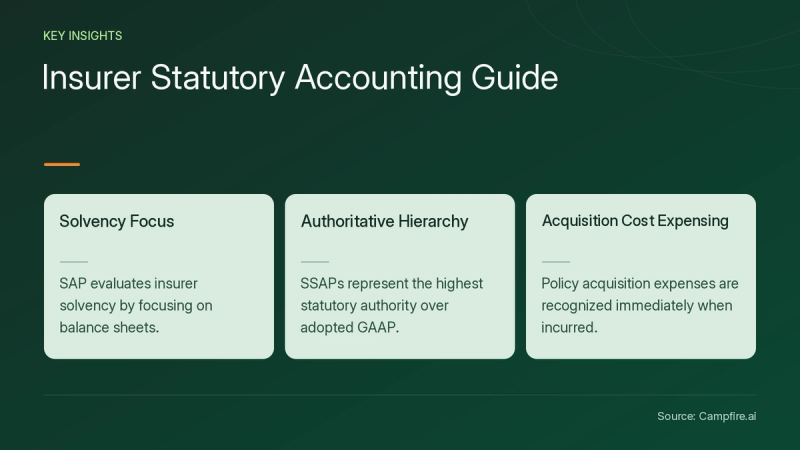
- SAP is designed to help regulators judge solvency. It focuses on the balance sheet, while U.S. GAAP leans toward investors and the income statement (NAIC[c1]).
- SAP rests on three concepts: conservatism, recognition and consistency (NAIC[c1]).
- SSAPs are Level 1, the highest authority in the statutory hierarchy. GAAP becomes part of SAP only if the NAIC adopts it (AP&P Manual, March 2026[c2]).
- Under SAP, policy acquisition costs are expensed as incurred. Under GAAP, qualifying costs are deferred and amortized (AP&P Manual Preamble[c2]).
What Framework Governs Life and Health Insurer Reporting?
The NAIC AP&P Manual governs life and health insurer reporting, subject to state law. The NAIC explains[c1] that the Manual does not override state laws. That creates two kinds of variation:
- Prescribed practices: rules in state law or regulation that apply to all insurers domiciled in that state.
- Permitted practices: exceptions a state regulator approves for one insurer.
The Manual's Preamble[c2] requires the domiciliary regulator to give other licensing states notice at least 5 days before approving a permitted practice. It also states that each state requires an annual financial statement and that all states use the NAIC annual statement blank. SAP statements include a balance sheet, summary of operations, changes in capital and surplus, and cash flow. Notes and supplementary schedules add disclosure.
How Does SAP Differ From U.S. GAAP?
SAP measures an insurer's ability to pay future claims, while GAAP measures emerging earnings from period to period. The table summarizes differences described in the AP&P Manual Preamble[c2] and on the NAIC SAP page[c1].
| Topic | SAP | U.S. GAAP |
|---|---|---|
| Primary users | SAPRegulators | U.S. GAAPVaried users, including investors |
| Primary focus | SAPBalance sheet and ability to pay obligations | U.S. GAAPMatching revenue to expense |
| Policy reserves | SAPIntentionally conservative | U.S. GAAPBased on the company's expected experience; may be higher or lower |
| Acquisition costs | SAPExpensed as incurred | U.S. GAAPQualifying costs deferred and amortized |
| Assets | SAPAssets unavailable to pay policyholders are nonadmitted and charged to surplus | U.S. GAAPRecognizes certain assets SAP nonadmits |
Which SSAPs Matter Most to Life and Health Insurers?
Several SSAPs in the March 2026 AP&P Manual[c2] deal directly with life and health contracts. Confirm which version applies with your auditors and domiciliary regulator.


| SSAP | Title |
|---|---|
| No. 7 | TitleAsset Valuation Reserve and Interest Maintenance Reserve |
| No. 26 | TitleBonds |
| No. 51 | TitleLife Contracts |
| No. 52 | TitleDeposit-Type Contracts |
| No. 54 | TitleIndividual and Group Accident and Health Contracts |
| No. 56 | TitleSeparate Accounts |
| No. 61 | TitleLife, Deposit-Type and Accident and Health Reinsurance |
| No. 71 | TitlePolicy Acquisition Costs and Commissions |
The same Manual's summary of changes lists items to watch in 2026. INT 23-01 on net negative (disallowed) IMR now runs to December 31, 2026. SSAP No. 61 risk-transfer clarifications give existing contracts provisions until December 31, 2026. New Actuarial Guideline LV also appears.
How Do You Research a Statutory Accounting Question?
Start with the SSAPs, then move down the statutory hierarchy. The steps below follow the Manual's "How to Use This Manual" guidance.
- Find the SSAP. Use the SSAP index. SSAPs are Level 1 authority.
- Check the status section. Look for "Affected By" amendments and related INTs (Level 2).
- Check Annual Statement Instructions. These sit at Level 3.
- Compare to GAAP. Use Appendix D to see whether a GAAP standard was adopted, modified or rejected.
- Apply state law. Confirm any prescribed or permitted practice in your state of domicile.
- Test materiality. The Preamble notes that a misclassification that triggers a Risk-Based Capital event may be material even when it is small in dollars.
Hypothetical example: A life insurer pays commissions on new policies. Step 1 points to SSAP No. 71. The Preamble confirms these costs are expensed as incurred under SAP. The GAAP reporting team defers qualifying costs instead, so the two ledgers need a documented reconciling item.


Where Does a General Ledger Fit in Insurance Reporting?
A general ledger supplies the controlled transaction data that statutory and GAAP reporting rely on. Campfire's core accounting page describes real-time multi-entity consolidation, built-in multi-currency, approval workflows and more than 1,200 granular permissions. It also lists SOC 1 and SOC 2 certification, with audit trails needed for SOX compliance. The supplied sources do not describe statutory annual statement preparation, so ask any vendor these questions in a demo:
- Can the chart of accounts carry separate SAP and GAAP treatment, such as for acquisition costs?
- How are nonadmitted assets tracked against surplus?
- Can reports drill down from a schedule total to the source entries?
For close analysis, Ember can draft journal entries, run flux analysis and flag missing accruals, according to the core accounting page.
Conclusion
Life and health insurer reporting starts with SAP. That means the AP&P Manual, its hierarchy and your state's prescribed or permitted practices. Work through each question in hierarchy order, track 2026 changes, and keep SAP-to-GAAP differences documented. To build a controlled ledger under that work, get started with Campfire.
FAQ
Who maintains Statutory Accounting Principles?
The NAIC Statutory Accounting Principles (E) Working Group maintains SAP through the AP&P Manual and reviews all authoritative U.S. GAAP guidance for relevance, according to the NAIC[c1].
What is a nonadmitted asset?
A nonadmitted asset is an asset that cannot readily be used to pay policyholder obligations, so SAP excludes it from the balance sheet and charges it against surplus, as the NAIC[c1] describes under the recognition concept.
Do GAAP standards automatically apply under SAP?
No, GAAP guidance does not become part of SAP until the NAIC adopts it, and Appendix D of the AP&P Manual[c2] records whether each standard was adopted, modified or rejected.
Are issue papers authoritative?
Issue papers sit at Level 5 of the statutory hierarchy and apply only where they do not conflict with other statutory guidance, per the March 2026 AP&P Manual[c2].
Sources
- [c1] Insurance Topics | Statutory Accounting Principles | NAIC — content.naic.org. Accessed November 13, 2026.
- [c2] www.in.gov — in.gov. Accessed November 13, 2026.