Accounting Anomaly Detection: How It Works and How to Review Flags
Listen to article
7:38
Accounting anomaly detection is the practice of finding journal entries and transactions that deviate from expected patterns so a person can investigate them. Gartner describes the software category as tools that use AI and ML to identify errors, unusual activity and violations of internal policies, compliance rules and accounting standards (Gartner Peer Insights[c1]). This guide covers what to flag, how detection methods differ and how to review an alert.

Key Takeaways
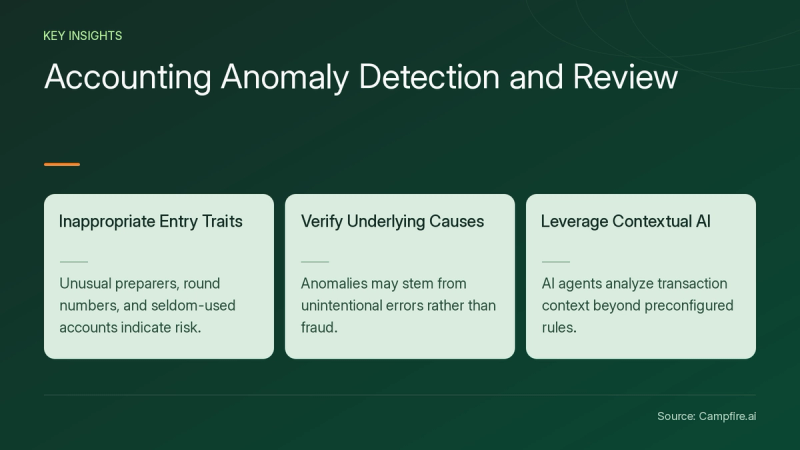
- PCAOB AS 2401 lists traits of inappropriate journal entries, including seldom-used accounts, unusual preparers, unexplained period-end entries and round numbers (PCAOB[c2]).
- An anomaly is not proof of fraud. AS 2401 notes that unusual conditions may have other causes, such as unintentional errors or economic changes.
- Rules-based tools catch only what someone configured. Nominal says AI agents read transaction context to catch issues no rule anticipated (Nominal[c3]).
- Every flag needs human review and a clear reason it was raised.
What Is Accounting Anomaly Detection?
Accounting anomaly detection identifies ledger activity that does not fit expected behavior. In auditing, EY describes it as selecting samples among general ledger journal entries and testing them for accuracy. EY illustrates the challenge: in a database of 100 million entries, maybe 10 will be cause for concern (EY[c4]).
Gartner notes these tools report findings in real time or through periodic batch processing. They can run on-premises, in the cloud, as stand-alone tools or integrated with ERP systems (Gartner Peer Insights[c1]).
Which Journal Entries Should You Flag?
Start with the characteristics PCAOB AS 2401 associates with inappropriate journal entries and the account types where they tend to appear (PCAOB AS 2401.61[c2]).
| Flag category | What to look for |
|---|---|
| Unusual accounts | What to look forEntries to unrelated, unusual or seldom-used accounts |
| Unusual preparers | What to look forEntries made by individuals who typically do not post journal entries |
| Timing | What to look forPeriod-end or post-closing entries with little or no description |
| Missing data | What to look forEntries without account numbers |
| Amount patterns | What to look forRound numbers or a consistent ending number |
| Risky accounts | What to look forComplex transactions, significant estimates, past errors, unreconciled differences, intercompany activity |
| Nonstandard entries | What to look forNonrecurring entries, consolidating adjustments and reclassifications that may sit outside normal controls |
AS 2401 says testing should ordinarily focus on period-end entries, while also considering activity throughout the period.


How Do Rules-Based and AI Detection Differ?
Rules-based detection applies fixed conditions, while AI detection evaluates transaction context. The comparison below reflects Nominal's description of the two approaches (Nominal[c3]).
| Factor | Rules-based | AI agent |
|---|---|---|
| Logic | Rules-basedDeterministic thresholds and conditions | AI agentReads descriptions, memos, vendors, accounts and history |
| Strength | Rules-basedEnforcing clear policies, such as approval thresholds | AI agentSpotting misclassifications, missing recurring entries and trend shifts |
| Limitation | Rules-basedCatches only what was configured | AI agentNeeds a review layer to filter false positives |
EY's Helix GL Anomaly Detector shows why explainability matters. Its team built visual maps showing why each entry was flagged, because auditors needed to understand the reason to evaluate impact (EY[c4]).
How Do You Run an Anomaly Review?
Run a review in five steps, adapted from the AS 2401 journal entry procedures (PCAOB AS 2401.58[c2]):
- Map the process. Document who can post entries, required approvals and how entries are recorded.
- Pull the full ledger. Export the complete period, not a sample, including adjustments outside formal entries.
- Apply flag criteria. Run the table above against the data, prioritizing period-end and nonstandard entries.
- Investigate support. Examine documentation and ask preparers about unusual activity.
- Record the outcome. Log each flag as cleared, corrected or escalated, with the reason.
Hypothetical example: a post-closing entry for $50,000 to a seldom-used account, posted by a sales manager with no memo, hits three flag categories. It goes to the top of the queue.


If you are evaluating software for this workflow, compare vendor pages such as Campfire's Accounting Intelligence overview against the checklist in the next section.
What Should You Check Before Trusting a Tool?
Check data access, explainability and human control first. Nominal recommends these criteria (Nominal[c3]):
- Direct ERP integration with full general ledger access
- Human-in-the-loop review, with no autonomous changes to the books
- Semantic reading of transaction content, not only thresholds
- A critic or validation layer to cut false positives
- A feedback loop so dismissed alerts are not repeated
Confirm how any tool connects to your systems by reviewing its integration documentation, such as Campfire's Integrations page, and asking the vendor to demonstrate a connection to your ledger.
Conclusion
Effective accounting anomaly detection combines clear flag criteria, complete ledger data and documented human review. Use the AS 2401 characteristics as your baseline, demand explainable alerts and treat every flag as a question to resolve. To see how a modern accounting platform fits your close process, get started with Campfire.
FAQ
Does an anomaly mean fraud occurred?
No, an anomaly means something needs investigation. PCAOB AS 2401 notes that missing documents, unreconciled ledgers or unexpected analytical results may come from lost files, unintentional errors or changes in economic factors rather than fraud (PCAOB[c2]).
Who is responsible for detecting fraud in the books?
Management is responsible for designing and implementing programs and controls to prevent, deter and detect fraud, according to PCAOB AS 2401. Auditors separately plan audits to obtain reasonable assurance that financial statements are free of material misstatement (PCAOB[c2]).
What types of anomalies can AI agents catch?
Nominal describes three agent types: missing transaction agents that spot recurring entries that stop, misclassification agents that find descriptions contradicting accounts, and trend variance agents that flag unexpected spending or revenue shifts (Nominal[c3]).
Why should anomaly flags be explainable?
Reviewers need to know why an entry was flagged to judge its impact. EY's Helix GL Anomaly Detector team added visual maps of flagged entries and detection reasons because auditors otherwise could not evaluate the algorithm's output (EY[c4]).
Sources
- [c1] Best Error and Anomaly Detection in Finance Reviews 2026 | Gartner Peer Insights — gartner.com. Accessed November 13, 2026.
- [c2] AS 2401: Consideration of Fraud in a Financial Statement Audit | PCAOB — pcaobus.org. Accessed November 13, 2026.
- [c3] What Is an Anomaly Detection Agent in Accounting? • Nominal — nominal.so. Accessed November 13, 2026.
- [c4] How an AI application can help auditors detect fraud | EY - Global — ey.com. Accessed November 13, 2026.