Accounting Automation Software for Multi-Entity Businesses: How to Choose
Listen to article
7:30
Accounting automation software for multi-entity businesses keeps separate books for each legal entity while automating intercompany entries, eliminations, currency handling and consolidated reporting. To choose one, test how a single entity's balance moves from local books to group statements. Campfire publishes this article, so verify every vendor claim, including ours, against public documentation and a live demo.

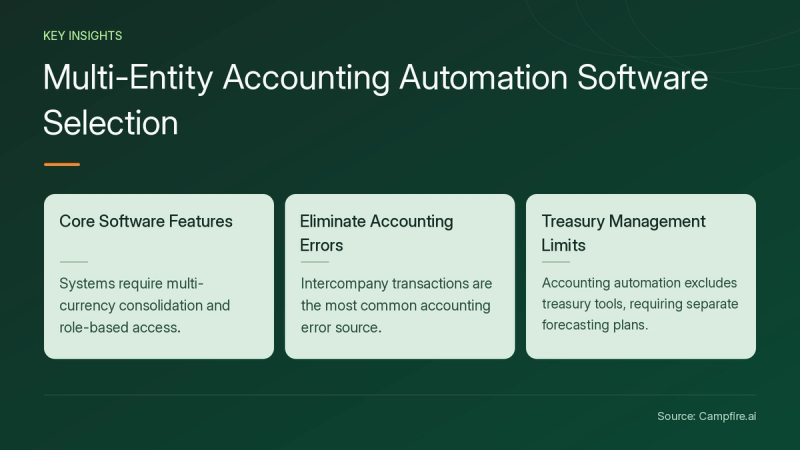
Key Takeaways
- Core multi-entity features include entity-level books, consolidation, intercompany eliminations, multi-currency support and role-based access (Avantiico[c1]).
- NetSuite calls intercompany transactions the most common source of errors in multi-entity accounting (NetSuite[c2]).
- QuickBooks and Xero require a separate subscription per entity and do not offer native consolidation (Avantiico[c1]).
- Accounting automation is not treasury management, so plan cash forecasting separately (Agicap[c3]).
What Does Multi-Entity Accounting Automation Software Do?
It manages two or more business units under common ownership or control in one system and rolls their results into consolidated statements. NetSuite's 10-step process covers entity setup, standardization, multicurrency and tax, intercompany transactions, data consolidation and mapping, eliminations, reporting, audit controls, automation and ongoing monitoring (NetSuite[c2]).
| Capability | What to confirm | Source |
|---|---|---|
| Consolidation | What to confirmSupports the right method for each ownership level: full (over 50%), equity (20% to 50%) or cost (under 20%) | SourceNetSuite (https://www.netsuite.com/portal/resource/articles/accounting/multi-entity-accounting.shtml)[c2] (https://www.netsuite.com/portal/resource/articles/accounting/multi-entity-accounting.shtml) |
| Intercompany eliminations | What to confirmRemoves transactions between entities from consolidated statements | SourceSage (https://www.sage.com/en-us/accounting-software/multi-entity/)[c4] (https://www.sage.com/en-us/accounting-software/multi-entity/) |
| Counterparty entries | What to confirmSome platforms automatically create the matching entry in the counterparty entity | SourceNetSuite (https://www.netsuite.com/portal/resource/articles/accounting/multi-entity-accounting.shtml)[c2] (https://www.netsuite.com/portal/resource/articles/accounting/multi-entity-accounting.shtml) |
| Multi-currency | What to confirmHandles exchange rates and translation for each entity | SourceAvantiico (https://avantiico.com/best-multi-entity-accounting-platforms-2025/)[c1] (https://avantiico.com/best-multi-entity-accounting-platforms-2025/) |
| Approvals and access | What to confirmCustom workflows by entity, department or transaction type | SourceAvantiico (https://avantiico.com/best-multi-entity-accounting-platforms-2025/)[c1] (https://avantiico.com/best-multi-entity-accounting-platforms-2025/) |
Which Software Categories Cover Multi-Entity Work?
No single category covers everything. Agicap separates the core ledger from close tools, payables tools and treasury (Agicap[c3]).
| Category | Examples named in sources | Scope |
|---|---|---|
| Core ERP / GL | Examples named in sourcesNetSuite, Sage Intacct, Microsoft Dynamics 365 | ScopeSystem of record, consolidation, financial statements |
| Close automation | Examples named in sourcesBlackLine, FloQast | ScopeReconciliations and close checklists; runs alongside the ledger |
| AP automation | Examples named in sourcesTipalti, Coupa | ScopeInvoices, approvals and payouts; not a GL replacement |
| ERP add-ons | Examples named in sourcesAMCS by Avantiico, Binary Stream MEM | ScopeExtend Dynamics 365 multi-company features |
Sources: Agicap[c3], Avantiico[c1].
How Do You Test a Vendor's Intercompany Close?
Run one hypothetical entity through the full path from local books to group reporting during the demo. The steps below are an evaluation exercise and do not describe any product.


- Pick a sample. Use a hypothetical UK subsidiary with a $50,000 intercompany receivable from its US parent.
- Match reciprocal entries. Ask the vendor to show both sides. If they differ, work out whether the cause is a posting-period difference, a currency translation difference or an account mapping mismatch.
- Trace translation. Check the rate source, rate date, local amount and reporting amount for the balance.
- Eliminate. Confirm that the balance nets to zero in the consolidated view and that the adjustment links back to its source entries.
- Record ownership. Have the Controller document who owns the local close, statutory filing and tax calculations, and where the evidence for each one lives.
Keep as evidence: screenshots of the match, the elimination entry and its audit trail.
How Much Automation Should Post Without Review?
Consider requiring human review before any automated or AI-suggested entry posts until you have tested the controls. Agicap advises buyers to look for explainable AI, a complete audit trail of what the AI proposed and who approved it, and permission-based access (Agicap[c3]). In the demo, change a flagged transaction's classification. Then confirm that the approval threshold and the activity log record the change.
If Campfire is on your shortlist, apply the same intercompany test to the workflows on its Core Accounting page and ask for a live walkthrough.


Run the review-threshold and audit-log checks against the workflows shown on the Ember AI page as well.
What Should You Ask About Pricing and Fit?
Ask how the vendor charges per entity and per user, because providers typically charge for each separate business (BILL[c5]). Sage says its multi-entity pricing depends on the modules you include (Sage[c4]). Pricing for other vendors is not documented in the supplied sources.
- Fit by size: NetSuite says growing companies often outgrow basic systems somewhere between $10 million and $20 million in revenue (NetSuite[c2]).
- Alternatives: Sage Intacct documents journaled consolidations and intercompany eliminations. In a published Sage testimonial, Heather Norum of VelocityEHS said global consolidations across five currencies now take "a few short minutes" (Sage[c4]).
- Integrations: Confirm early that the platform works with your ERP, CRM and AP tools (Avantiico[c1]).
Conclusion
Choose multi-entity accounting automation software by proof, not by feature list. Trace one intercompany balance through matching, translation and elimination. Confirm review controls and audit logs. Then compare pricing per entity and per user across your shortlist, which may include ERPs such as Sage Intacct or NetSuite. When you are ready to run these tests on Campfire's platform, get started with Campfire.
FAQ
What is multi-entity accounting software?
Multi-entity accounting software manages the books of several legal entities, such as subsidiaries or branches, in one system. It automates intercompany transactions, handles multiple currencies and produces both entity-level and consolidated reports, according to Sage[c4].
Can QuickBooks consolidate multiple entities?
No. According to Avantiico[c1], QuickBooks does not offer native consolidation, so you need third-party tools or Excel exports to build consolidated reports, and each company file requires its own subscription.
What is the difference between combination and consolidation?
Combination adds together the financial statements of entities under common control that have no ownership relationship. Consolidation applies when entities hold ownership interests in each other and requires eliminations and accounting for noncontrolling interests, per NetSuite[c2].
Does accounting automation software replace cash forecasting tools?
Not necessarily. Agicap[c3] argues that accounting systems record historical accrual data, while treasury tools manage real-time bank positions and forward cash forecasts, so many groups run the two separately.
Sources
- [c1] Comparing the Best Multi-Entity Accounting Software Platforms [2025] — avantiico.com. Accessed November 17, 2026.
- [c2] What Is Multi-Entity Accounting? | NetSuite — netsuite.com. Accessed November 17, 2026.
- [c3] Accounting Automation Software for US Mid-Market | Agicap — agicap.com. Accessed November 17, 2026.
- [c4] Multi-Entity Accounting Software | Sage US — sage.com. Accessed November 17, 2026.
- [c5] Best Multi-Entity Accounting Software (+ How to Choose) — bill.com. Accessed November 17, 2026.