Accounting Automation Software Implementation Cost: A Budget Guide
Listen to article
7:15
Estimate accounting automation software implementation cost by defining the work you want delivered, obtaining a quote for that scope and adding the time your own team will contribute. Keep the implementation budget separate from the software subscription and ongoing operating costs. The worked budget below uses fictional amounts to show the calculation; it is not a Campfire quote or a market benchmark.
Start with the records and workflows you plan to move. For each item, ask who will prepare it, who will configure or import it, and what evidence your finance owner will accept before approving that part of the rollout.

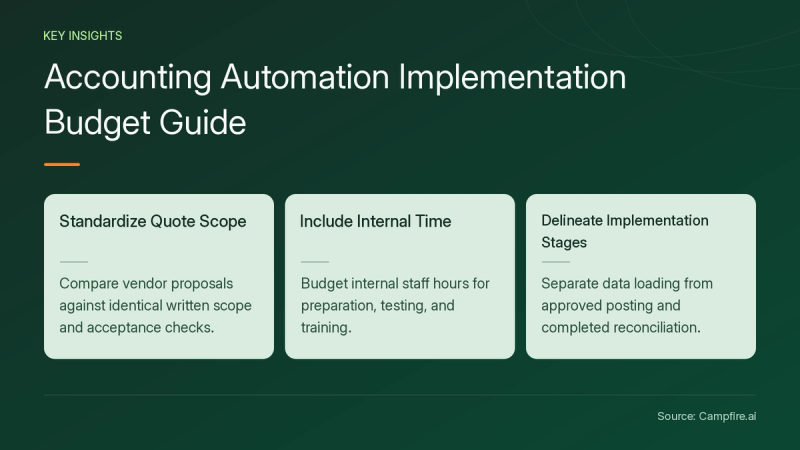
Key Takeaways
- Compare implementation quotes against the same written scope and acceptance checks.
- Include your own team's preparation, testing and training time in the project budget.
- Separate a proposed data load from an approved posting and a completed reconciliation.
- Use the fictional example to build your worksheet, then replace every assumption with your own quote or staffing estimate.
What work should your implementation quote include?
List the entities, chart of accounts, historical periods, dimensions and workflows included in the proposed rollout. Ask the provider to identify the files, mappings and configuration it expects your team to prepare. Give each deliverable an owner and a completion test so you can compare the same work across proposals.
Ask separately about data cleanup, integration setup, test imports, reconciliation, training and support during the agreed transition period. Record exclusions alongside the price rather than treating an unlisted task as included. For work priced by time, request the proposed roles, rates and assumptions. For a fixed scope, ask how a change will be documented and priced.
How does the migration workflow define the scope?
Campfire's Implementation and Migration page describes loading the chart of accounts, vendors, departments and entities before preparing and mapping journal entries. It describes balance and format checks before writing, with no posting until a person approves, followed by an account-by-account reconciliation against the old balance sheet.
Use that sequence to structure your scope discussion: what enters the workflow, what is prepared, who approves it and which reconciliation demonstrates the result. Ask the provider to show those steps with your agreed sample. Keep data preparation, the import and finance acceptance as separate deliverables in your budget worksheet.
What can preparation change before implementation begins?
In Campfire's full Klarity customer story, the company had refined its Salesforce setup and consolidated expense management from three platforms into Ramp before implementation. The story also describes Klarity using its own Process Index to map workflows across its U.S. operations and third-party accounting firm, including approval structures and departmental allocations.


This is an attributed example of preparation, not a price or savings estimate for another buyer. Before requesting your own quote, identify which source systems and workflows are ready and which still need cleanup or decisions. Ask the implementation team to separate work already completed from work it is being asked to deliver.
How do you build a sample implementation budget?
For this fictional exercise, assume migration preparation costs $4,000, integration setup costs $2,000 and training costs $1,000. Assume your internal testing takes 30 hours at an illustrative internal rate of $100 per hour, or $3,000. The sample implementation total is $10,000. These invented inputs demonstrate the worksheet only; replace them with written quotes and your own staffing assumptions.
| Fictional budget line | Sample amount | Scope to replace with your own agreement |
|---|---|---|
| Migration preparation | Sample amount$4,000 | Scope to replace with your own agreementNamed files, history, mapping decisions and reconciliation outputs |
| Integration setup | Sample amount$2,000 | Scope to replace with your own agreementNamed connections, data directions and agreed test cases |
| Training | Sample amount$1,000 | Scope to replace with your own agreementNamed roles, sessions and operating instructions |
| Internal testing | Sample amount30 hours × $100 = $3,000 | Scope to replace with your own agreementYour estimated preparation, review and acceptance time |
| Sample implementation total | Sample amount$10,000 | Scope to replace with your own agreementThe sum of the four fictional project lines |
The example excludes the subscription, taxes and ongoing support or operating costs. List these separately when you need a broader ownership estimate. If a proposal bundles services and software, ask for the scope and charging basis for each component before comparing it with this implementation-only worksheet.
How should you test and accept the proposed work?
Choose a fictional sample or an approved test environment with known inputs. Give the presenter a ledger file, account mapping and expected balance, then inspect the prepared import and its exceptions. Identify who approves a posting and compare the resulting balance with your expected result. Save the input, mapping, approval and reconciliation evidence so another finance participant can repeat the exercise.


For a connection included in the quote, define the record to transfer, expected destination and expected outcome before the demonstration. Ask the team to show an ordinary case and a deliberately invalid record. Record what was corrected, what required a decision and who owns each unresolved item. Use those observations to clarify the agreed deliverables and remaining project work.
What should you confirm before approving the budget?
Keep the proposal, assumptions, exclusions, owners and acceptance checks together. Ask the provider to identify dependencies and explain how it will handle changes to historical periods, entities, integrations or training scope. Agree how your team will approve an added task before it becomes part of the project.
For related workflow context, see Campfire's Core Accounting overview. Use the same sample and acceptance requirements when evaluating another provider, and compare the written scope rather than an advertised migration headline.
Conclusion
Build your implementation estimate from scoped deliverables, actual quotes and your team's planned work. Keep the fictional worksheet as a calculation aid and replace its assumptions before making a purchase decision. Bring your source files and acceptance checklist when you get started with Campfire.
FAQ
Is the sample budget a Campfire implementation price?
No. Every amount in the worked budget is fictional. Request a written proposal for your entities, data, integrations, training and acceptance requirements before estimating your own project.
Should subscription fees be included in this implementation total?
This sample separates the implementation project from the subscription and ongoing operating costs. Keep those other costs in separate worksheet lines when comparing the broader ownership cost.
What evidence should the finance owner keep at acceptance?
For the proposed test above, save the source file, mapping decisions, approved import, reconciliation and unresolved exceptions. Have another participant repeat the sample and compare the observed output with the expected result before accepting the work.