Accounting Automation Software Total Cost of Ownership: A Model
Listen to article
7:53
Build an accounting automation software total cost of ownership worksheet around a defined evaluation period, the work you expect the software to cover and the systems you plan to keep. For the planning model in this guide, combine the implementation project, recurring charges, your own operating work and a separately stated exit assumption. Replace the fictional example with your proposals, contracts and staffing estimates before making a purchase decision.
Keep cost and capability questions together. Ask which workflow a quoted charge covers, who will operate it and what evidence your finance owner can inspect when something needs review.

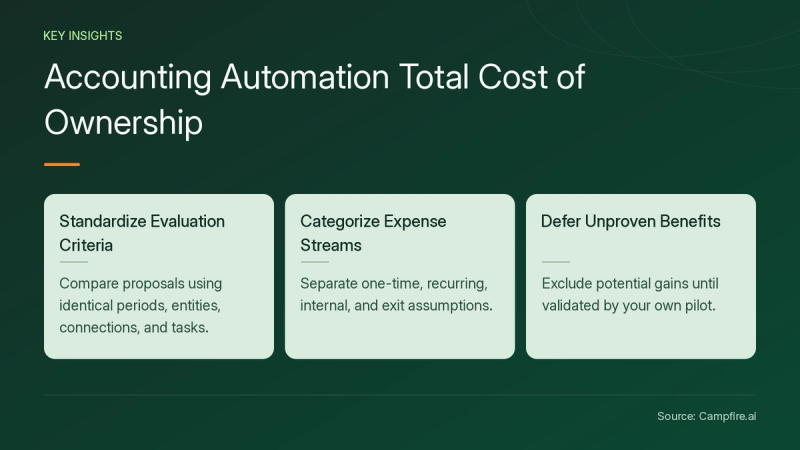
Key Takeaways
- Use the same evaluation period, entities, connections and operating tasks for every proposal.
- Separate one-time work, recurring fees, internal work and your chosen exit assumptions.
- Inventory the existing tools and contracts before assuming a new platform replaces them.
- Keep possible benefits outside the base cost calculation until you have evidence from your own pilot.
What belongs in your ownership-cost worksheet?
Begin with your intended scope: entities, currencies, source systems, historical data, reporting and the roles that will use the platform. Ask each provider to price that same scope and identify exclusions. Record the charging basis, term, renewal assumptions and the date each charge starts.
Use separate lines for implementation services, subscriptions, agreed support, integration work and your team's operating time. Ask who maintains each connection, resolves failed transfers and updates mappings when your business changes. List any retained systems and contracts separately so another reviewer can see exactly which costs the proposed plan includes.
How can product documentation guide the operating questions?
Campfire's Core Accounting page describes native integrations for banks, billing systems, HRIS and payment processors. It also describes custom reports with drill-down from metrics to source data. Use those documented workflows to define a demonstration of a named connection and a report your team actually needs.
Ask which connection and reporting configuration the quote includes. Have the presenter show the source record, its destination and the report's supporting detail, then identify who handles an exception. Record any additional setup or recurring work the demonstrated configuration requires. Use the same task and expected result when testing another provider.
Which existing tools would your plan actually replace?
Campfire's full Klarity customer story describes an earlier setup where QuickBooks served as the GL and Rillet held contracts and the revenue waterfall, without a connection to the GL or Salesforce. The story later describes Campfire's revenue recognition module replacing Rillet and bringing revenue recognition and GL work into one platform.


Use that attributed example to frame your own inventory, not as proof of savings for a different buyer. List what each current system does, which proposed workflow could replace it and what your team must verify before retiring it. Check your own contract dates and remaining requirements before removing an existing cost from the worksheet.
How does a fictional three-year model work?
For this fictional exercise only, assume a $10,000 implementation project. Assume annual charges of $12,000 for the subscription and $2,000 for support, plus $3,000 of internal operating work each year. Over three years those recurring and internal lines total $51,000. Add a fictional $2,000 exit allowance. The sample ownership total is $63,000: $10,000 + $51,000 + $2,000.
Every amount and the three-year period are invented inputs for this worksheet. They are not Campfire prices, a quote for another product or an expected market range. The sample assumes unchanged annual amounts and excludes taxes and any tasks not listed.
| Fictional model line | Sample calculation | Amount over the sample period |
|---|---|---|
| Implementation project | Sample calculationOne invented project amount | Amount over the sample period$10,000 |
| Subscription | Sample calculation$12,000 × 3 years | Amount over the sample period$36,000 |
| Support | Sample calculation$2,000 × 3 years | Amount over the sample period$6,000 |
| Internal operating work | Sample calculation$3,000 × 3 years | Amount over the sample period$9,000 |
| Exit allowance | Sample calculationOne invented end-of-period assumption | Amount over the sample period$2,000 |
| Sample ownership total | Sample calculationSum of the five fictional cost lines | Amount over the sample period$63,000 |
Replace each input with your own evidence and show where it came from. If a proposal bundles support into the subscription, record the bundle once and mark the separate support line as included. If a fee changes during your evaluation period, show the applicable amount for each year rather than using this sample's unchanged annual assumption.


How should you compare possible benefits with these costs?
For this exercise, keep benefits in a separate worksheet. Choose a repeatable task, record your own starting process and measure the same task during an agreed pilot. Identify the input, preparer, reviewer and accepted output so another participant can repeat the comparison.
For example, ask the presenter to move a fictional record through the proposed connection and trace the resulting report to its source. Include a deliberately invalid record and observe who resolves it. Record the demonstrated work and any unresolved exception; do not turn a product description or another customer's result into a guaranteed reduction in your own staffing or operating costs.
What should you verify about renewal and exit assumptions?
Ask for the terms that apply to your proposed purchase. Identify which quantities or scope changes can affect charges, what is included in support and what happens when the agreement renews. Ask how your team would retrieve its records and supporting material if the arrangement ends, and request the scope and price of any related service.
For related preparation context, see Campfire's Implementation and Migration overview. Keep its workflow separate from your actual proposal: a product description does not establish the services or prices in your agreement.
Conclusion
Compare accounting automation ownership costs using a common scope, period and set of operating tasks. Keep the cost assumptions traceable and possible benefits separate until your own test supports them. Bring your system inventory and sample report when you get started with Campfire.
FAQ
Is the $63,000 example a vendor price?
No. It is the result of adding five fictional cost lines over an invented three-year period. Replace each input with your own written proposal, contract or staffing estimate.
How do we avoid counting a bundled charge twice?
In your worksheet, list the bundle once and mark its included components accordingly. Keep the written scope beside the amount so the next reviewer can see what the charge covers.
Should we subtract advertised time savings from the base model?
This exercise keeps possible benefits separate from costs. Test a defined task with your own inputs and acceptance checks before using an observed result in a separate benefits comparison.