Accounting Automation Technical Debt: How to Find, Cost and Fix It
Listen to article
7:15
Accounting automation technical debt is the recurring maintenance cost and control risk created by fragile, undocumented or outdated automations in close, reconciliation and posting workflows. You can find it by inventorying each automation, costing its upkeep and repairing the riskiest items without weakening review. For the wider role, see our accounting engineer guide.

Key Takeaways
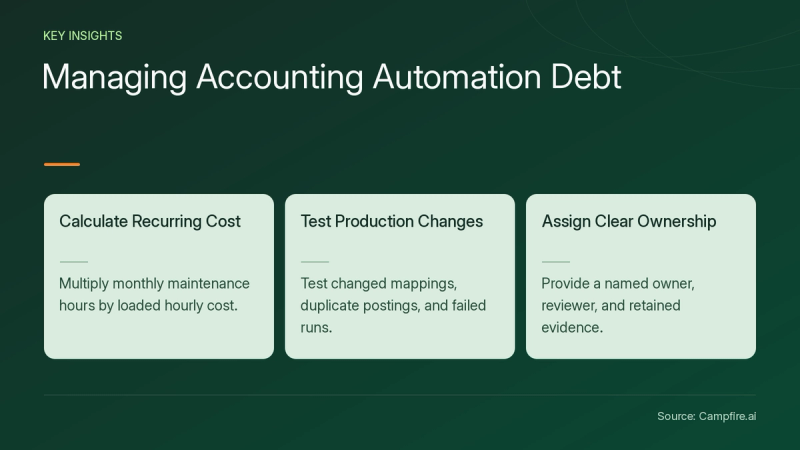
- Automation debt is an existing automation that needs repeated repair or manual compensation. Work that was never automated is a separate opportunity cost.
- Estimate recurring cost as monthly maintenance hours multiplied by loaded hourly cost. Track avoided risk separately.
- Test changed account mappings, duplicate postings and failed runs before any production change.
- Give every automated posting step a named owner, a reviewer and retained evidence.
What is accounting automation technical debt?
Accounting automation technical debt is an existing automation that costs more to keep accurate than it saves, or that weakens controls when it fails. Common examples include hard-coded account maps, undocumented scripts and integrations that post duplicates after a source system changes.
It differs from manual work that was never automated. That manual work is an opportunity cost, not debt, and it needs a separate decision. Maviwork reported that 59% of finance leaders actively used AI in their finance function, up from 37% in 2023. Adoption grows quickly, so each new automation needs an owner and a test.
How do you inventory automation debt in accounting?
Start with a register that lists every automation that creates, changes or checks a journal entry. Record the fields below for each item.
| Field | What to record | Hypothetical payout integration entry |
|---|---|---|
| Owner | What to recordNamed maintainer and backup | Hypothetical payout integration entryFinance Systems Manager, with a Controller as backup |
| Source and destination | What to recordFeeds and ledger accounts | Hypothetical payout integration entryPayment processor payouts into a clearing account |
| Mapping rules | What to recordHard-coded account or class mappings | Hypothetical payout integration entryFee mapped to one expense account, last changed 14 months ago |
| Failure mode | What to recordHow the run can break | Hypothetical payout integration entryDuplicate posting after a retried webhook |
| Control evidence | What to recordWhat reviewers retain | Hypothetical payout integration entryDaily batch report with reviewer sign-off |
| Maintenance hours | What to recordMonthly upkeep | Hypothetical payout integration entry6 hours per month |
The payout example is hypothetical and does not describe a real company. Record owners as broad roles so responsibility stays clear when staff change. Our accounting engineering operating model resource explains how these roles fit together.


How do you cost automation technical debt?
Recurring cost equals monthly maintenance hours multiplied by loaded hourly cost, then multiplied by 12 for an annual view. In the hypothetical payout integration, 6 hours per month at a loaded rate of $75 per hour equals $450 per month, or $5,400 per year.
Record avoided risk, such as a misstated clearing balance, on a separate line. Do not net it against the recurring cost, because it is an estimate and not a saving.
Which repair option fits each automation?
Choose among eliminate, standardize, repair, replace or retain as a manual control, based on whether the step adds value and what evidence it produces. Parsli reported that 42% of finance activities are fully automatable with current commercial technology, which measures feasibility rather than control safety.
| Option | Use when | Evidence to keep |
|---|---|---|
| Eliminate | Use whenThe step duplicates another control | Evidence to keepEntry counts before and after |
| Standardize | Use whenThe same logic exists in several scripts | Evidence to keepOne mapping table with version history |
| Repair | Use whenThe failure has a known, testable cause | Evidence to keepFixture results and reviewer sign-off |
| Replace | Use whenUpkeep stays high after repair | Evidence to keepCost comparison and cutover plan |
| Retain manually | Use whenJudgment or approval must stay human | Evidence to keepReviewer log and approval threshold policy |
Duplicate detection is one control to evaluate. Campfire's accounting intelligence page describes duplicate detection with review and audit trails, but test it against your own ledger before relying on it.


How do you repair automation debt without weakening close controls?
Repair in this order, and do not change production until each step passes.
- Baseline: Record current outputs for a full close cycle.
- Set tolerances: Have the Controller approve a reconciliation tolerance for each account.
- Run fixtures: Feed a changed mapping and a duplicate payout through a test environment. Expect a flagged exception, not a posting.
- Approve cutover: A named approver signs the change with test results attached.
- Document rollback: Keep the prior mapping version and a tested revert step.
Scripted fixture checks can follow our Python for accounting automation guide. Journal extracts for tolerance tests fit our SQL for accountants resource.
Migrations carry extra risk. Impact My Biz reported that 64% of ERP implementations exceed budget, so fund rollback work early. Campfire's implementation and migration page describes historical journal entry migration, chart of accounts cleanup and reconciliation of migrated data.
Conclusion
Accounting automation technical debt is manageable when each automation has an owner, a cost and a test. List every automation that touches a journal entry, then cost the upkeep of the riskiest ones first. Repair them with fixtures, tolerances and rollback steps before any production change.
Each month, track failed runs, exception age, manual corrections and reviewer completion to confirm the debt is shrinking. Teams that want help mapping these controls can get started with Campfire.
FAQ
How is automation technical debt different from manual work?
Automation technical debt is an existing automation that needs ongoing repair, rework or manual compensation to stay accurate. Manual work that was never automated is an opportunity cost, so it should be evaluated for elimination, standardization or retention as a control.
How often should a controller review the debt register?
Review the register monthly during close and after any change to a mapping, source system or approval threshold. Each review should confirm owners, recent failed runs and the evidence reviewers retained.
Does AI adoption reduce automation technical debt?
No. Adding AI does not remove debt by itself, because new tools still need named owners, tests, tolerances and retained evidence. Treat AI-driven steps like any other automation in the register.