Accounting Chart of Accounts Example: Sample Codes and Setup Steps
Listen to article
7:26
An accounting chart of accounts example is a numbered list of every general ledger account, grouped into assets, liabilities, equity, revenue and expenses, often with codes such as 1000-1999 for assets and 5000-5999 for expenses (NetSuite). Below is a sample chart, the logic behind its numbers and a short walkthrough for building and checking your own.

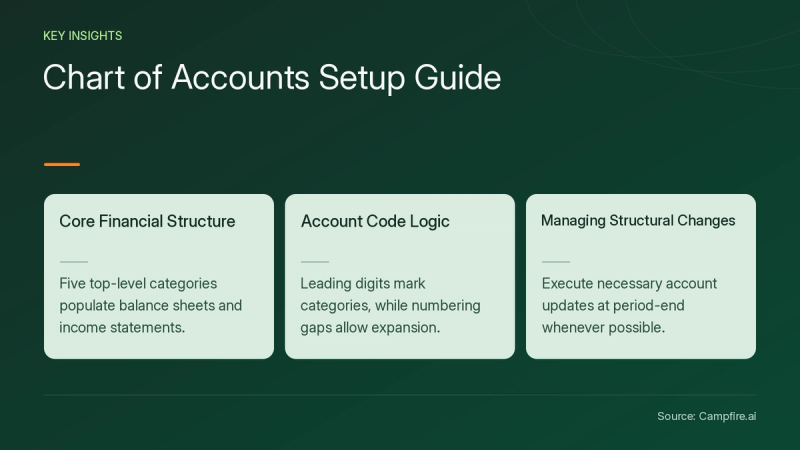
Key Takeaways
- Most charts use five top-level categories. Assets, liabilities and equity feed the balance sheet, and revenue and expenses feed the income statement (NetSuite).
- The first digit usually identifies the category, and gaps between numbers leave room for new accounts (AccountingCoach).
- Account codes vary widely between entities because of laws, industry guidelines, business needs and software limits (CPA Hall Talk).
- When changes are needed, make them at period-end where possible (NetSuite).
What Does an Accounting Chart of Accounts Example Look Like?
A basic example lists each account's code, name, type and the side (debit or credit) that increases it. The hypothetical chart below combines account names and conventions from the cited sources. It includes a contra account, Accumulated Depreciation, which increases with a credit even though it sits among assets (AccountingCoach).
| Code | Account | Type | Increases With | Source Pattern |
|---|---|---|---|---|
| 1010 | AccountCash | TypeAsset | Increases WithDebit | Source PatternCPA Hall Talk sample chart |
| 1020 | AccountAccounts Receivable | TypeAsset | Increases WithDebit | Source PatternCPA Hall Talk sample chart |
| 1030 | AccountInventory | TypeAsset | Increases WithDebit | Source PatternCPA Hall Talk sample chart |
| 1500 | AccountEquipment | TypeAsset | Increases WithDebit | Source PatternAccountingCoach small company chart |
| 1510 | AccountAccumulated Depreciation - Equipment | TypeContra asset | Increases WithCredit | Source PatternAccountingCoach small company chart |
| 2010 | AccountAccounts Payable | TypeLiability | Increases WithCredit | Source PatternAccountingCoach liability accounts |
| 2020 | AccountWages Payable | TypeLiability | Increases WithCredit | Source PatternAccountingCoach liability accounts |
| 3010 | AccountOwner's Capital | TypeEquity | Increases WithCredit | Source PatternAccountingCoach equity accounts |
| 3020 | AccountRetained Earnings | TypeEquity | Increases WithCredit | Source PatternCPA Hall Talk sample chart |
| 4010 | AccountSales Revenue | TypeRevenue | Increases WithCredit | Source PatternGermanna journal entry rules |
| 5010 | AccountCost of Goods Sold | TypeExpense | Increases WithDebit | Source PatternGermanna journal entry rules |
| 5020 | AccountRent Expense | TypeExpense | Increases WithDebit | Source PatternGermanna journal entry rules |
How Are Account Numbers Structured?
Account numbers are usually structured so the first digit shows the category and later digits show subcategories and individual accounts. In NetSuite's five-digit example, 10010 means asset (1), current asset (00) and a specific account (10) (NetSuite).
| Format | Asset Range or Example | Source |
|---|---|---|
| Three-digit | Asset Range or Example101-199 | SourceGermanna numbering table |
| Four-digit | Asset Range or Example1000-1999 | SourceNetSuite coding system |
| Five-digit | Asset Range or Example10000-16999 for current assets | SourceAccountingCoach large corporation chart |
| Segmented prefix | Asset Range or Example10-10-1000, where 10 means asset and the second 10 means cash | SourceCPA Hall Talk account coding |
Longer segmented codes let you total groups automatically, such as adding every account that starts with 10-10 to get total cash. Short codes are faster to enter but may force manual work in spreadsheets (CPA Hall Talk).
How Do You Build a Chart of Accounts From This Example?
Start from your reporting needs, then assign categories and numbers. These steps condense the setup process described by CPA Hall Talk:


- Identify the financial statements and reports you need.
- Confirm your basis of accounting. GAAP requires accrual accounts such as Accounts Receivable; the cash basis does not.
- Check whether regulations dictate your structure, as with some governments and nonprofits.
- Choose a numbering system, often in increments of 10 or 100.
- Create main categories, add subcategories, then assign numbers and short descriptions.
- Confirm your software supports the code length you want.
- Record sample transactions, revise, train users and review periodically.
Verification checks: Does each balance sheet account map to one balance sheet line? Do related accounts exist in pairs, such as a debt liability and its interest expense (NetSuite)? Is every contra account flagged with its credit increase? Are there duplicate accounts that split the same activity?
If you are moving accounts into a new system, Campfire's Implementation and Migration page describes its onboarding approach.
How Should You Change or Maintain the Chart?
Change the chart as rarely as possible and, when needed, at the end of an accounting period to avoid corrupting records (NetSuite). To split an account, add new codes beside the old one, such as 40031 and 40032 under 40030, then journal the existing balance into the new lines.


Common problems to watch for include overcomplication, inconsistent naming and duplicate categories. If a chart needs more than three levels, NetSuite suggests considering subledgers (NetSuite).
For an overview of Campfire's general ledger product, see Core Accounting.
Conclusion
A good chart of accounts example follows the five categories, uses numbers with gaps for growth and records which side increases each account. Test it with sample entries before going live, and save changes for period-end. When you are ready to put your chart to work, get started with Campfire.
FAQ
What are the five types of accounts in a chart of accounts?
The five types are assets, liabilities, equity, revenue (income) and expenses, though some charts break out gains and losses as separate top-level categories (NetSuite).
How many accounts should a chart of accounts have?
The number depends on company size and complexity: AccountingCoach notes a small local retailer may need as few as one hundred accounts, while an international corporation may need thousands (AccountingCoach).
Can I change my chart of accounts mid-year?
You can add accounts mid-period if your coding scheme has room, but NetSuite recommends making changes at period-end where practical and notes that existing lines usually cannot be deleted mid-period, so balances are moved with journal entries (NetSuite).
How often should a chart of accounts be reviewed?
No fixed schedule appears in the cited sources; CPA Hall Talk advises reviewing the chart periodically as business needs change, and a practical approach is to align reviews with your period-end close (CPA Hall Talk).
Sources
- [c1] Chart of Accounts: Definition, Best Practices, and Examples | NetSuite — netsuite.com. Accessed November 20, 2026.
- [c2] Chart of Accounts: In-Depth Explanation with Examples | AccountingCoach — accountingcoach.com. Accessed November 20, 2026.
- [c3] Understanding the Chart of Accounts: A Fundamental Guide - CPA Hall Talk — cpahalltalk.com. Accessed November 20, 2026.
- [c4] Chart of Accounts — germanna.edu. Accessed November 20, 2026.