Accounting for Fixed Assets Under IFRS: A Step-by-Step IAS 16 Guide
Listen to article
10:38
Under IFRS, tangible fixed assets such as machinery, buildings and equipment are accounted for under IAS 16, Property, Plant and Equipment. An item is recognized as an asset when future economic benefits are probable and its cost can be measured reliably. The standard then governs initial cost, depreciation and derecognition, while impairment is assessed under IAS 36. This guide follows one hypothetical machine from purchase to disposal, then shows how to keep the register reconciled through general ledger and month-end close workflows.

Key Takeaways
- IAS 16 covers tangible assets expected to be used for more than one period, not every long-lived asset.
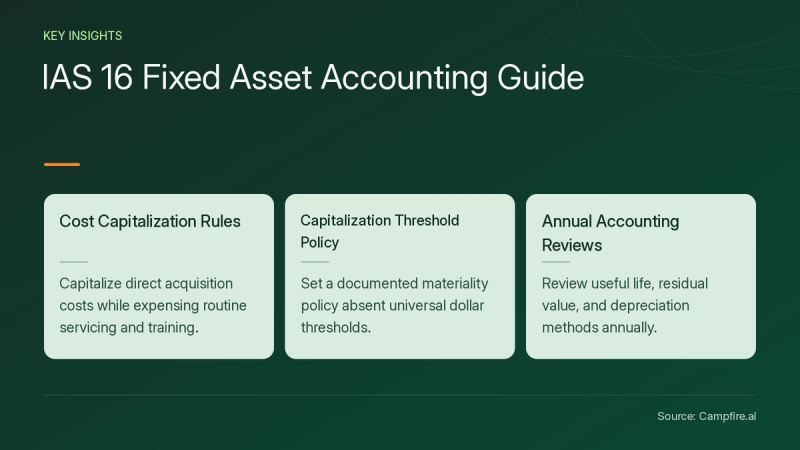
- Capitalize the purchase price and directly attributable costs. Expense routine servicing and operator training.
- IAS 16 sets no universal dollar threshold, so apply a documented, materiality-based policy.
- Depreciation starts when an asset is available for use and generally continues while it is idle.
- Useful life, residual value and depreciation method are reviewed at least annually.
Which Assets Does IAS 16 Cover?
Does IAS 16 apply to every long-lived asset?
No. IAS 16 applies to tangible property, plant and equipment held for production, supply, rental or administrative purposes and expected to be used for more than one period. Other long-lived assets follow different standards.
| Asset type | Governing standard |
|---|---|
| Tangible property, plant and equipment | Governing standardIAS 16 |
| Right-of-use assets from leases | Governing standardIFRS 16 |
| Investment property | Governing standardIAS 40 |
| Intangible assets | Governing standardIAS 38 |
| Assets held for sale | Governing standardIFRS 5 |
Check each asset against its standard before applying IAS 16 rules.
How Is Cost Measured at Recognition?
Which costs are capitalized?
Capitalize the purchase price plus costs directly attributable to bringing the asset to its intended location and working condition. For example, a machine bought for $500,000 with $20,000 of eligible installation costs has an initial cost of $520,000.
| Cost item | Treatment |
|---|---|
| Purchase price, import duties and non-refundable taxes | TreatmentCapitalize |
| Installation and commissioning directly attributable to the asset | TreatmentCapitalize |
| Dismantling and restoration obligations, where recognized | TreatmentInclude in cost |
| Routine servicing and repairs | TreatmentExpense |
| Staff training to operate the asset | TreatmentExpense |
IAS 16 does not set a dollar capitalization threshold. An entity sets its own policy, applied consistently and considering materiality. That policy is an entity choice, not an IFRS requirement.


How Do You Depreciate Assets and Review Estimates?
When does depreciation start?
Depreciation starts when the asset is available for use, not necessarily when it first generates revenue. Depreciation generally continues while the asset is idle, according to the IAS 16 standard text.
Using the $520,000 machine with a $20,000 residual value and a 10-year life, straight-line depreciation is ($520,000 minus $20,000) divided by 10, or $50,000 per year. Significant components with different useful lives are depreciated separately.
How often should useful life and residual value be reviewed?
Useful life, residual value and depreciation method must be reviewed at least annually, and changes in estimates are applied prospectively. Finance teams should document the evidence behind each change.
A current watchpoint is the IFRS Interpretations Committee's tentative agenda decision on estimating residual value, which focuses on current prices. Comments closed on November 30, 2026. The decision is tentative and does not change IAS 16 yet.


How Do You Record Disposals and Impairment?
How is a disposal recorded?
Derecognize the asset and recognize the difference between net disposal proceeds and carrying amount as a gain or loss. In the example, the machine has accumulated depreciation of $200,000 after four years, so its carrying amount is $320,000. If it sells for $250,000, the loss is $70,000.
| Account | Debit ($) | Credit ($) |
|---|---|---|
| Cash | Debit ($)250,000 | Credit ($) |
| Accumulated depreciation | Debit ($)200,000 | Credit ($) |
| Loss on disposal | Debit ($)70,000 | Credit ($) |
| Property, plant and equipment (cost) | Debit ($) | Credit ($)520,000 |
When should impairment be tested?
Test for impairment under IAS 36 when indicators exist. Compare the carrying amount with the recoverable amount, which is the higher of fair value less costs of disposal and value in use.
How Do You Keep the Register Reconciled?
What should the fixed-asset register track?
The register should track cost, in-service date, useful life, residual value, components, accumulated depreciation, disposals and impairment decisions. Each entry should link to supporting evidence. Tools such as Campfire's Accounting Intelligence provide review and audit trails for transaction matching and accrual suggestions, which can support the review steps for asset-related transactions.
- Reconcile the register to the general ledger every close.
- Confirm in-service dates for assets available for use.
- Reassess useful lives, residual values and impairment indicators.
- Record disposals and replaced components.
- Document evidence for every estimate change.
Conclusion
IAS 16 governs fixed assets across their full lifecycle, from recognition to derecognition. Teams that document cost judgments, depreciation start dates and annual estimate reviews reduce audit friction and reconciliation effort. To see how this workflow can run inside your close, get started with Campfire.
FAQ
Does IAS 16 require a minimum capitalization amount?
No. IAS 16 does not prescribe a universal dollar threshold for capitalization. Entities set a policy that is applied consistently and considers materiality, and the recognition criteria still apply to each item.
Should depreciation stop when an asset is idle?
No. Depreciation generally continues while an asset is idle, provided the asset is available for use. Entities should still review useful life and residual value at least annually.
Can an entity use a revaluation model for fixed assets under IFRS?
Yes. IAS 16 permits the revaluation model as an alternative to the cost model. It must be applied to an entire class of property, plant and equipment, not selectively to individual assets.
Sources
- [c1] IFRS - IAS 16 Property, Plant and Equipment — ifrs.org. Accessed November 24, 2026.