Accounting for Foreign Currency Bank Accounts: Entries and Reconciliation
Listen to article
6:36
A foreign currency bank account is recorded in the entity's functional currency, and its foreign-currency balance is remeasured at each reporting date. Record funding at the spot rate, remeasure the balance at the closing rate, record conversion and fees separately, and reconcile both the foreign-currency units and the functional-currency carrying amount. This guide shows each step with a hypothetical example.

Key Takeaways
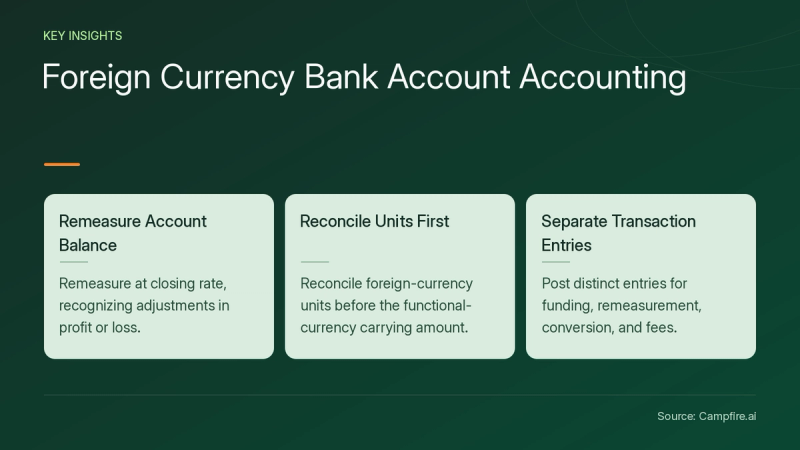
- Remeasure the foreign-currency balance at the closing rate. The change generally goes to profit or loss, subject to applicable exceptions.
- Reconcile bank-statement units first, then the functional-currency carrying amount and the remeasurement journal.
- Post funding, remeasurement, conversion and fees as separate entries so each gain, loss and cost stays traceable.
- Retain the bank statement, rate source, calculation, journal and reviewer approval for every close.
- Escalate under IFRS when a currency is not exchangeable and no reliable rate is available.
How do you remeasure a foreign currency bank account at period end?
Multiply the foreign-currency balance by the closing rate, then post the difference to the carrying amount. Confirm the rate direction first, for example dollars per euro, because a reversed quote produces a wrong gain or loss.
Assume a hypothetical entity with a USD functional currency holds a €100,000 bank balance. The rate moves from $1.10 to $1.15 per euro.
| Item | Calculation | Amount (USD) |
|---|---|---|
| Carrying amount at $1.10 | Calculation€100,000 × 1.10 | Amount (USD)110,000 |
| Carrying amount at $1.15 | Calculation€100,000 × 1.15 | Amount (USD)115,000 |
| Remeasurement gain | Calculation115,000 less 110,000 | Amount (USD)5,000 |
IAS 21 requires monetary items to be translated at the closing rate, so this cash balance is remeasured on that basis. Under ASC 830, confirm the treatment with your accounting adviser because exceptions apply in some cases.
Which journal entries record funding, remeasurement, conversion and fees?
Record each event as a separate entry so the funding, remeasurement, conversion and fee amounts can each be traced. The example below assumes the $5,000 remeasurement from above and a $200 wire fee charged in USD on conversion.


| Event | Account | Debit (USD) | Credit (USD) |
|---|---|---|---|
| Funding at $1.10 | AccountForeign currency bank (EUR) | Debit (USD)110,000 | Credit (USD) |
| AccountUSD operating bank | Debit (USD) | Credit (USD)110,000 | |
| Remeasurement at $1.15 | AccountForeign currency bank (EUR) | Debit (USD)5,000 | Credit (USD) |
| AccountForeign exchange gain | Debit (USD) | Credit (USD)5,000 | |
| Conversion at $1.15 | AccountUSD operating bank (net of fee) | Debit (USD)114,800 | Credit (USD) |
| AccountBank fees expense | Debit (USD)200 | Credit (USD) | |
| AccountForeign currency bank (EUR) | Debit (USD) | Credit (USD)115,000 |
Total debits and credits each equal $230,000. If conversion happens on a date other than the last remeasurement, post the difference between the conversion rate and the last carrying amount as a realized gain or loss. Teams that keep journal entries and multi-currency balances in one ledger can review this flow on the Core Accounting page.
How do you reconcile a foreign currency bank account?
Reconcile in two stages. First match the bank statement to the ledger in foreign-currency units, then reconcile the functional-currency carrying amount to the remeasured balance.
- Match the statement balance in euros to the ledger balance in euros, and list outstanding items.
- Assign an owner for each missing or late bank feed, and record the cutoff time.
- Multiply the reconciled euro balance by the documented closing rate.
- Compare the result with the ledger's USD carrying amount, and post any difference as a remeasurement entry.
- Save the rate source, calculation, journal and reviewer approval in the close file.
A zero remeasurement report does not complete the reconciliation if the euro units still differ from the statement. Accounting Intelligence describes bank matching with review and audit trails, which can support the matching and evidence steps when a reviewer approves each result.


Which controls should govern exchange rates and non-exchangeable currencies?
Document each rate's direction, source, date, approver and fallback before close. Require written justification and approval for any manual override.
Odoo's documentation describes an Unrealized Currencies report, manual rate changes and adjustment postings, but its steps do not include a full bank reconciliation walkthrough. The U.S. Treasury manual's rates and forms apply to specified federal entities, so commercial teams should set their own rate policy.
What should you do when a currency is not exchangeable?
Assess whether the currency is exchangeable, estimate the rate when it is not, and disclose the assumptions used. The IASB lack-of-exchangeability requirements apply to annual reporting periods beginning on or after January 1, 2025.
Conclusion
Record the funding, remeasure at the closing rate, post conversion and fees separately, and reconcile units before carrying amounts. Keep rate source, calculation, journal and reviewer approval with each close. To test this close workflow on your own accounts, get started with Campfire.
FAQ
Do foreign currency bank accounts create realized or unrealized gains?
Changes in the closing rate on an open balance create unrealized gains or losses, and converting the balance creates realized gains or losses. Track both separately so the close file shows which amounts remain open at period end.
Is a foreign currency bank account a monetary item?
Yes, a foreign currency bank balance is a monetary asset, so it is remeasured at the closing rate at each reporting date. The resulting difference is generally recognized in profit or loss.
Do gains on a foreign currency bank account go to other comprehensive income?
Generally no, because these gains and losses are recognized in profit or loss. An exception applies only when a qualifying net investment hedge is designated, so confirm that treatment with your accounting adviser.