Accounting for Foreign Currency Transactions: Entries and Close Steps
Listen to article
7:34
Accounting for a foreign currency transaction means recording it at the spot rate on the transaction date, remeasuring open foreign currency monetary balances at each reporting date, and recording the exchange difference at settlement. Those differences generally flow through profit or loss. This guide walks through a worked example, a close checklist and the boundary with translation.
Entities that run several currencies in one ledger can keep these balances organized with multi-currency general ledger software. The accounting logic stays the same, but the workflow is easier to control.

Key Takeaways
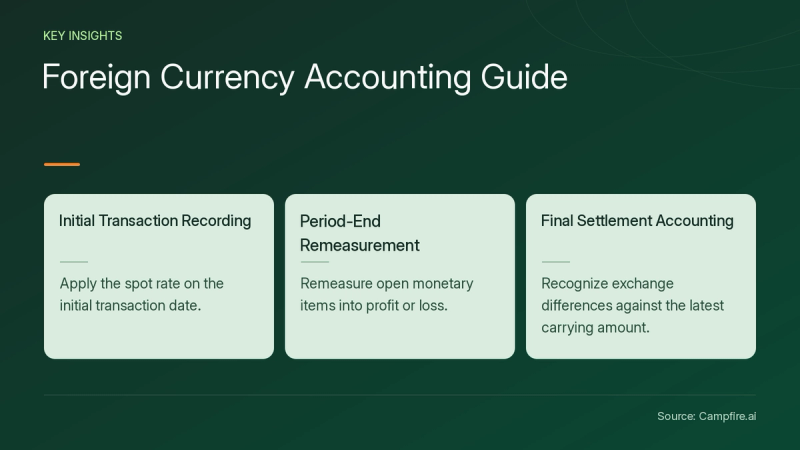
- Record a foreign currency transaction at the spot rate on the transaction date.
- Remeasure open foreign currency monetary items at each reporting date and recognize the difference in profit or loss.
- Settlement creates a final exchange difference measured against the latest carrying amount.
- Keep the rate source, currency-pair direction and reconciliation evidence for every close.
- Treat IAS 21 lack-of-exchangeability rules as an IFRS-only check, not a US GAAP rule.
What is a foreign currency transaction?
A foreign currency transaction is a sale, purchase, borrowing or other transaction denominated in a currency other than the entity's functional currency. Under ASC 830 and IAS 21, transaction accounting is separate from translating a foreign entity's statements into a reporting currency.
Which balances are remeasured at period-end?
Monetary items are remeasured at period-end, including cash and receivables or payables settled in a fixed or determinable number of currency units. Nonmonetary items, such as prepaid assets, are not subject to periodic FX revaluation.
How do you record a foreign currency payable?
Record the payable at the spot rate on the invoice date, adjust it at period-end, and record settlement at the payment-date rate. The example below is hypothetical. A USD-functional entity owes a supplier €10,000, and rates are quoted as USD per EUR.
| Stage | Rate (USD per EUR) | Journal entry | Amount (USD) | Profit or loss effect |
|---|---|---|---|---|
| Invoice recorded | Rate (USD per EUR)1.10 | Journal entryDr Expense or asset $11,000; Cr Accounts payable $11,000 | Amount (USD)11,000 | Profit or loss effectNone |
| Period-end remeasurement | Rate (USD per EUR)1.14 | Journal entryDr Foreign exchange loss $400; Cr Accounts payable $400 | Amount (USD)400 | Profit or loss effect$400 loss |
| Settlement at 1.20 (alternative) | Rate (USD per EUR)1.20 | Journal entryDr Accounts payable $11,400; Dr Foreign exchange loss $600; Cr Cash $12,000 | Amount (USD)12,000 | Profit or loss effect$600 loss at settlement |
If the invoice is paid at 1.14, cash is $11,400 and no further difference arises. The total loss in the alternative case is $1,000, which equals the change from $11,000 to $12,000.


What belongs in a foreign currency close checklist?
A close checklist should name the approved rate source, currency-pair direction, subledger-to-GL reconciliation, reversal treatment, exception owner and retained evidence. Assign each control to a named role so no balance goes unreviewed.
| Control | Owner | Evidence to retain |
|---|---|---|
| Approved rate source and date | OwnerController | Evidence to retainRate table with source and timestamp |
| Pair direction (USD per EUR) | OwnerAccounting Manager | Evidence to retainRate import log showing the quoted direction |
| Subledger-to-GL reconciliation | OwnerAccounting Manager | Evidence to retainSigned reconciliation by currency |
| Reversal of foreign accruals | OwnerAccounting Manager | Evidence to retainReversal entry linked to the original entry |
| Exception resolution | OwnerController | Evidence to retainException log with resolution and approval |
PwC's 2025 Global Treasury Survey found that 36% of exposure-capture respondents still used some manual processes. That share describes process use, not an FX error rate.
How do you resolve a close variance?
Trace the variance to the rate log, then correct the entry and retain the correction as evidence. In a hypothetical close, the subledger shows $11,400 and the GL shows $11,000. The Accounting Manager finds that the payable used the wrong rate, posts a correcting entry, and attaches the rate log. Both balances then show $11,400. Teams that use Ember AI agents for transaction matching can review proposed matches, but accountants still approve each action.


How does translation differ from remeasurement?
Remeasurement adjusts a transaction balance in the entity's own books, while translation converts a foreign entity's financial statements into the group's reporting currency. The PwC accounting guide overview draws this same distinction between transaction measurement and foreign-entity translation.
To test the boundary, trace one local balance through account mapping, translation where applicable, and group reporting. The Controller should record who owns the local close, statutory filing and tax calculations, and where the evidence for each result is stored.
Does IAS 21 change the workflow?
For IFRS reporters, IAS 21 lack-of-exchangeability amendments apply to annual reporting periods beginning on or after January 1, 2025. They address how to assess whether a currency is exchangeable, how to estimate a rate when it is not, and what to disclose. Check the IAS 21 standard text directly before applying it, because older training material may not reflect these amendments.
Conclusion
Record each foreign currency transaction at the spot rate, remeasure open monetary balances at period-end, and measure settlement against the latest carrying amount. Keep the rate source, pair direction, reconciliation and exception owner for every close. Use the IAS 21 exchangeability rules only where IFRS applies. Trace one foreign currency payable through each stage first, then get started with Campfire.
FAQ
Where do foreign currency exchange differences get recorded?
Transaction exchange differences generally go to profit or loss in the period they arise. This includes differences from period-end remeasurement and from settlement of foreign currency balances. Translation differences for foreign entities are handled separately from these transaction gains and losses.
Which rate should I use when a foreign currency transaction is first recorded?
Use the spot rate on the transaction date, taken from the rate source your accounting policy approves. Record the currency pair direction clearly, such as USD per EUR, so the rate is applied in the correct direction.
Does the IAS 21 exchangeability amendment apply under US GAAP?
No. The lack-of-exchangeability amendments are part of IAS 21 and apply to IFRS reporters. US GAAP entities follow ASC 830, so this check should be labeled as an IFRS exception in any close procedure.
Sources
- [c1] superfastcpa.com — superfastcpa.com. Accessed November 25, 2026.
- [c2] pwc.com — pwc.com. Accessed November 25, 2026.
- [c3] 4.1 Foreign currency transactions overview — viewpoint.pwc.com. Accessed November 25, 2026.