Accounting for Software Revenue Recognition: ASC 606 Guide With Examples
Listen to article
6:44
Software revenue is recognized when a company satisfies each performance obligation in a contract under ASC 606, not when it sends the invoice. Finance teams need the contract terms, standalone selling price (SSP) support and a schedule that ties each recognized dollar to a journal entry. Revenue automation for subscription and usage billing covers this flow from contract to journal entry.

Key Takeaways
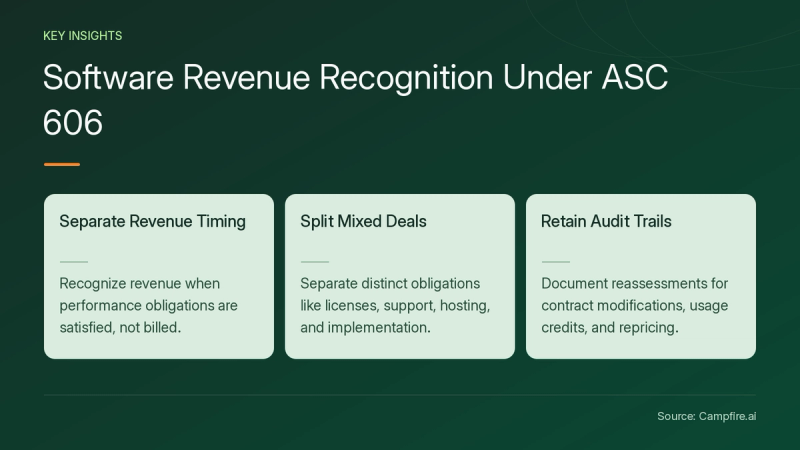
- Billing timing and revenue timing are separate. Recognize revenue as obligations are satisfied.
- Split mixed software deals into distinct obligations, such as hosted access, licenses, support and implementation.
- A prepaid annual subscription usually moves from deferred revenue to revenue as service is delivered.
- Modifications, usage credits and price changes need a documented reassessment and a retained audit trail.
What are the five ASC 606 steps for software contracts?
ASC 606 applies five steps to each software contract: identify the contract, identify performance obligations, determine the transaction price, allocate that price, and recognize revenue when each obligation is satisfied. Timing depends on the obligation. Hosted access is often recognized over time, while some on-premises licenses are recognized at a point in time.
| Step | What finance checks in a software deal | Evidence to retain |
|---|---|---|
| 1. Identify the contract | What finance checks in a software dealEnforceable terms, approvals and collectability | Evidence to retainSigned order form or master agreement |
| 2. Identify performance obligations | What finance checks in a software dealWhether hosted access, licenses, support and implementation are distinct | Evidence to retainDistinctness memo |
| 3. Determine the transaction price | What finance checks in a software dealFixed fees, usage fees, discounts and credits | Evidence to retainPricing schedule and usage terms |
| 4. Allocate the transaction price | What finance checks in a software dealRelative SSP for each obligation | Evidence to retainSSP analysis and supporting data |
| 5. Recognize revenue | What finance checks in a software dealTiming for each obligation | Evidence to retainRecognition schedule and journal entries |
Tabs.com reported that 71% of public company finance departments found contract reviews and performance obligation extraction somewhat or very difficult. Map each step to a named document before the close begins.
How do you account for a $120,000 prepaid SaaS contract?
Assume a customer prepays $120,000 for 12 months of hosted access starting January 1, with one distinct obligation and no variable fees. The team records the invoice as deferred revenue, then recognizes $10,000 each month. These assumptions are illustrative, and actual conclusions depend on contract facts and ASC 606.


| Event | Entry | Amount |
|---|---|---|
| January 1 invoice issued | EntryDebit accounts receivable, credit deferred revenue | Amount$120,000 |
| Each month of service | EntryDebit deferred revenue, credit subscription revenue | Amount$10,000 |
| March 31 balance | EntryDeferred revenue after three months | Amount$90,000 |
| December 31 balance | EntryDeferred revenue after 12 months | Amount$0 |
What should the close team reconcile each month?
The close team should reconcile the opening deferred revenue balance, plus new billings, less revenue recognized, to the closing balance in the ledger. Any difference should be explained before the schedule is approved. Keep the schedule, invoice register and journal entries as linked records.
Where do modifications and usage credits change the schedule?
A mid-contract change, such as a usage credit, requires the team to reassess the transaction price and document the revised schedule. The Manufacturer reported that identifying SSP, evaluating variable consideration and modifying existing software contracts are recurring technical accounting burdens.
Hypothetical walkthrough: in month four, the customer receives a $6,000 credit for a service failure. If the team concludes the credit reduces the remaining transaction price, the remaining $90,000 becomes $84,000 over nine months, or about $9,333 per month. The credit memo is recorded separately from the revised schedule, and the new roll-forward shows the change.


What controls should the close team document?
Document each judgment, its source data and a reviewer's approval before the schedule posts. Key controls include:
- Validate usage data against the contract's pricing tiers and cutoff dates.
- Reconcile the deferred revenue balance to the recognition schedule.
- Trace each invoice and credit memo to the general ledger.
- Have the Revenue Accounting Manager explain each change, and the Controller sign off.
RightRev describes regulatory inspectors finding deficiencies in documenting management judgment, reconciling deferred balances and tracing billing transactions to ledger entries. Core accounting supports journal entries and month-end close checklists in the same workflow.
Conclusion
Software revenue follows performance obligations, not invoice dates. Teams should split deals into obligations, build a schedule for each contract, and reconcile deferred balances every month.
Start by mapping one live contract to the five ASC 606 steps this week, then test one modification against its schedule. Teams that want the schedule, journal entries and reconciliation in one system can get started with Campfire.
FAQ
Does billing timing determine when software revenue is recognized?
No. Software revenue is recognized as performance obligations are satisfied, so an annual invoice paid upfront is usually recorded as deferred revenue and recognized over the service period.
What is the difference between deferred revenue and remaining performance obligations?
Deferred revenue is a balance sheet amount for billings or cash received before revenue is recognized. Remaining performance obligations cover contracted revenue not yet recognized, including amounts not yet invoiced.
Do usage-based fees follow the same recognition steps?
Yes, but the team must estimate variable consideration and confirm usage data before recognizing it. ASC 606 includes a constraint on variable amounts, so the team should document its estimate and the evidence behind it.