Accounting Integration Acceptance Testing: A Finance-Led Go-Live Guide
Listen to article
7:18
Accounting integration acceptance testing confirms that data moving between systems produces complete, accurate and timely ledger results before go-live. Finance owns the pass criteria, not only the technical team. The test checks journal entries, control totals, exception handling and audit evidence against expectations agreed in advance.
Teams connecting finance systems should test accounting outcomes, not just connections. Campfire describes its native integrations as connections to banking, payroll, revenue, tax and other finance systems. Whatever the platform, the acceptance test should prove the ledger results.

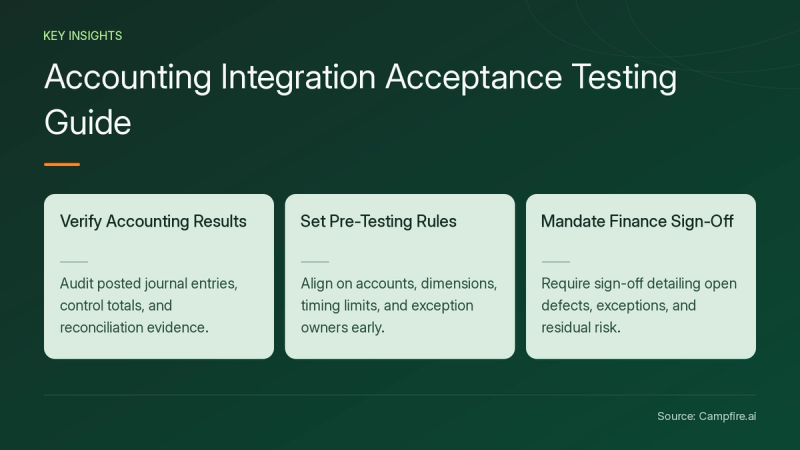
Key Takeaways
- Test accounting results, including journal entries, control totals and reconciliation evidence.
- Agree on accounts, dimensions, timing limits and exception owners before testing starts.
- Use a hypothetical invoice walkthrough to check one source event against one posted entry.
- Test duplicates, failed posts, reversals and closed periods with expected ledger outcomes.
- Require a finance sign-off that lists open defects, approved exceptions and residual risk.
How does integration acceptance testing differ from technical integration testing?
Integration acceptance testing checks whether accounting outcomes are correct, while technical integration testing checks whether messages move between systems. A technical pass does not prove a finance pass. Stoneridge Software's discussion of financial UAT notes that APIs can return a "200 Success" code while downstream accounting rules or chart-of-accounts mapping fail. Finance should therefore test the posted result, not the response code.
How do you build an acceptance matrix?
An acceptance matrix lists each test scenario with fixed input, expected ledger result, evidence, owner and pass criteria. Each row should be repeatable by a different tester.
| Scenario | Test input | Expected ledger result | Evidence to retain | Owner |
|---|---|---|---|---|
| Standard invoice | Test inputOne illustrative $1,000 invoice | Expected ledger resultAgreed debit and credit accounts with required dimensions | Evidence to retainSource record, posted entry, matching totals | OwnerAccounting Manager |
| Duplicate delivery | Test inputSame event ID sent twice | Expected ledger resultOne accounting result | Evidence to retainEvent log, ledger query, duplicate flag | OwnerFinance Systems Manager |
| Failed posting | Test inputRecord with an unmapped account | Expected ledger resultHeld exception, no partial posting | Evidence to retainException queue entry and owner assignment | OwnerAccounting Manager |
| Period close | Test inputTransaction dated in a closed period | Expected ledger resultRejected or routed to the approved period | Evidence to retainPeriod status and approval record | OwnerController |
Mapping errors are a common risk. PwC's 2026 Southeast Europe CFO survey found that 54% of finance leaders rated accounting-data standardization as moderate to none. That result is regional, so use it as a prompt to test each account and dimension mapping explicitly.
How do you test a $1,000 invoice from source to ledger?
Post one illustrative $1,000 invoice, then reconcile that single source record to one ledger entry. The walkthrough below uses hypothetical account names and amounts.


- Record the system of record, record type, direction and sync frequency.
- Send the invoice with a known event ID and confirm the agreed debit and credit accounts.
- Check that entity and dimension values match the mapping plan.
- Compare source total, interface total and ledger total. All three should be $1,000.
- Resend the same event ID and confirm there is still one accounting result.
The duplicate check should not rely on a single tool. Accounting Intelligence includes duplicate detection with review and audit trails, which can support this test. The test still needs its own pass criteria and evidence.
Which exception scenarios should acceptance tests cover?
Acceptance tests should cover exceptions that change ledger balances or audit evidence. Each exception needs a test input, an expected result and a named recovery owner.
- Failed posting and retry: confirm the record posts once after correction and leaves no partial entry.
- Reversals: confirm the reversal offsets the original amounts and dimensions.
- Foreign currency: confirm rates and rounding follow the agreed policy.
- Interrupted transfer: stop an import after its first write, replay it, and compare totals.
Mapping changes also need retesting. Implementation and Migration covers chart of accounts cleanup and reconciliation of migrated financial data, which overlaps with these mapping checks.


How do you make the go-live decision?
Go live only when every critical test passes, approved exceptions have owners and finance signs the residual risk. Technical sign-off alone is not enough.
- All critical matrix rows pass, with evidence attached.
- Source, interface and ledger totals reconcile for the test period.
- Open defects have severity ratings and approved workarounds.
- The Controller signs accounting results and the Finance Systems Manager signs technical evidence.
Testing often misses business readiness. Original Software's benchmark reported that 29% of respondents said software handed to business end users for UAT was severely substandard or lacked functional parity with everyday accounting operations. Retest any mapping, integration or period-setting change before the next close.
Conclusion
Accounting integration acceptance testing proves accounting outcomes before a system goes live. Use a matrix with fixed inputs, check the invoice walkthrough and exception cases, and require finance sign-off on residual risk. Each test should name an owner and retain evidence for audit review. Finance teams that want a practical starting point can get started with Campfire.
FAQ
What is the difference between integration testing and UAT?
Integration testing checks whether systems exchange data correctly, while UAT checks whether finance users accept the business result. For accounting integrations, UAT should verify journal entries, control totals, exceptions and audit evidence. Both tests are needed before go-live.
How many test transactions are enough?
Test enough transactions to cover each account mapping, exception type and peak-volume pattern in the plan. The number depends on the integration's scope and risk, so the team should document the reason for its sample. Pass criteria should be set before testing begins.
What should a finance sign-off include?
A finance sign-off should list the tests run, the evidence retained, open defects with severity ratings, approved exceptions and residual risk. It should name the people who approve accounting results and technical evidence. The sign-off should be dated and tied to the tested version.
When should acceptance tests be repeated?
Repeat acceptance tests after any change to mappings, integration logic, chart of accounts or period settings. Rerun the critical matrix rows and any exception tests affected by the change. Retest before the next close so that changes do not reach the ledger untested.