Accounting Software API Reconciliation Controls: A Controller's Guide
Listen to article
8:50
Accounting software API reconciliation controls are documented checks that prove synced records are complete, accurate and posted to the ledger. Each control names a source population, a comparison, an owner, evidence and an exception route. A clean match alone does not show that nothing is missing.

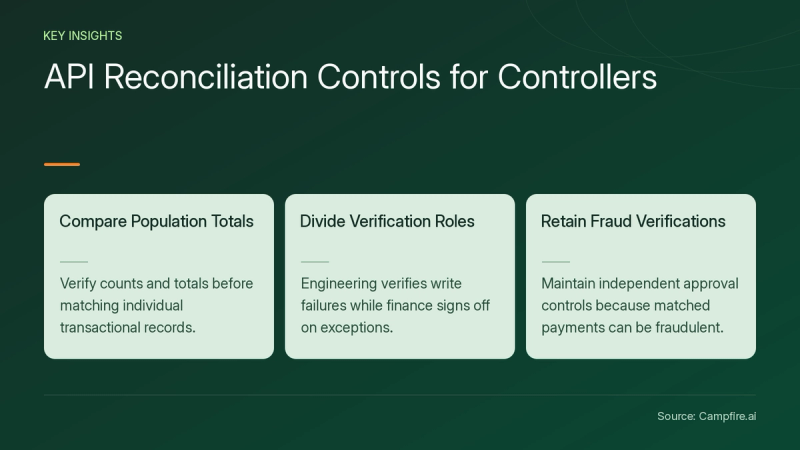
Key Takeaways
- Compare source populations, counts and amounts before matching individual records.
- Assign engineering to verify failed writes and finance to review open exceptions and sign-off.
- Check the destination state before retrying an uncertain write.
- A matched payment can still be fraudulent, so keep independent verification and approval controls.
What are accounting software API reconciliation controls?
Accounting software API reconciliation controls confirm that data moved between systems completely and correctly. They cover source extraction, transformation, posting and the bank or processor comparison. A control is useful only when it has a defined owner, frequency, evidence and escalation path.
Automated matching handles volume but does not replace these checks. Campfire's Accounting Intelligence offers bank matching, duplicate detection and review and audit trails. Teams still need to define what each match must prove.
How do you prove source population completeness?
You prove completeness by comparing an independent count and control total from the source system with what reached the ledger. Match populations before matching individual transactions. Record the cutoff date, record count and amount total for each batch.
The need is practical. In a 2025 revenue-accounting survey, 28% of respondents selected cross-system data reconciliation as a manual task they wanted to eliminate.


- Record count per source extract matches the count received by the integration.
- Amount control total matches within a documented tolerance.
- Cutoff date and time zone are recorded for each batch.
- Late-arriving records reopen the batch or roll forward with a log entry.
How do you reconcile a processor payout to bank and GL?
Reconcile in three steps: gross transactions to processor settlement, settlement to bank deposit, then bank deposit to GL postings. The example below is hypothetical and shows where an open exception appears.
| Stage | Amount | Evidence | Status |
|---|---|---|---|
| Gross card sales | Amount$1,000 | EvidenceProcessor transaction report | StatusMatched to orders |
| Processor fees | Amount-$30 | EvidenceProcessor fee detail | StatusPosted to fee expense |
| Refunds | Amount-$20 | EvidenceRefund report | StatusPosted as revenue contra |
| Expected net deposit | Amount$950 | EvidenceSettlement report | StatusExpected Day 2 |
| Bank deposit received Day 2 | Amount$925 | EvidenceBank statement | Status$25 variance |
| Open exception | Amount$25 | EvidenceException log with aging | StatusOwner: accounting operations; reviewed before close |
Note: amounts are illustrative, not benchmark data.
How should teams recover from failed API writes?
Engineering verifies the destination state before any retry, and finance decides how open items close. Never repeat a write blindly, because a timed-out call may already have posted. Xero’s API limits documentation specifies 60 calls per minute per tenant. When a minute or daily limit triggers a 429 response, use the Retry-After header to determine when to send the next request.
Campfire’s Populi case study describes how intermittent syncing in its former system led to manual reconciliation. Populi later built a custom integration to send invoices to the Campfire ledger. In acceptance testing, replay a failed invoice batch and trace each source invoice to one destination record or a documented exception.


| Failure | Engineering check | Finance check before close |
|---|---|---|
| Timed-out write | Engineering checkQuery the destination for the record ID before retrying | Finance check before closeConfirm no duplicate posting in the GL |
| Missed webhook | Engineering checkRun a scheduled change-data-capture pull for the window | Finance check before closeCompare period counts to the source |
| Stale update | Engineering checkCompare source version to destination version | Finance check before closeReview aged items |
| Rate limit (429) | Engineering checkBack off per Retry-After and resume from checkpoint | Finance check before closeConfirm the batch completed before cutoff |
What should a control matrix include?
A control matrix lists each risk, control, owner, frequency, evidence and test. Use one row per stage from source extraction to GL verification. In a 2025 finance-leader survey, only 12% of respondents described their monthly or quarterly close as completely automated, so documented evidence matters.
Campfire's Core Accounting page covers general ledger, journal entries and month-end close checklists. Link those checklists to each matrix row so close status and reconciliation status stay visible together.
| Stage | Risk | Owner (role) | Frequency | Evidence | Test |
|---|---|---|---|---|---|
| Source extraction | RiskMissing records | Owner (role)Integration engineer | FrequencyEach run | EvidenceRecord count and control total | TestCompare to source report |
| Transformation | RiskMapping or rounding error | Owner (role)Accounting operations lead | FrequencyEach run | EvidenceMapping version and sample trace | TestTrace one record end to end |
| Posting | RiskDuplicate or failed write | Owner (role)Integration engineer | FrequencyEach run | EvidenceDestination ID log | TestCheck for duplicate IDs |
| Bank and processor match | RiskUnrecorded deposit | Owner (role)Accounting operations lead | FrequencyDaily | EvidenceBank statement and exception log | TestRe-perform match on a sample |
| Close review | RiskUnresolved items | Owner (role)Controller | FrequencyMonthly or quarterly | EvidenceAging report and sign-off | TestVerify sign-off before period lock |
Why does a matched payment still need fraud controls?
A match does not establish that a payment was legitimate. AFP's 2026 survey of 465 corporate professionals found that 76% of organizations experienced attempted or actual payments fraud in 2025.
- Verify bank detail changes by call-back to a known contact, not someone in payment entry.
- Require dual approval for payments above a set threshold.
- Review new payee records independently of the reconciliation team.
Conclusion
Strong API reconciliation controls compare complete populations, document every exception and separate engineering recovery from finance review. Start by mapping one settlement flow from processor to bank to GL, then extend the matrix to each integration. To test these controls against your own close data, get started with Campfire.
FAQ
What is the difference between matching and reconciliation controls?
Matching pairs individual records, while reconciliation controls prove that populations, totals and cutoffs are complete and correctly posted. A control also needs an owner, evidence and an escalation path. Matching is one step inside that process.
Who should own API reconciliation controls?
Accounting operations or the controller should own review and sign-off, while integration engineers own extraction, posting and failed-write recovery. Split ownership so the team that builds the sync does not approve its completeness alone. Document each role in the control matrix.
How often should these controls run?
Run completeness checks on every batch and bank or processor matches daily when volume is high. Close-period controls should run before the period lock date. Set frequency by risk and volume, and record the reason for each choice.
Sources
- Xero’s API limits documentation — developer.xero.com.