Accounting Software Audit Evidence Export: A Controlled Workflow
Listen to article
7:11
An accounting software audit evidence export is a dated extract of ledgers, journal entries, reconciliations and supporting documents that an auditor can test. A successful export does not prove completeness on its own. Finance teams need a defined scope, a reconciliation to the trial balance, and a documented review before they send anything to the auditor.
Start with the core records in general ledger and journal entry records in Core Accounting, since these form the population most requests test.

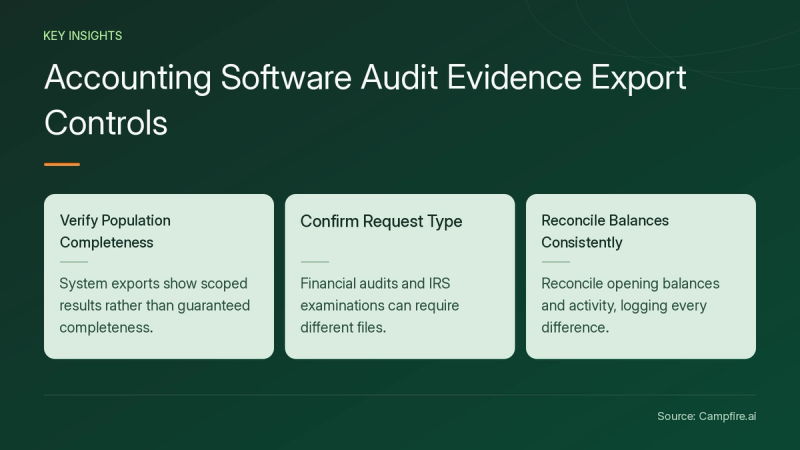
Key Takeaways
- An export shows what the system returned for the scope you selected, not that the population is complete.
- Confirm the request type first: a financial-statement audit request and an IRS examination request can need different files.
- Reconcile opening balances plus journal activity to closing trial balances by account and entity, and log every difference.
- Record permissions, filters, extraction time and reviewer approval so the package can be rebuilt later.
What evidence should an audit export include?
Most financial-statement requests need the trial balance, the journal entry population, account reconciliations, manual adjustments and the supporting documents linked to those entries. Confirm the exact list with the auditor before extracting data.
| Evidence item | Purpose | Basic check |
|---|---|---|
| Opening and closing trial balance | PurposeTies balances to the financial statements | Basic checkTotals agree to the reporting package |
| Journal entry population | PurposeTests postings and cutoff | Basic checkLine count and value agree to system control totals |
| Account reconciliations | PurposeSupports reported balances | Basic checkPreparer and reviewer sign-off recorded |
| Manual adjustments | PurposeShows post-close changes | Basic checkEach adjustment has an approver and a reason |
| Supporting documents | PurposeCorroborates individual entries | Basic checkEach link points to the correct entry |
How do you tell which export a request needs?
Separate financial-statement requests from tax examination requests before preparing any file. The IRS FAQ on electronic accounting software records distinguishes original backup files from Excel reports and notes that examiners may request records for the month before and after the tax year to test cutoff.
Snapshot, audit trail or original backup?
- Snapshot: a point-in-time extract of active records, useful for reconciliations.
- Audit trail: the history of changes, approvals and deleted items.
- Original backup: the full company file, which the IRS treats differently from Excel reports.
Agree the format and period with the requester in writing. The right artifact depends on the request, not on the label "audit-ready."


How do you prove export scope and completeness?
Compare the exported entity and account list against the source scope you are authorized to share, then record every exclusion. Datarails states that its audit package omits accounts the exporting user cannot access, even when other accounts in the same entity are included, so a successful export does not confirm completeness. Protiviti noted in 2021 that scrutiny of information produced by the entity was pushing teams to log and prove the completeness and accuracy of underlying system exports.
- Pull the authorized entity and account list from the source system.
- Compare it with the entities and accounts in the export.
- Log any account the exporting user could not access, with the reason.
- Record the extraction timestamp, filters and export owner.
How do you reconcile the export to the trial balance?
Reconcile opening balance plus journal activity to the closing trial balance for each account and entity. Investigate every difference and document it before delivery. The figures below are illustrative, not customer data.
| Entity | Account | Opening | Journal activity | Calculated close | Trial balance close | Difference | Status |
|---|---|---|---|---|---|---|---|
| Entity A | Account1000 Cash | Opening50,000 | Journal activity12,000 | Calculated close62,000 | Trial balance close62,000 | Difference0 | StatusCleared |
| Entity B | Account2100 Accrued liabilities | Opening-18,000 | Journal activity-4,500 | Calculated close-22,500 | Trial balance close-22,000 | Difference500 | StatusInvestigate |
For each open difference, log the cause, the owner, the resolution date and the reviewer who approved the final treatment. Auditors decide whether any further evidence is needed.


How do you handle late postings and versions?
Keep a dated snapshot for each extract and compare successive versions by account and entity. Traack.ai reported that 29% of respondents still depend heavily on manual Excel exports when assembling audit evidence. Versioned snapshots reduce that dependence by showing exactly what changed after a late posting.
Use transaction review and audit trails in Accounting Intelligence to trace categorizations and approvals back to the original entry during this comparison.
What should a software evaluation checklist cover?
- Whether exports carry entity, account, period and timestamp metadata.
- How the system handles restricted accounts and deleted records.
- Whether journal entries link to approvals and supporting documents.
- Whether exports remain usable outside the platform, such as in Excel with preserved references.
Conclusion
Key takeaways: confirm the request type, reconcile every export to the trial balance, record exclusions and versions, and obtain reviewer approval before delivery. Run one recent close package through this checklist first, then get started with Campfire to see how these controls fit your close process.
FAQ
Is a one-click audit package enough for an auditor?
No. A one-click package shows what the system returned for the selected scope, but it does not prove that the requested population is complete. Reconcile it to the trial balance, confirm account and entity coverage, and document any exclusions before sending it.
Does an IRS examination need the same export as a financial-statement audit?
Not necessarily. IRS examinations may request original backup files or specific periods, while financial-statement requests usually focus on trial balances, journals and reconciliations. Confirm the format, period and scope with the requester before preparing the file.
What should an exception log include?
An exception log should include the entity, account, amount, cause, owner, resolution date and reviewer approval for each difference. Keep resolved and open items in the same log so the auditor can trace how each one was closed.
Who should approve an audit evidence export?
A reviewer who did not prepare the export should approve it. The approval should confirm the scope, reconciliation results, exclusions and extraction timestamp. The auditor then decides whether additional evidence is required.
Sources
- [c1] Use of electronic accounting software records: Frequently asked questions and answers | Internal Revenue Service — irs.gov. Accessed November 27, 2026.