Accounting Software Business Continuity Requirements for Finance Teams
Listen to article
7:42
Accounting software business continuity requirements are the recovery targets, manual fallbacks, approval controls and data checks a finance team needs when its system is unavailable. They answer three questions: which processes must keep running, how quickly they must return, and how the team proves the books are accurate afterward. Teams can map these needs against their month-end close checklists in Core Accounting.

Key Takeaways
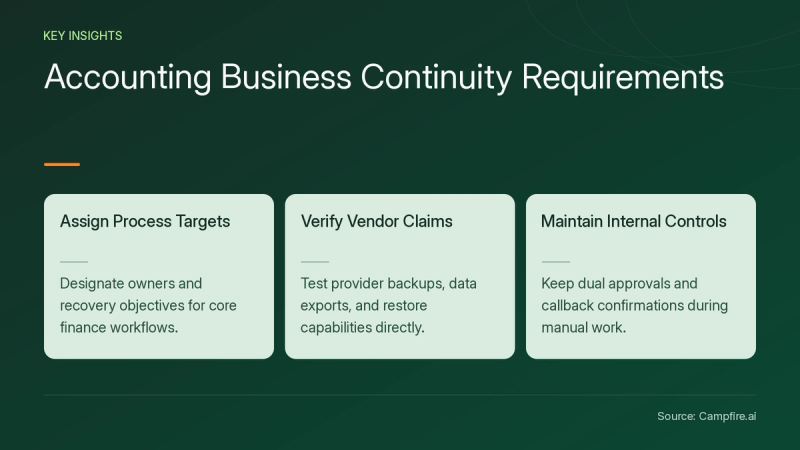
- Assign an owner and a recovery target to each finance process: payroll, accounts payable, receivables and close.
- Treat vendor recovery claims as questions to verify, including backup scope, exports and restore tests.
- Keep dual approval and callback verification in place during manual operations.
- Reconcile offline entries, bank activity and subledgers before the controller approves return to normal posting.
What are the core accounting software continuity requirements?
Core requirements are a named owner for each finance process, recovery targets, a tested manual fallback, vendor recovery evidence and a reconciliation step before normal posting resumes. Few organizations have written these down. In a 2024 U.S. Chamber Foundation study, 94% of surveyed small and midsize businesses believed they were prepared for disasters, but only 26% had a disaster plan. That is a general business measure, not an accounting-software finding.
A practical requirements list includes:
- A process inventory with named owners
- Recovery time objectives (RTO) and recovery point objectives (RPO) for each process
- Maximum manual operating periods for each fallback
- Vendor evidence for backups, exports and restore testing
- Approval and reconciliation steps for return to service
Which requirements are legal and which are recommended?
Legal obligations depend on the business, its sector and its jurisdiction, and general accounting software does not carry a universal rule for a standalone continuity plan. Tax professionals have a specific duty: the IRS's 2026 guidance states they need a written information security plan. That is a security obligation, separate from a continuity plan. Customer contracts can add recovery commitments, so confirm applicability with counsel.
How should finance teams set recovery targets by process?
Set targets by process, using the deadline each process must meet and the longest acceptable delay. The table below shows illustrative planning examples, not industry benchmarks.


| Process | Illustrative RTO | Illustrative RPO | Manual fallback limit |
|---|---|---|---|
| Payroll | Illustrative RTOBefore the next pay-date cutoff | Illustrative RPOLast approved payroll batch | Manual fallback limitOne pay cycle |
| Accounts payable | Illustrative RTOWithin 1 business day | Illustrative RPOLast posted payment run | Manual fallback limitOnly payments due within the window |
| Accounts receivable | Illustrative RTOWithin 2 business days | Illustrative RPOLast cash application | Manual fallback limitManual customer statements and bank tracking |
| Month-end close | Illustrative RTOBefore the close deadline | Illustrative RPOLast locked period | Manual fallback limitClose checklist with a manual journal log |
Validate each target against vendor recovery terms and your real dependencies. Targets that exceed what a vendor can provide need a manual workaround.
How do you keep payments safe during a manual period?
Keep dual approval, callback verification and controlled bank-detail changes in place even when the system is down. The FBI's 2025 report recorded approximately $3.05 billion in business email compromise losses, a cross-industry total. Manual periods are a time when impersonation requests are more likely to succeed.
- Verify every bank-detail change by calling a number already on file.
- Require two approvers for payment runs above a set threshold.
- Record manual payments in a numbered offline register.
- Check for duplicate invoices before release.
After systems return, Accounting Intelligence supports duplicate detection and bank matching, with review and audit trails.
What should a vendor continuity scorecard cover?
A vendor scorecard should cover backup scope, customer-accessible exports, restore testing, identity dependencies and contract commitments. Request written evidence for each area rather than relying on a general statement of resilience.


| Area | Question to ask | Evidence to request |
|---|---|---|
| Backup scope | Question to askWhich data is backed up, and how often? | Evidence to requestWritten backup scope and frequency |
| Customer exports | Question to askCan we export ledgers, subledgers and reports ourselves? | Evidence to requestSample export files |
| Restore testing | Question to askWhen was the last restore test, and what was recovered? | Evidence to requestTest summary with dates |
| Identity dependencies | Question to askWhat happens if single sign-on fails? | Evidence to requestDocumented access fallback |
| Contract commitments | Question to askWhich uptime, support and recovery terms are written? | Evidence to requestService agreement and recovery terms |
Cloud hosting does not guarantee recovery. Confirm what the vendor restores and what your team must retain.
How do you reconcile after an outage?
Reconcile offline entries, bank activity and subledgers against the general ledger, then obtain controller sign-off before normal posting resumes. Use this sequence:
- Freeze the affected period and record every offline entry in the transaction log.
- Compare bank activity with logged payments and receipts.
- Check for duplicate payments and double-posted entries.
- Reconcile subledgers to the general ledger.
- Obtain controller sign-off before normal posting resumes.
Partial failures also need planning. A review of a partial Sage Intacct outage reported that financial-report exports to Excel were affected. Continuity plans should list critical reports, not only log-in access. Public guides from Xero, Wolters Kluwer and Total Cover IT cover planning well but generally stop short of this transaction-level recovery step.
Conclusion
Strong continuity requirements give each finance process an owner, a recovery target, a manual fallback and a reconciliation step. Review the matrix quarterly and after every vendor change. Start by mapping one critical process this week, then get started with Campfire to see how an AI-native ERP supports your close workflow.
FAQ
What is the difference between RTO and RPO?
RTO is the maximum time a process can stay unavailable before recovery is required. RPO is the maximum amount of data loss a process can tolerate, measured as the time since the last usable copy. Finance teams should set both for each process, because a fast restore that loses the last payment run still creates work.
Does cloud accounting software guarantee business continuity?
No. Cloud hosting does not by itself guarantee recovery, and vendor claims about no data loss need checking against backup scope, service terms and restore evidence. Buyers should request exports, restore test results and written recovery commitments before relying on any vendor.
Should a small finance team write a business continuity plan?
A short written plan is practical for most finance teams, even when no law requires one for general accounting software. It should name owners, list recovery targets, describe manual fallbacks and set reconciliation steps. Tax professionals may face a separate written security plan requirement under IRS guidance.