Financial Close Platforms With Clear Pricing: How to Verify Them
Listen to article
11:44
Yes, but you have to verify both the pricing and the dependability yourself. Some vendors publish plan prices, and others price by quote. A published price does not prove a platform can run your close reliably, and neither does a polished demo. The dependable choice is the platform that prices your exact scope in writing and passes a close rehearsal on your own data before you sign.

Key Takeaways
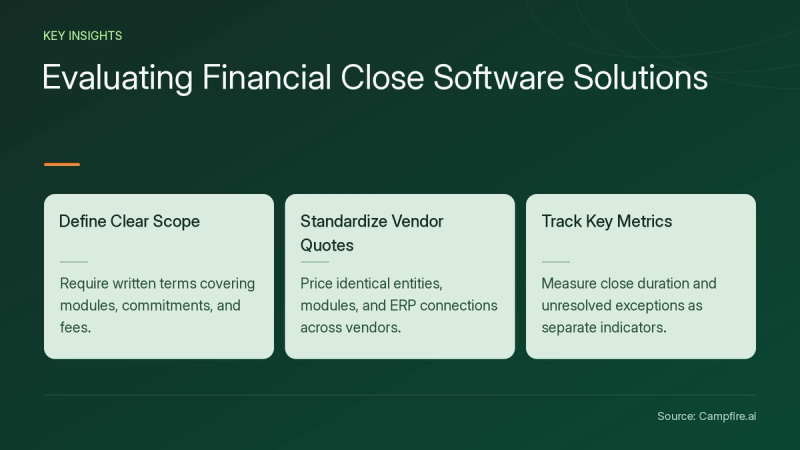
- Clear pricing is a written scope. It names the billing unit, minimum commitment, included modules, implementation fees and renewal terms. A monthly number alone does not meet that standard.
- Ask every vendor to price the same entities, modules and ERP connections so you can compare quotes directly.
- Test dependability with failure cases: duplicate imports, missing records, changed mappings, failed refreshes and attempted self-approval.
- Track close duration and unresolved exceptions as separate metrics. A faster close that leaves open items has not improved.
- Before you compare prices, decide whether you need a close add-on, a consolidation layer or a different core ledger.
What Does Clear Pricing Mean for a Financial Close Platform?
Clear pricing means you can calculate the full cost of your specific scope before you sign. Vendors use different pricing units, such as users, entities, connected clients, modules or flat rates. Quotes are only comparable when every vendor prices the same entities, modules and ERP connections.
Use this checklist to judge whether a quote is clear:
| Pricing element | What to ask for in writing | Why it matters |
|---|---|---|
| Billing unit | What to ask for in writingPer user, per entity, per client, per module or flat rate | Why it mattersEach unit grows at a different rate as the company scales |
| Minimum commitment | What to ask for in writingMinimum seats, minimum term and payment schedule | Why it mattersA low unit price can still carry a high annual floor |
| Included scope | What to ask for in writingNamed modules, entities, currencies and integrations | Why it mattersReconciliation, consolidation and reporting may be packaged separately |
| Buyer segment | What to ask for in writingWhether the plan applies to internal finance teams or to accounting firms | Why it mattersA plan published for accounting firms may not apply to a corporate deployment |
| Implementation | What to ask for in writingFixed fee or estimate, partner costs and data migration | Why it mattersServices can add substantially to first-year cost |
| Renewal and exit | What to ask for in writingRenewal price caps, expansion pricing and data export terms | Why it mattersThese determine whether the price stays predictable after year one |
How Do You Build a Three-Year Total Cost Estimate?
Add subscription, implementation and internal labor over three years, then run the total against a growth scenario. The worksheet below is a hypothetical template. Fill each line from the vendor's written quote and your own staffing data, not from marketing pages.
| Cost line | Year 1 | Years 2-3 | Source of the number |
|---|---|---|---|
| Subscription | Year 1Units × price, or the minimum floor if that is higher | Years 2-3Renewal cap plus expected growth | Source of the numberSigned order form |
| Implementation and migration | Year 1Vendor and partner fees | Years 2-3Usually none unless you add entities or modules | Source of the numberStatement of work |
| Internal project labor | Year 1Hours × loaded rate for mapping, testing and training | Years 2-3Ongoing administration hours | Source of the numberYour time tracking |
| Parallel running | Year 1Extra hours while the old and new processes run side by side | Years 2-3None | Source of the numberPilot plan |
| Integration upkeep | Year 1Connector fees or middleware | Years 2-3Maintenance hours and connector fees | Source of the numberIT owner estimate |
| Growth scenario | Year 1N/A | Years 2-3Re-price with new entities, users or currencies | Source of the numberVendor's written expansion terms |
Integration upkeep is often underestimated. List every bank, billing, payroll and HRIS feed the close depends on, and ask who owns each connector. For example, Campfire lists native integrations for banks, billing systems, HRIS and payment processors. Whichever vendor you evaluate, confirm which connectors are included in the quote and which cost extra.
Track the hours a platform frees up separately from the cash it saves. Released capacity has value for analysis work, but it lowers cost only if spending actually changes.


How Can You Test Whether a Close Platform Is Dependable?
Run a close rehearsal on a prior period's real data and check how the platform handles failures as well as normal processing. Every test should produce the expected result and leave audit evidence that a reviewer can check.
| Test | Expected result | Owner | Evidence to keep |
|---|---|---|---|
| Duplicate import | Expected resultThe duplicate is flagged and never posted twice | OwnerAccounting manager | Evidence to keepException log entry |
| Missing source record | Expected resultSource totals fail to tie and an alert is raised | OwnerSystems owner | Evidence to keepSource-to-GL tie-out report |
| Changed account mapping | Expected resultThe change is logged with the user and a timestamp | OwnerController | Evidence to keepAudit trail export |
| Failed data refresh | Expected resultThe failure is visible and recovers without manual re-keying | OwnerSystems owner | Evidence to keepRecovery steps and timing |
| Intercompany mismatch | Expected resultThe mismatch is surfaced before consolidation | OwnerSenior accountant | Evidence to keepMismatch report |
| Attempted self-approval | Expected resultThe system blocks a preparer from approving their own work | OwnerController | Evidence to keepPermission denial record |
What does a good exception workflow look like?
A good exception workflow gives every unmatched item an owner, supporting evidence, an approval and a final disposition. In a hypothetical example, a $4,200 bank deposit has no matching invoice. A preparer is assigned the item and attaches the remittance detail. A reviewer then approves either a cash application or a suspense entry, and the platform records each step.
Set a go/no-go rule before the pilot starts. One example: no unresolved exceptions older than the close deadline, and every test above passed with evidence.
Which Type of Close Platform Fits Your Scope?
The right type of platform depends on where your close actually breaks: task coordination, consolidation or the ledger itself. Buy for that gap. A tool layered on top of a weak ledger adds another integration your team has to maintain.


| Approach | Best fit | Pricing questions to ask |
|---|---|---|
| Close management add-on | Best fitA stable ERP that needs checklists, reconciliations and sign-offs | Pricing questions to askIs it priced per user or per entity? Are reconciliation and journal modules extra? |
| Consolidation or EPM suite | Best fitComplex multi-entity groups with eliminations and planning needs | Pricing questions to askWhat are the seat minimums, the term length and the partner implementation fees? |
| AI-native ERP with built-in close | Best fitTeams replacing a ledger that lacks close, consolidation and reporting | Pricing questions to askWhat do migration, integrations and entity growth cost? |
Disclosure: Campfire publishes this article, and its product follows the third approach. Campfire's AI-powered general ledger with multi-entity consolidation covers the following:
- Real-time consolidation across entities and currencies
- Custom reporting
- Close checklists that agents create and assign
- Ember AI, which can draft journal entries, run flux analysis and flag missing accruals
The same page states that Campfire is SOC 1 and SOC 2 certified, with audit trails and controls for SOX compliance and more than 1,200 granular permissions. Pricing is not documented in the supplied sources, so request a written quote scoped to your entities.
That page also quotes Brian Lese, Head of Finance at TwelveLabs: "We're able to close our books in half the time without adding headcount." That is one published customer's experience, not a guarantee, so verify any result in your own pilot.
What Should You Measure During a Pilot?
Measure the quality and effort of the close separately from its speed. Record a baseline from your current process, then compare the pilot against it.
- Close duration: calendar days from the trial balance to approved statements.
- Unresolved exceptions: the count and age of open items at sign-off.
- Preparation hours: time spent building reconciliations and entries.
- Review and rework hours: automation can move effort into review instead of removing it.
- Tie-out accuracy: source totals compared with general ledger totals for every connected system.
Conclusion
Dependable close platforms with clear pricing exist, but you establish both qualities during procurement, not from vendor claims. Get a written scope that names the billing unit, minimums, modules, implementation and renewal terms. Build a three-year cost estimate that includes your team's own hours. Run a close rehearsal with failure tests, named owners and retained evidence, and track close duration and unresolved exceptions separately. If your gaps span the ledger, consolidation and close together, scope an AI-native ERP alongside add-on tools. When you are ready to price and pilot one on your own data, get started with Campfire.
FAQ
Do financial close software vendors publish their prices?
Some vendors publish plan prices and others price only by quote. A public list price still needs checking: confirm the billing unit, minimum commitment, included modules and eligible buyer segment in writing, because a published plan may not cover your scope.
Why do quotes for close software vary so much?
Quotes vary because vendors price on different units, such as users, entities, modules or transaction volume, and they bundle different services. To compare quotes fairly, give every vendor the same entities, currencies, ERP connections and modules, and ask each one to itemize subscription, implementation and renewal terms.
How do I know a close platform is dependable before buying?
Run a close rehearsal on a prior period's data and check how the platform handles duplicate imports, missing records, changed mappings, failed refreshes, intercompany mismatches and attempted self-approval. A platform is dependable for your team when each test produces the expected result and leaves audit evidence a reviewer can check.
Is a faster close the best measure of success?
No. Speed is one measure, and it should be tracked alongside unresolved exceptions, review and rework hours, and source-to-ledger tie-out accuracy. A close that finishes sooner but leaves open items or adds review work has not improved, so set acceptance criteria for quality as well as duration.