Revenue Automation Tools With Flexible Contract Management
Listen to article
6:53
Evaluate revenue automation tools by following a changing customer contract from its source record to a proposed schedule, an approval and the resulting invoice or journal output. Campfire provides one documented example below. Give every provider the same amendment and expected results so your team can evaluate the workflow it actually demonstrates.
Start with the handoff that creates work for your team: an upsell, a changed service date, a usage adjustment or a cancellation. Write down who owns the contract terms and who approves the resulting billing and accounting changes before you select a pilot.

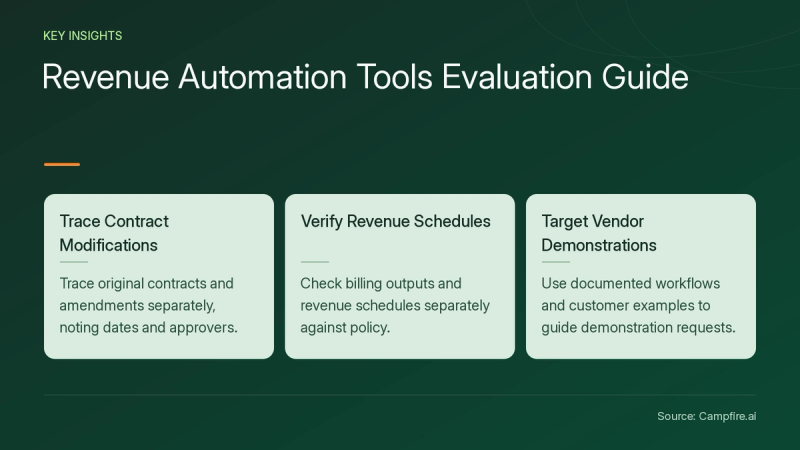
Key Takeaways
- Trace the original contract and its amendment separately, including the effective date and approving role.
- Check billing output and revenue schedules separately against the policy supplied for your sample.
- Use documented product workflows and attributed customer examples to decide what to ask the provider to demonstrate.
- Keep the inputs, approval history and output references so another reviewer can repeat the test.
What does flexible contract management need to demonstrate?
Choose the contract changes your team encounters and describe the desired result for each. An amendment should be distinguishable from the original record in your test evidence. Ask the presenter to show which fields changed, when the change takes effect and which person can accept it. Record any configuration needed to produce that result.
Ask to see how the agreed change reaches the billing output and the revenue schedule. Have your reviewer compare each with the sample policy rather than treating the invoice amount as the recognition calculation. Include a held or disputed amendment so the provider demonstrates what happens before the owner resolves it.
Which Campfire workflows are documented?
Campfire’s Revenue Automation page describes contract modifications, upsell and downsell management, and standalone selling price handling. It also describes tracking changes to terms, pricing and dates with timestamps and user attribution. Use those documented capabilities to request a demonstration of your own amendment, then inspect the resulting change history.
Ask the presenter to identify the proposed billing and accounting outputs before any approval or posting. Specify the roles your team intends to use and have those roles perform the sample. Keep the demonstrated permission and approval decisions with the run evidence.


What can a real customer workflow help you test?
In Campfire’s published Coder customer story, Controller Daniel deCoen describes a Salesforce-to-revenue workflow. The story says closed-won deals generate deferred and recognized revenue schedules ready for approval. It also describes keeping revenue and billing synced with the originating Salesforce contract as invoices are issued and paid.
Translate that attributed example into an acceptance test for your team. Bring one fictional closed-won contract and an amendment. Ask the presenter to show the originating record, proposed schedules, approval decision and invoice references. Have another participant follow those references back to the contract and explain which version produced each output.
How can you test an amendment with known results?
Use this fictional billing-only example. Set the base charge for one sample period to $1,000. Define an approved add-on of two units at $100 each, effective at the start of that period. Under these sample billing rules, the add-on is $200 and the expected revised invoice is $1,200. Supply a separate revenue policy for the presenter to use when preparing a recognition schedule.


| Sample case | Expected result under the supplied test rules | Evidence to keep |
|---|---|---|
| Load the base contract | Expected result under the supplied test rulesThe sample billing output is $1,000 | Evidence to keepSource contract ID, version and period |
| Apply the approved amendment | Expected result under the supplied test rulesThe $200 add-on appears once and the revised invoice totals $1,200 | Evidence to keepAmendment ID, effective date, approver and invoice reference |
| Submit an unapproved change | Expected result under the supplied test rulesFor this pilot, the change remains held and does not alter the accepted invoice | Evidence to keepException status and assigned owner |
| Replay the approved amendment | Expected result under the supplied test rulesNo second add-on or duplicate invoice is created | Evidence to keepRun history and unchanged invoice total |
| Inspect the proposed revenue schedule | Expected result under the supplied test rulesThe reviewer can compare it with the separate policy supplied for the test | Evidence to keepSchedule version, policy reference and approval decision |
Save the expected billing calculations before the demonstration. If a date, rate or mapping differs from your worksheet, record the difference and who resolves it. Ask a second participant to repeat the same inputs before your team accepts the pilot.
What should you verify before implementation?
Ask which system owns each contract field, how failed updates return to the queue and who can approve a correction. Have the provider identify the integrations used in the demonstration and the work needed to repeat the workflow with your chosen systems. Request an estimate covering setup, imports, support and changes to the agreed scope.
For related reading when defining the ledger endpoint and adjacent automation, see Campfire’s Core Accounting overview and Accounting Intelligence overview. Keep those scope discussions separate from the results your presenter demonstrated.
Conclusion
Choose a small contract test with an amendment, a held item and expected billing calculations. Evaluate the proposed schedule against your supplied policy and keep the approval and output references. Bring the same contract and acceptance checks when you get started with Campfire.
FAQ
How can we evaluate a tool’s contract flexibility?
Give the provider a base contract, an amendment and your desired approval rules. Ask it to demonstrate both an accepted change and a held exception, then keep the resulting version and output references.
Should the invoice and revenue schedule have the same expected result?
Specify them separately in your pilot. The fictional example above defines billing arithmetic only. Give the presenter the revenue policy your reviewer will use to evaluate the proposed recognition schedule.
What should another reviewer be able to reproduce?
The reviewer should be able to identify the original contract, amendment, effective date and approval decision in your saved test evidence. Ask them to rerun the inputs and compare the outputs with your worksheet.