Secure AI for Enterprise Finance: Controls to Verify
Listen to article
6:25
Evaluate AI platforms for enterprise finance by testing the data each connection can access, the source records behind an answer and the approval path for a proposed change. Use current product and integration documentation to define the test. Campfire’s documented workflows below provide one example you can ask a provider to demonstrate with a fictional ledger.
Start with one finance task and the roles that will use it. Write down the approved data, expected answer and actions the presenter is allowed to take before connecting the test environment.

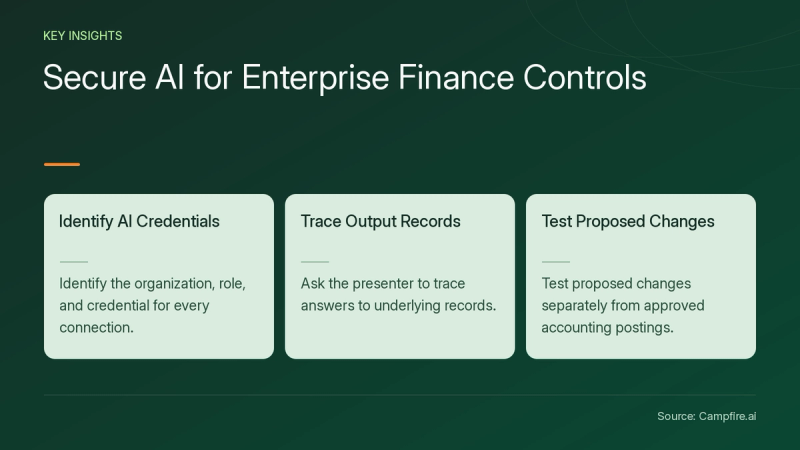
Key Takeaways
- Identify the organization, role and credential used by each AI connection.
- Ask the presenter to trace an answer to its underlying records.
- Test a proposed change separately from an approved posting.
- Keep the settings, output references and action history so your reviewer can repeat the demonstration.
Which finance workflow should you evaluate first?
Choose a task with known inputs and an output your team can calculate independently. For an initial demonstration, ask for an expense total and the records that explain it. Define a separate test for proposing a journal entry, including who is allowed to approve it and what evidence the reviewer needs before posting.
Ask the provider to identify the application, integration and credential involved in each step. Record which parts of the demonstration use the proposed production configuration and which require additional setup. Have the intended finance role repeat the task rather than relying only on a presenter’s administrator account.
What does Campfire document about answer and action traceability?
Campfire’s Ember page says responses link to source GL accounts, transactions and documents. The page also describes agent actions as logged, attributed and reviewable. Use these documented capabilities to request an expense-answer walkthrough and an inspection of the corresponding action history.
Ask the presenter to open the supporting records from the answer, identify the period and explain any filters. Then ask a second participant to follow the same references. Keep the demonstrated path and any missing evidence with the pilot results.


What should you check about an external AI connection?
Campfire’s MCP integration guide describes authenticating API requests with a token and returning results scoped to its organization. The guide also warns that the token provides full access to Campfire data. Include the connection’s credential scope, storage and removal in your access discussion, and have the provider show the settings used for your approved test organization.
Ask who issues the credential, where it is stored and how your team would remove the connection when its use ends. List any additional AI tools involved in the proposed workflow and request their applicable data-handling terms. Record the actual configuration the provider demonstrates rather than assuming every connection uses the same permissions.
How can you test an AI answer with a fictional ledger?
For this sample, create an approved test organization with two fictional expense records: A for $100 and B for $200 in the same period. The expected total for the sample is $300. Keep a separate fictional organization outside the connection’s agreed scope so the presenter can demonstrate the boundary using test data only.


| Pilot case | Expected evidence for this sample | What to save |
|---|---|---|
| Ask for the sample expense total | Expected evidence for this sampleA $300 answer that can be checked against records A and B | What to saveQuestion, period, filters and source references |
| Inspect the supporting records | Expected evidence for this sampleThe reviewer can identify the two amounts in the approved test organization | What to saveRecord IDs and the demonstrated navigation path |
| Ask about the separate fictional organization | Expected evidence for this sampleThe presenter demonstrates the configured access boundary without returning that organization’s records | What to saveConnection scope, observed response and access settings |
| Propose a sample entry | Expected evidence for this sampleYour reviewer can distinguish the proposal from a posting and identify the configured approval decision | What to saveProposal, approver role and resulting status |
| Review the action history | Expected evidence for this sampleThe presenter can identify the actor and the action the reviewer just observed | What to saveHistory reference and any unexplained difference |
Supply your expected results before the demonstration. If an answer or permission differs from the agreed sample, record the difference and assign an owner to resolve it. Ask a second participant to repeat the same inputs and compare the evidence before your team accepts the pilot.
What should you collect before choosing a platform?
Keep the sample data, role and connection settings, output references, approval decisions and observed exceptions. Request the current documentation and contractual terms that apply to your deployment, including data handling, retention, support and implementation responsibilities. Have the provider identify any configuration or integration work excluded from the demonstration.
For related reading when defining the ledger endpoint and adjacent workflows, see Campfire’s Core Accounting overview and Accounting Intelligence overview. Use the same task, sample and evidence requirements when evaluating other providers.
Conclusion
Use a small finance task to evaluate access, source traceability and the path from a proposed action to an approval. Keep the settings and results your team can reproduce. Bring your sample ledger and acceptance checks when you get started with Campfire.
FAQ
What should an enterprise finance team test first?
Choose a task with a known result, such as the fictional $300 expense total above. Ask the presenter to show which connection supplies the answer and how a reviewer can retrieve the supporting records.
How should we evaluate a proposed accounting change?
Define the permitted actions and approval rule before the demonstration. Ask the presenter to show the proposal, the reviewer’s decision and the resulting status separately, using the roles your team plans to assign.
How can another reviewer reproduce the AI test?
Give the reviewer the same fictional ledger, question, period, role and connection settings. Ask them to compare the total, source references and action history with your saved expected results.