Are There Trusted Accounting Software Reviews for Mid-Market Buyers?
Listen to article
6:22
Yes, but no review source is trustworthy by default. Mid-market buyers can find useful reviews from credentialed analysts, buyer's guides and peer platforms. Each one still needs checks for author identity, commercial relationships, segment fit and evaluation method. Treat reviews as a way to build a shortlist, then confirm every claim against your own workflows.
Disclosure: Campfire, the publisher of this article, sells accounting software. Apply the checks below to vendor content, including ours.

Key Takeaways
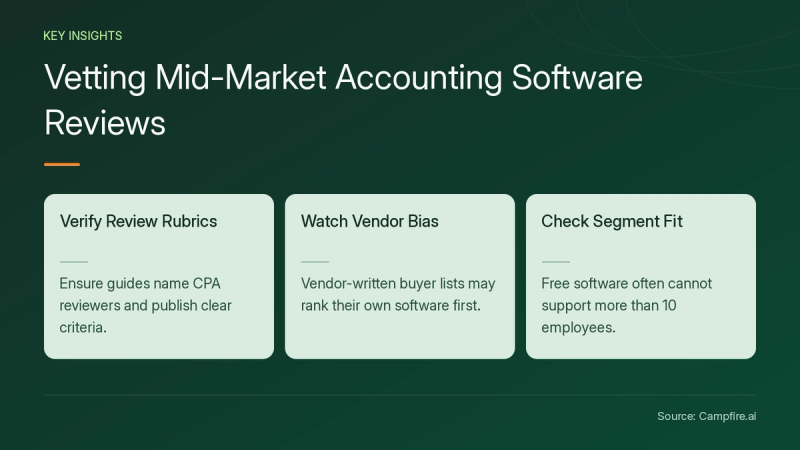
- Look for named authors and a published rubric. TechnologyAdvice's mid-sized guide names a CPA reviewer and lists its criteria. It also discloses that vendors may pay it.
- Vendor-written "best of" lists can rank their own product first. A Bring IT buyer's guide ranks its own Hotel 360° at number one.
- Check segment fit. Small business reviews, such as the US Chamber's free tools guide, note that free software may not support companies with more than 10 employees.
- Use reviews to build a shortlist, then test real workflows and total cost of ownership.
Where Can Mid-Market Buyers Find Credible Reviews?
Credible reviews come from sources that disclose who wrote them, how they evaluated products and who pays them. The table compares the source types found in current search results.
| Source type | Example | What it offers | What to check |
|---|---|---|---|
| Analyst-style review site | ExampleTechnologyAdvice mid-sized business guide | What it offersA CPA reviewer, a rubric covering pricing, controls and integrations, and published prices such as Business Central at $80 per user per month, paid yearly | What to checkIts disclosure says vendors may pay for traffic, and the page is labeled a paid placement |
| Buyer's guide | ExampleBusiness-Software.com mid-market guide | What it offersEvaluation criteria: multi-entity support, approval workflows, audit trails and total cost of ownership | What to checkIt names no products, so pair it with product-level reviews |
| Vendor-published comparison | ExampleBring IT hospitality guide | What it offersIndustry detail and cited peer ratings, such as Sage Intacct at 4.3 out of 5 across 4,258 G2 reviews | What to checkThe author's own product is ranked first |
| Community Q&A | ExampleQuora mid-size thread | What it offersPractitioner advice, such as using a business case and an RFI, RFP and RFQ process | What to checkOne contributor posts similar recommendations for the same free product across many questions |
How Do You Tell If a Review Is Trustworthy?
A review is trustworthy when you can verify its author, its incentives and its method. Ask these questions about every source:


- Who wrote it? Look for a named author with relevant credentials, such as the CPA byline on TechnologyAdvice.
- Who profits? Find the affiliate or sponsorship disclosure. If the publisher sells a product on the list, discount its ranking.
- What was tested? Prefer reviews with stated criteria, such as audit trails, segregation of duties and multi-entity consolidation.
- Which segment? Confirm the review targets mid-sized companies, not freelancers or micro businesses.
- Are limitations listed? Credible reviews name drawbacks. For example, TechnologyAdvice says Xero is not built for complex multi-entity consolidation.
Vendor pages need the same scrutiny. For example, read Campfire's Core Accounting page as vendor material and confirm any claim in a demo.
How Do You Verify Reviews Against Your Own Needs?
You verify reviews by testing the shortlisted products against your own workflows and costs. Use this walkthrough:


- Name your breaking point. Business-Software.com lists warning signs: delayed closes, heavy spreadsheet use, weak controls and growing audit pressure.
- Map reports before demos. List the reports you need by entity, department, location and currency, as TechnologyAdvice recommends.
- Test real workflows. Run your close and reporting process in the product instead of watching a scripted demo. Include both accounting and operations staff.
- Price the full project. Add implementation effort, required add-ons and upgrade paths to the license cost.
- Check security evidence. Ask for independent audits, such as SOC 1, SOC Type II or ISO 27001, which the US Chamber lists as industry-standard controls.
Hypothetical check: suppose a review praises fast consolidation. Ask the vendor to consolidate two of your sample entities live, then compare the output with your current reports. Migration plans deserve the same test. Campfire's Implementation and Migration page is one vendor example to question this way.
Conclusion
Trusted mid-market accounting software reviews do exist, but trust depends on disclosure, method and segment fit. Use credentialed reviews and buyer's guides to build a shortlist. Discount vendor-ranked lists, then confirm each claim with your own data, reports and cost model. When you are ready to evaluate a modern option with these checks, get started with Campfire.
FAQ
Are paid placements in software reviews a red flag?
Paid placements are not automatically disqualifying, but they require extra verification. TechnologyAdvice discloses that vendors may pay it and says its content remains editorially independent, so confirm its findings with your own tests.
Can small business software reviews help mid-market buyers?
Small business reviews offer limited help because they evaluate different needs. The US Chamber notes that free accounting software may not support companies with more than 10 employees or businesses seeking external funding.
Should I trust a vendor's "best software" list?
Use a vendor's list for industry context, not for rankings. The Bring IT guide ranks its own product first, so verify its competitor claims against independent sources and demos.
What should I do after reading reviews?
After reading reviews, build a business case, issue an RFI or RFP and test real workflows. A Quora contributor recommends this process, and Business-Software.com advises testing reporting and close processes before you buy.
Sources
- [c1] 5 Best Accounting Software for Mid-Sized Businesses in 2026 — technologyadvice.com. Accessed November 20, 2026.
- [c2] Hospitality Accounting Software: The Buyer’s Guide — bringitps.com. Accessed November 20, 2026.
- [c3] Best Free Accounting Software for Small Businesses | CO- by US Chamber of Commerce — uschamber.com. Accessed November 20, 2026.
- [c4] Choosing Accounting Software for Growing Mid-Market Companies: A Practical Buyer’s Guide — business-software.com. Accessed November 20, 2026.
- [c5] What accounting software works well for mid-size and large businesses with complex finances? - Quora — quora.com. Accessed November 20, 2026.