Can You Split One Vendor Invoice Across Entities With Separate Approvers?
Listen to article
7:30
Yes, but only if the system can split one invoice by legal entity, route each share to that entity's approver, post balanced entries in each entity, and pay the vendor once. Many systems handle some of these steps natively and leave the rest to spreadsheets or manual journals. Test all four before relying on a workflow. Campfire's Core Accounting page describes multi-entity general ledger and consolidation, which covers the entity-level books, but each approval route must be verified in your own setup.

Key Takeaways
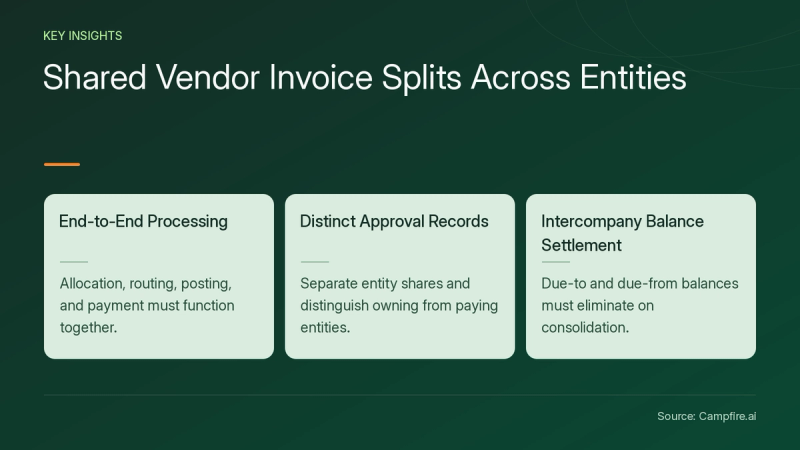
- A system handles a split invoice only when allocation, routing, posting and payment all work on the same invoice.
- Automated approvals do not prove end-to-end support. In Ardent Partners' 2025 research, 41% reported fully automated approvals, but only 22% reported fully automated validation and reconciliation.
- Each entity's share needs its own approval record, and the invoice-owning entity must be distinguished from the paying entity.
- Due-to and due-from balances must net to zero after settlement and eliminate on consolidation.
- Test rejection, changed splits, delegation and duplicate detection in a live two-entity demo before buying.
What must a system support for a split invoice?
A system must support four linked steps: allocation by entity, separate approval routing, balanced posting in each entity, and a single vendor payment. Missing any one step creates manual work.
- Allocation: a percentage or line-level split tied to a legal entity, not only to a cost center.
- Routing: each share goes to that entity's approver under its delegation of authority.
- Posting: each entity records its expense and its intercompany balance.
- Payment: one payment settles the vendor, with a clear paying entity.
Public guides cover parts of this. Ramp's shared-vendor guide covers vendor setup and entity-level coding, Finto's multi-entity approval article covers approval matrices, and Stampli's allocation guide covers split templates. None walks one invoice through all four steps.
How does one invoice move through two entities?
The invoice-owning entity records the full vendor liability and recharges the other entity's share through intercompany balances. In this illustrative example, a $10,000 invoice is split $6,000 to Entity A and $4,000 to Entity B. Entity A is invoiced and pays the vendor, and the recharge assumes a contractual basis.
| Stage | Entity A | Entity B |
|---|---|---|
| Approval | Entity AApprover A approves the $6,000 share | Entity BApprover B approves the $4,000 share |
| Invoice posting | Entity ADr Expense 6,000; Dr Due from B 4,000; Cr Accounts payable 10,000 | Entity BDr Expense 4,000; Cr Due to A 4,000 |
| Vendor payment | Entity ADr Accounts payable 10,000; Cr Cash 10,000 | Entity BNo entry |
| Intercompany settlement | Entity ADr Cash 4,000; Cr Due from B 4,000 | Entity BDr Due to A 4,000; Cr Cash 4,000 |
| Consolidation | Entity AEliminate due from and due to of 4,000 | Entity BCombined expense of 10,000 |
After settlement, both intercompany balances clear to zero, and the vendor payable clears at $10,000. Reconcile these balances in both ledgers.


Can one rejected share block the whole invoice?
Public guides do not establish whether one rejected share blocks the whole bill, so treat this as a required test. The same applies to whether changing a split after approval invalidates earlier approvals. Ask the vendor to show both behaviors on a live invoice, including how partial approval appears in the audit trail.
How should you test a finance system before buying?
Run one invoice, two approvers and one payment through the system. Record each step as native, configured or manual.
| Test | Pass condition |
|---|---|
| Approve the split | Pass conditionEach owner sees only their share and approves it |
| Change the split after approval | Pass conditionEarlier approvals are flagged or reset according to your policy |
| Reject one share | Pass conditionBill status and the exception owner are clear |
| Delegate an approver | Pass conditionThe delegate acts under the correct authority |
| Resubmit the invoice | Pass conditionDuplicates are flagged across entities |
| Inspect ERP postings | Pass conditionEntries balance in each legal entity |
| Pay once | Pass conditionOne payment reconciles to both entity ledgers |
Campfire's Accounting Intelligence page lists duplicate detection with review and audit trails. Confirm it works across entities in your own test.


Where do intercompany and tax issues remain?
Intercompany settlement and tax treatment require review against your actual entities and jurisdictions. Public guides give little scenario-specific detail on cross-border tax, invoice addressee, currency or the contractual basis for a recharge.
Intercompany matching is where split-invoice balances must agree. Campfire's Ember AI page lists intercompany reconciliation among its accounting agents, with accountants reviewing proposed actions. Confirm it matches your recharge balances before relying on it.
Does approval control also protect payment?
No. Approving each entity's share does not verify the vendor's bank account or who can change payment details. In AFP's 2026 survey, 76% of 465 organizations experienced attempted or actual payments fraud in 2025. AFP's payments fraud research supports separating cost approval from payment authorization. Microsoft's centralized-payments documentation also distinguishes the invoice-owning entity from the paying entity.
Conclusion
A finance system can handle a shared vendor invoice split across entities, but only when allocation, separate approvals, balanced entries and one payment work together. Verify each step in a live two-entity test before committing. Treat intercompany, tax and payment-control questions as separate reviews. Run the test script on your own entities before you buy, or get started with Campfire to see how multi-entity accounting fits your setup.
FAQ
Can an ERP alone split an invoice across entities?
Some ERPs can split invoice lines across entities, but native support varies widely. Public vendor material suggests that many teams pair a multi-entity ERP with an AP automation layer to route each share to its owner. Verify the native and configured steps in a demo.
Should each approval owner have a separate vendor record?
Ramp's guide describes both a single vendor record with entity-level routing and separate records where approval owners differ. The right choice depends on your configuration and reporting needs. Test both setups before standardizing on one.
Who should be the payer on a shared vendor invoice?
The invoice-owning entity carries the vendor liability, and the paying entity makes the payment. Microsoft's documentation distinguishes these roles, so define both before setting up routing. Document the recharge basis in the intercompany agreement.
Sources
- [c1] How should shared vendors be handled across multiple entities? — ramp.com. Accessed November 25, 2026.
- [c2] Invoice approval across multiple entities — gofinto.com. Accessed November 25, 2026.
- [c3] How do I split one invoice across multiple departments, locations, or entities? - Stampli — stampli.com. Accessed November 25, 2026.