Can Lean Teams Handle Acquisitions Without a Separate Consolidation Tool?
Listen to article
9:04
Yes, conditionally. A lean finance team can support an acquisition strategy without a separate consolidation tool if acquired entities move into an ERP with multi-entity consolidation, a standardized chart of accounts, and controlled intercompany eliminations. Some ERP-focused guides set the same condition. Campfire's Core Accounting includes multi-entity and multi-currency consolidation, so this guide tests that model against a real acquisition close.

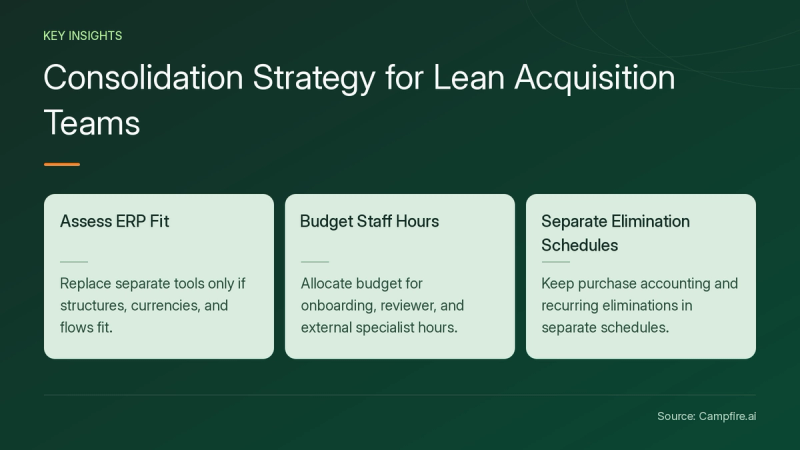
Key Takeaways
- An ERP can replace a separate consolidation tool only if the group's entity structure, currencies, and intercompany flows fit its design.
- Avoiding a new tool does not avoid hiring. Budget for onboarding, reviewer, and specialist hours.
- Onboarding needs named owners, an opening trial balance, and an acceptance test before the first close.
- Purchase accounting and recurring eliminations belong in separate schedules with separate support.
- Reassess the model when close effort, aged exceptions, or late adjustments keep rising after onboarding.
Can your ERP replace a separate consolidation tool?
Often yes, if the ERP already handles the group's ownership, currencies, and intercompany flows. Test each area before signing an acquisition.
| Readiness test | What to confirm | Evidence to keep |
|---|---|---|
| Entity hierarchy | What to confirmOwnership percentages and parent-subsidiary links can be modeled | Evidence to keepEntity chart with ownership dates |
| Chart of accounts | What to confirmAcquired accounts map to group accounts under written rules | Evidence to keepSigned mapping table |
| Currency | What to confirmTranslation uses approved rate sources and methods | Evidence to keepRate table and translation run |
| Intercompany | What to confirmMatching and elimination rules exist for each flow | Evidence to keepMatching report with aging |
| Audit trail | What to confirmEach consolidation entry traces to source data | Evidence to keepJournal listing with preparer and approver |
Each acquired entity adds intercompany transactions, FX remeasurements, and consolidation adjustments, according to Prophix's financial consolidation use case. A failed row means you need a control or tool for that gap before closing the deal.
How do you onboard an acquisition into a lean close?
Onboard in three phases: before close, at closing, and during the first consolidated close. Assign one owner per step and require evidence before moving on.
| Phase | Step | Owner | Evidence | Acceptance test |
|---|---|---|---|---|
| Before close | StepAssess controls, policies, and source systems | OwnerController | EvidenceDiligence memo | Acceptance testGaps listed with named owners |
| At closing | StepCapture opening trial balance and acquisition-date entries | OwnerEntity accountant | EvidenceSigned opening balances | Acceptance testBalances tie to closing statement |
| First close, week 1 | StepMap accounts and load historical entries | OwnerAccounting lead | EvidenceMapping sign-off | Acceptance testNo unmapped balances |
| First close, week 2 | StepReconcile intercompany balances | OwnerIntercompany owner | EvidenceMatching report | Acceptance testUnmatched items aged and explained |
| First close, final | StepPost group adjustments and review | OwnerController and reviewer | EvidenceReviewer approval | Acceptance testConsolidated totals tie to entity totals |
Historical journal entry loading and chart of accounts cleanup are the heaviest onboarding tasks. Campfire's Implementation and Migration page covers both, plus reconciliation of migrated financial data.
What does the first consolidated close look like?
The first close separates purchase accounting from recurring eliminations. Keep each schedule separate so every entry has its own support.


Hypothetical example: a parent buys 100% of a target for 1,000,000. The target's book net assets are 700,000. Identifiable net assets at fair value are 800,000, including a 100,000 customer relationships intangible with a five-year life. Goodwill is 200,000.
| Acquisition-date entry | Debit | Credit |
|---|---|---|
| Target equity (book) | Debit700,000 | Credit |
| Customer relationships (fair value step-up) | Debit100,000 | Credit |
| Goodwill | Debit200,000 | Credit |
| Investment in target (parent) | Debit | Credit1,000,000 |
| Total | Debit1,000,000 | Credit1,000,000 |
Recurring entries follow the first close:
- Annual amortization of the intangible: 20,000 debit to amortization expense and 20,000 credit to accumulated amortization, if the target's books do not carry the step-up.
- Intercompany sales of 50,000 eliminated: debit intercompany sales and credit cost of sales.
- Intercompany payables and receivables eliminated at period end.
Under IFRS 3, goodwill is the residual after fair values are assigned. U.S. GAAP (ASC 805) has its own rules, so a qualified accountant should review the framework and entries.
How do you keep controls intact?
Tie every late adjustment to a source reconciliation and a dated approval. Control gaps grow as entity count grows.
In Vena's month-end close benchmarks survey, 78% of surveyed finance teams had corrected supposedly final close numbers. Use these controls:


- Version-control every source file and consolidation output.
- Reconcile the trial balance to each consolidated report.
- Keep an approval log with preparer, reviewer, and date.
- Post late adjustments in the current period with a written reason.
Campfire's Ember AI agents can prepare intercompany reconciliations and close checklists. Accountants review and approve every proposed action.
When should you add a separate consolidation tool?
Reassess when close effort, aged exceptions, or deal cadence keep rising after onboarding. Set your own thresholds rather than copying a universal entity count.
Headcount matters in this decision. In Consero's 2026 CFO survey of 102 PE- and VC-backed finance leaders, 87% said they were hiring more finance staff. Include that cost in every option.
| Option | Best fit | Main cost | Watch for |
|---|---|---|---|
| ERP-native consolidation | Best fitFew entities, shared currency, clear intercompany rules | Main costSetup and reviewer time | Watch forManual eliminations growing each close |
| ERP plus controlled manual adjustments | Best fitShort-term integration with a defined end date | Main costOngoing preparer and reviewer hours | Watch forAdjustments repeating every month |
| Separate consolidation platform | Best fitMany entities, FX complexity, frequent deals | Main costLicense, integration, and administration | Watch forDuplicate data and integration errors |
Reassess when any two of these persist for two consecutive closes: close days above target, intercompany exceptions older than one close, late adjustments after sign-off, or reviewer hours rising faster than deal count.
Conclusion
A lean team can support acquisitions on an ERP when the entity structure, close controls, and staffing fit the workload. Test readiness before the deal, assign owners for the first close, and keep purchase accounting separate from recurring eliminations. Reassess with measured triggers rather than assumptions. Start with the readiness table this week, and get started with Campfire to plan your first acquisition close.
FAQ
Can a lean finance team use ERP-native consolidation after an acquisition?
Yes, if the ERP can model the acquired entity's ownership, currencies, account mapping, and intercompany eliminations, and reviewers can test each close. Entity count alone does not settle the question, so assess the group's actual complexity first.
Does avoiding a consolidation tool reduce staffing needs?
No. Avoiding a tool changes where the work sits, not whether the work exists. Budget for onboarding, monthly close, reviewer, and specialist hours before assuming the current team can absorb a deal.
What is the first consolidation entry in an acquisition?
The first consolidation entry eliminates the parent's investment against the acquired entity's equity and recognizes identifiable assets, liabilities, and goodwill at fair value. Under IFRS 3, goodwill is the residual, and a qualified accountant should confirm the applicable framework.
When is an ERP-only approach no longer enough?
It stops being enough when close effort rises, intercompany exceptions age beyond one close, late adjustments repeat, or deal cadence increases. Set your own thresholds, document the decision, and review it after each acquisition.
Sources
- [c1] bringitps.com — bringitps.com. Accessed November 25, 2026.
- [c2] prophix.com — prophix.com. Accessed November 25, 2026.