Can AI Map Messy CSV Exports Without Losing Auditability?
Listen to article
8:59
Yes, AI can suggest mappings from messy CSV exports into a new accounting platform without losing auditability, but only when the workflow keeps source lineage, human approval and reconciliation. AI proposes account and dimension mappings. Reviewers decide, and the system records each step. Campfire's implementation and migration offering covers historical journal entry migration, chart of accounts cleanup and reconciliation of migrated financial data.

Key Takeaways
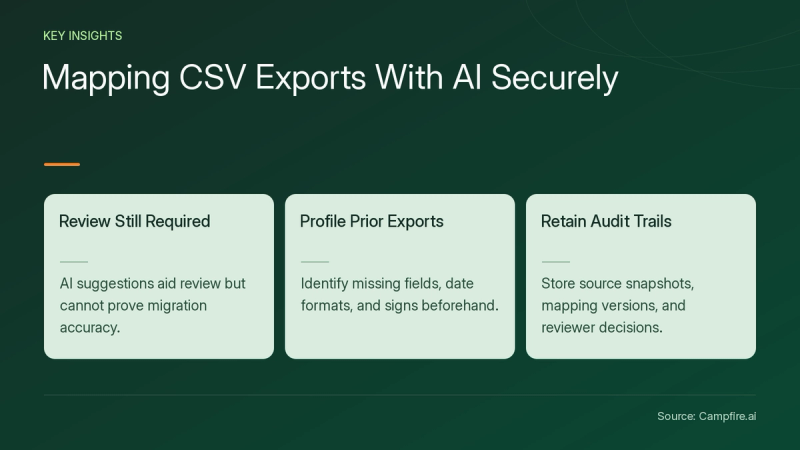
- AI suggestions support review. They do not prove a migration is correct.
- Profile each export before mapping. Missing fields, mixed date formats and sign conventions cause most errors.
- Retain source snapshots, row IDs, mapping versions, reviewer decisions and import IDs for every record.
- Reconcile counts and balances by entity and currency. Matching totals alone do not prove each row was classified correctly.
Can AI reliably map messy CSV exports?
AI can help with mapping, but the strongest evidence supports assisted review, not autonomous migration. In a 2026 study by Choi and Xie, AI assistance improved transaction-classification accuracy by about 18 percentage points.
The same study found no statistically significant average reduction in completion time. Some accountants also followed incorrect AI suggestions that differed from their own judgment. Classification results do not establish migration accuracy.
Data readiness matters as much as the model. Gartner's 2025 survey of 183 senior finance leaders cited data quality and availability, along with technical skills, as major adoption obstacles in finance AI adoption research. Profile the export first. Identify missing fields, duplicate keys, mixed date formats and sign conventions before any mapping starts.


What evidence must a migration package keep?
A migration package must link every target record back to its source row, the mapping logic that produced it, and the person who approved it. Retain these items for each import.
| Evidence item | What to retain | Why it matters |
|---|---|---|
| Source snapshot | What to retainUnchanged file, name, hash and export date | Why it mattersShows exactly what was mapped |
| Row identifiers | What to retainFile ID and row number for each record | Why it mattersTraces a ledger entry to its source line |
| Mapping version | What to retainRules, version number and change history | Why it mattersShows which logic produced each suggestion |
| AI suggestion | What to retainProposed account, dimension and confidence | Why it mattersLets reviewers focus on weak or consequential rows |
| Reviewer decision | What to retainApprove, reject or override, with role and timestamp | Why it mattersDocuments human judgment |
| Import record | What to retainTarget ID, import log and rejected-row report | Why it mattersLinks the source row to the ledger |
| Reconciliation | What to retainCounts and totals by entity and currency | Why it mattersShows completeness |
How does one row move through the workflow?
A row moves from the source snapshot to a reviewed import, and each step writes a record. The example below is hypothetical.
- Row 218 of a hypothetical file, bank_export_0412.csv, reads "EXAMPLE SUPPLY 442" for 1,240.00. AI proposes account 6150 Office Supplies at low confidence. The row is held for review under mapping version 1.3.
- An Accounting Manager rejects the suggestion and selects 6150 with the correct entity dimension. The decision, rationale, role and timestamp are saved.
- Row 219 reads "EXAMPLE CLOUD HOSTING" for 310.00. AI proposes 6200 Software Subscriptions at high confidence. The row falls into a random sample of high-confidence rows, which a Controller reviews and approves.
- Row 219 imports as hypothetical target ID IMP-0412-219. The reconciliation shows 500 source rows: 487 imported, 6 rejected as duplicates and 7 held for review.
What should a cutover checklist cover?
A cutover checklist should prove that the source, the mapping and the imported balances agree before sign-off. Run these steps in order.


- Approve the source snapshot and mapping table before any import.
- Test required fields, duplicates, dates, signs, currencies and entity assignments.
- Import opening balances separately from historical transactions, and reconcile each set.
- Reconcile the trial balance and applicable subledgers by entity and currency.
- Sample high-confidence suggestions using a documented, risk-based rule, and record the rationale.
- Log every rejected, duplicate or held row with its resolution, then obtain sign-off.
How should you evaluate an AI migration platform?
Evaluate a platform by asking it to demonstrate controls on your own sample file, not by reviewing feature lists. Campfire's Accounting Intelligence page describes transaction categorization with review and audit trails. Treat those descriptions as claims to verify.
| Requirement | Demo test | Evidence to keep | Owner |
|---|---|---|---|
| Exportable lineage | Demo testTrace one ledger entry back to its source row | Evidence to keepRow-level lineage export | OwnerAccounting Manager |
| Restricted posting | Demo testAttempt a post under a preparer role | Evidence to keepDenied-action log | OwnerController |
| Reviewer override | Demo testReject one suggestion and approve another | Evidence to keepTimestamped decision record | OwnerController |
| Versioned mappings | Demo testChange one rule and rerun a sample | Evidence to keepPrior and new version, with differences | OwnerImplementation lead |
| Rejected-row handling | Demo testImport a file with duplicates and invalid dates | Evidence to keepRejection report | OwnerAccounting Manager |
| Data-use terms | Demo testRequest written retention and model-use terms | Evidence to keepSigned terms | OwnerController with IT or legal |
| Post-import reconciliation | Demo testCompare counts and totals by entity and currency | Evidence to keepReconciliation report | OwnerAccounting Manager |
Campfire's Implementation and Migration page also lists reconciliation of migrated financial data. Confirm each row above in a live demo before relying on it.
Conclusion
AI can help map messy CSV exports, but auditability comes from controls around the model. Keep source snapshots, row IDs, mapping versions and reviewer decisions. Reconcile opening balances and historical transactions separately, and treat each unverified vendor claim as a test to run.
Start with the evidence table in this guide and build a sample file to test it against your own exports, then get started with Campfire.
FAQ
Does AI-assisted mapping make a migration auditable by itself?
No. AI-assisted mapping creates suggestions, and an audit requires evidence that links each source row to its mapping version, reviewer decision, import record and reconciliation. Without those records, a reviewer cannot reconstruct how a ledger entry was created.
How many high-confidence suggestions should reviewers sample?
Supplied sources do not document a standard sampling rate. Set a risk-based sample that covers high-value, unusual or consequential rows, record the rule and rationale, and expand the sample if errors appear.
Should opening balances be imported with historical transactions?
No. Import opening balances and historical transactions separately because they serve different reconciliation purposes. Reconcile each set to the trial balance and applicable subledgers by entity and currency before sign-off.
Is it safe to send bank or payroll exports to an AI tool?
Only after you confirm who can access the files, how long the provider retains them, and whether the provider may use them for model training. A 2026 field study of accountants found that about 40% reported data-security or job-security concerns, so these terms belong in the vendor evaluation.
Sources
- [c1] gartner.com — gartner.com. Accessed November 25, 2026.