Can an Accounting Platform Explain Balance Changes, Not Just Variances?
Listen to article
7:32
Yes. Some accounting platforms can trace a month-over-month balance change to the journal lines and subledger records behind it, then draft an explanation for reviewer approval. A variance report only shows the difference. An explanation also shows which postings caused it and whether any part remains unexplained. Results depend on the product, its integrations and the permissions your team holds.

Key Takeaways
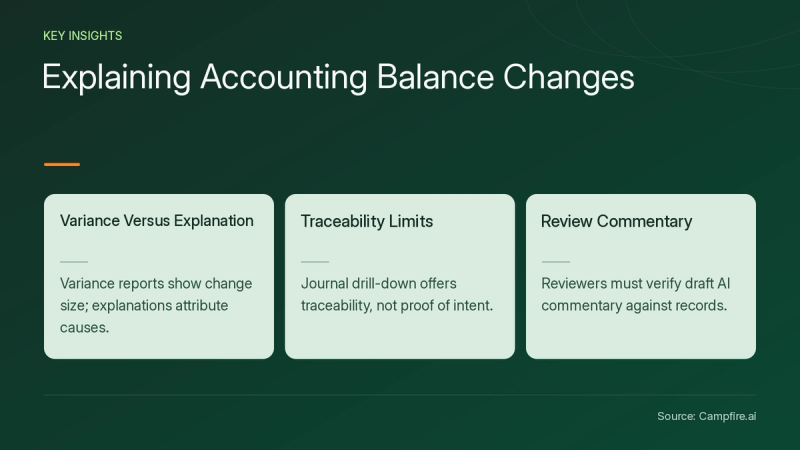
- A variance report shows the size of a balance change. An explanation attributes that change to recorded activity.
- Journal drill-down shows traceability, not proof of the business reason for a change.
- A zero residual shows the bridge adds up. It does not prove every posting is correct.
- Test journal completeness, source permissions, late postings and currency effects before buying.
- Treat AI commentary as a draft that reviewers verify against the underlying records.
What does a variance report miss?
A variance report shows what changed, but not the activity behind the change. It compares two figures and returns a dollar difference and a percentage. For example, an illustrative accounts receivable balance rising from $1.0 million to $1.3 million shows a $300,000 increase, or 30%. It does not identify which invoices, collections or credit memos produced that increase.
An explanation tool fills that gap. Ember AI offers flux and variance analysis agents, and accountants review and approve the actions it proposes. Its value depends on whether the underlying records are linked, not on the wording of the draft.
How does a balance bridge link changes to journals?
A balance bridge starts with the opening balance, adds each signed category of posted activity, and ends at the closing balance with any unexplained residual shown. The table below uses an illustrative example, not a sourced business result.
| Bridge line | Signed amount | Evidence to link |
|---|---|---|
| Opening AR balance | Signed amount$1,000,000 | Evidence to linkGL balance at a locked prior period |
| Invoices posted | Signed amount+$700,000 | Evidence to linkInvoice journal lines and subledger invoices |
| Cash collections applied | Signed amount-$350,000 | Evidence to linkReceipt and cash application journals |
| Credit memos | Signed amount-$50,000 | Evidence to linkCredit memo journal lines |
| Unexplained residual | Signed amount$0 | Evidence to linkShown explicitly, never netted away |
| Closing AR balance | Signed amount$1,300,000 | Evidence to linkGL balance at the locked current period |
The bridge works only if the journal population is complete. Core Accounting covers the general ledger, journal entries and month-end close checklists that supply that population.


Does journal drill-down prove why the balance changed?
No. Journal drill-down shows which recorded postings sit behind a reported number, not why the business event happened. Oracle documents a configuration in which reports query balances and drill down to journals, which demonstrates traceability rather than automatic business causation.
Where does a zero residual stop?
A zero residual shows the arithmetic agrees, but it does not confirm that the postings are correct or that the explanation is true. Explanations work at three levels, and each needs different evidence.
- Calculation: the signed movement equals the closing minus the opening balance.
- Attribution: each category ties to recorded journals or subledger records.
- Verified explanation: a reviewer confirms the business cause, such as a billing timing change, using invoice dates and commercial context.
Reconciliation supports the ending balance. Variance analysis explains the movement. Neither replaces the other.
What should a buyer test before purchase?
Buyers should test the platform with a real account that has large postings, offsetting entries and at least one late adjustment. Ask the vendor to reproduce the bridge live from source records.


- Lock the entity, account, currency and comparison periods.
- Tie the opening and closing balances to the general ledger.
- Confirm that every posted journal line in scope appears, with no double counting.
- Show unmatched items and any residual rather than hiding them.
- Test restricted source access and confirm who can open each linked document.
- Re-run the review after a late posting or a changed source balance.
- Test zero or negative prior balances, foreign exchange translation, eliminations and entity scope changes.
Separate currency translation, consolidation eliminations and reclassifications from operational activity. A platform should label these effects instead of forcing a complete-sounding narrative.
How should AI fit into the explanation workflow?
AI should draft commentary and flag anomalies, while accountants verify the facts and approve the result. Trintech announced separate Flux and Variance Analysis Agents in June 2026, and says buyers should verify journal-level traceability during a demonstration. Trintech's announcement describes both agents as reviewable workflows.
Generated insights need checking. Oracle NetSuite advises users to verify generated insights against the underlying reports and records. Gartner reported that 63% of surveyed finance organizations said AI implementation was slower than expected in 2025, which argues for a bounded pilot with clear acceptance criteria.
Conclusion
An accounting platform can explain a balance change when it links the bridge to journals, subledger records and reviewer approval. A variance report alone cannot do that. Verify the traceability, residuals and late-posting controls before you rely on any explanation. Start with one account and one entity, measure preparation and review time against your current close, and then get started with Campfire to test the workflow on your own records.
FAQ
Is flux analysis the same as budget variance analysis?
No. Flux analysis compares actual balances or activity across periods, such as March receivables against February receivables. Budget variance analysis compares actual results with a plan, which may exist only at an aggregate level. A platform can support both, but a budget narrative does not answer a month-over-month balance question.
What happens if a journal is posted after an explanation is approved?
The approved explanation may no longer match the ledger. The package should be flagged, and the affected bridge should be re-reviewed before it is relied on. Buyers should confirm that the platform detects late postings and preserves a record of the earlier approval.
Does AI-written commentary count as a balance explanation?
Not by itself. Commentary counts as an explanation only when each statement links to a verified posting, subledger record or documented business fact. Unsupported statements should be marked as hypotheses or left as unknown until evidence is found.
How should currency translation be handled in a balance bridge?
Translation effects should be separated from operational activity before the bridge is reviewed. Eliminations, reclassifications and changes in entity scope should also appear as their own categories. A platform that cannot isolate these effects gives an incomplete explanation for multi-currency or consolidated balances.