Can an Accounting Platform Support Custom Workflows Without Engineering?
Listen to article
8:42
Yes, for workflows that use rules, fields, roles and approvals the platform already supports. Finance teams can often configure these without a full engineering project. Cross-system data or logic outside the platform still needs an integration or custom code, and each capability should be verified before you commit. A platform such as Core Accounting includes month-end close checklists, which is a common starting point for these workflows.

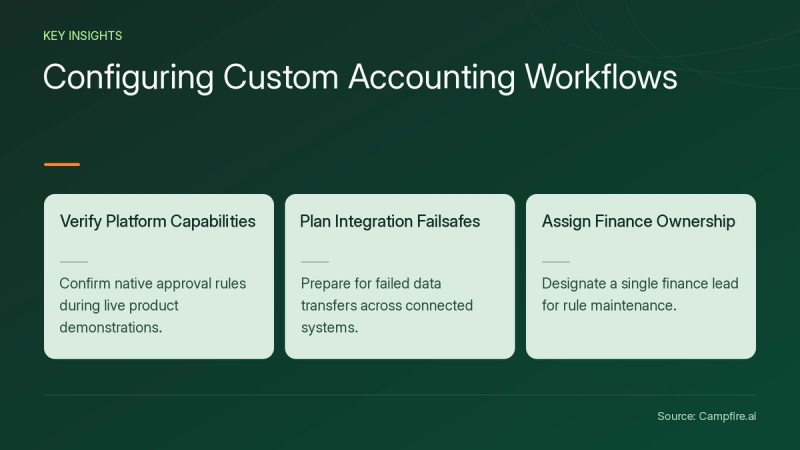
Key Takeaways
- Native configuration covers supported rules and approvals. Verify each one in a live demo.
- Use an integration when data must move between systems, and plan for failed transfers.
- Test threshold boundaries, missing approvers, rejections, duplicate events and post-approval changes before launch.
- Name one finance owner for rule changes, and budget time for training and maintenance.
- Measure a baseline and require finance sign-off before expanding the workflow.
When Can Native Configuration Replace an Engineering Project?
Native configuration replaces an engineering project when the workflow uses logic the platform already exposes. NetSuite's workflow automation guide states that modern cloud platforms are designed to support custom workflows without dedicated engineering or IT development cycles. Treat that as a vendor claim to test against your own policy.
| Path | Best fit | Ownership | Escalate when |
|---|---|---|---|
| Native configuration | Best fitRules, fields and approvals the platform supports | OwnershipFinance workflow owner | Escalate whenRequired logic cannot be expressed in available rules |
| External automation layer | Best fitData must cross systems | OwnershipFinance with IT for connectors | Escalate whenSource system changes break transfers |
| Custom build | Best fitLogic, scale or controls the platform cannot meet | OwnershipEngineering team | Escalate whenPolicy cannot be met after configuration tests |
Table note: Use these categories as evaluation criteria, not product guarantees. If a workflow pulls data from banking, payroll or tax systems, check whether the platform's native integrations cover that connection before scoping custom code.
How Do You Map a Custom Invoice Approval Workflow?
Map the workflow from submission to payment, then write each rule as a testable condition. The steps below are a hypothetical example, not a description of a specific product configuration.


- Trigger on invoice submission using entity, vendor and amount fields.
- Route invoices below the threshold to a department approver and invoices above it to a controller.
- Block self-approval so the approver is independent of the submitter.
- Return rejected invoices to the submitter with a reason code.
- If the approver is inactive, escalate to a named backup instead of skipping approval.
- If the amount changes after approval, return the invoice for re-approval.
Which Test Cases Matter Before Launch?
Boundary, missing approver, rejection, duplicate and post-approval change tests catch most configuration gaps. Run each case in a sandbox and record the expected and actual result.
| Test | Hypothetical input | Expected result |
|---|---|---|
| Threshold boundary | Hypothetical inputInvoice exactly at the controller limit | Expected resultRoutes under the rule the policy defines, documented |
| Missing approver | Hypothetical inputDepartment approver inactive | Expected resultEscalates to named backup |
| Rejected invoice | Hypothetical inputApprover rejects with reason | Expected resultReturns to submitter, no payment release |
| Duplicate event | Hypothetical inputSame invoice submitted twice | Expected resultBlocked or flagged for review |
| Change after approval | Hypothetical inputAmount edited after sign-off | Expected resultRe-routes for approval |
Platforms with built-in duplicate detection, such as the capabilities described in Accounting Intelligence, can reduce this test load. Confirm the behavior in your own sandbox before relying on it.


Who Should Own the Workflow After Launch?
A named finance owner should approve rule changes, while engineering supports integrations and technical escalations. In AICPA and CIMA's 2025 survey, 61% of respondents identified on-the-job training as effective for technology upskilling. Training on your own workflow examples fits that result better than generic courses. Restrict who can publish changes and keep an audit trail of every edit.
How Should You Measure a Pilot?
Measure cycle time, staff handling time, exceptions, rework, control failures and support hours against a baseline. In BILL and Logica's 2025 survey of 354 primarily small and midsize US finance leaders, 12% reported a completely automated monthly or quarterly close. Treat full automation as a rare outcome, not a default target.
| Metric | Baseline measure | Post-pilot measure |
|---|---|---|
| Cycle time | Baseline measureDays from submission to approval | Post-pilot measureSame definition, same period |
| Staff handling time | Baseline measureHours per week on the workflow | Post-pilot measureSame measure |
| Exceptions | Baseline measureCount and reason codes | Post-pilot measureSame codes |
| Control failures | Baseline measureApprovals bypassed or edited without review | Post-pilot measureTracked, with a target of zero |
| Engineering support hours | Baseline measureHours spent on fixes or changes | Post-pilot measureSame measure |
Conclusion
Native configuration handles supported rules, integrations handle cross-system data, and custom code covers what remains. Test boundaries, duplicates and post-approval changes before launch. Assign one owner and measure a baseline so finance can approve expansion with evidence. To see which of your approval and close steps fit native configuration, get started with Campfire.
FAQ
Does a custom accounting workflow always require engineering?
No. Workflows that use supported rules, fields, roles and approvals can often be configured by finance staff, while cross-system data or unsupported logic may require an integration or custom code.
What is the difference between an integration and a custom build?
An integration connects two systems so data moves between them, while a custom build adds logic or screens the platform does not provide. Integrations need a source-system owner and failure handling, and custom builds need ongoing engineering maintenance.
Who should own a finance workflow after launch?
A named finance owner should approve rule changes and maintain test cases, with engineering supporting integrations and technical escalations. Limit who can publish changes and keep an audit trail of each edit.
How long should a workflow pilot run?
The right length depends on your close calendar and transaction volume. Run the pilot long enough to cover at least one full close cycle and the common exception types, and confirm the duration with finance before launch.