Can an Accounting System Explain CTA Down to Subsidiary Balances?
Listen to article
8:16
Yes, but only if the system keeps each entity's local trial balance, the rate applied to each line, historical equity movements and consolidation adjustments, and shows how they reconcile to the reported CTA. A single balancing amount does not explain CTA. A reviewer needs to trace one subsidiary's contribution back to its balances and rates without an unexplained plug.

Key Takeaways
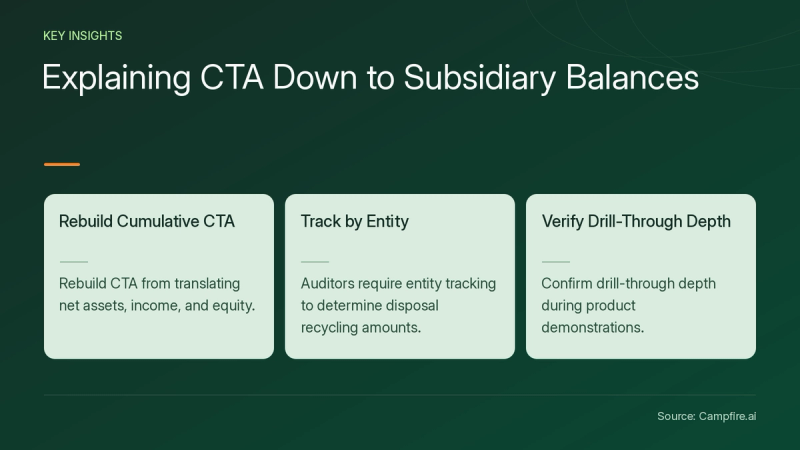
- CTA results from translating net assets, income and equity at different rates, so it must be rebuilt from its inputs.
- Auditors expect CTA to be tracked by entity, because it determines the amount recycled on disposal.
- In a hypothetical EUR subsidiary, the ending CTA is a $4.23 credit, which splits into a $4.00 opening-equity effect, a $0.25 income effect and a $0.02 dividend effect.
- Test vendors by changing a rate, posting a late journal and rerunning consolidation.
- Drill-through depth varies by product, so confirm it in a demo.
What does a system need to explain CTA?
A system needs four inputs: the local trial balance, the rate applied to each line, historical equity and the consolidation adjustments. IAS 21 identifies two main sources of translation differences: opening net assets translated at a different closing rate, and income and expenses translated at transaction-date rates. A period average is an approximation and can be inappropriate when rates fluctuate significantly.
Auditors require CTA to be tracked entity by entity, as KPMG's foreign currency handbook explains, because the accumulated amount determines the gain or loss recycled into earnings on disposal. Multi-currency consolidation, such as the capability listed on Campfire's Core Accounting page, is a starting point for this evaluation. That page lists multi-entity and multi-currency consolidation but does not document CTA drill-through, so verify it directly.
How does a $4.23 CTA break down by subsidiary?
In this hypothetical, the ending CTA is a $4.23 credit for a EUR-functional subsidiary. The translated net assets are $48.40, and equity before CTA is $44.17. The example assumes no opening retained earnings, no prior CTA and no other movements.
| Line | EUR amount | Rate (USD per EUR) | USD amount |
|---|---|---|---|
| Net assets (104 less 60) | EUR amount44 | Rate (USD per EUR)1.10 closing | USD amount48.40 |
| Contributed capital | EUR amount40 | Rate (USD per EUR)1.00 historical | USD amount40.00 |
| Income | EUR amount5 | Rate (USD per EUR)1.05 transaction rate | USD amount5.25 |
| Dividend | EUR amount(1) | Rate (USD per EUR)1.08 historical | USD amount(1.08) |
| Equity before CTA | EUR amount44 | Rate (USD per EUR) | USD amount44.17 |
| CTA (credit) | EUR amount | Rate (USD per EUR) | USD amount4.23 |
How do you bridge CTA from opening to closing?
Split the ending CTA into the rate effect on each equity component. Each row below multiplies the EUR amount by the difference between the closing rate and the rate applied to it. Positive values are credits to CTA.


| Component | Calculation | USD effect |
|---|---|---|
| Opening capital | Calculation40 x (1.10 less 1.00) | USD effect4.00 |
| Income | Calculation5 x (1.10 less 1.05) | USD effect0.25 |
| Dividend | Calculation(1) x (1.10 less 1.08) | USD effect(0.02) |
| Total CTA | Calculation | USD effect4.23 |
Any residual that does not clear to zero is an unexplained difference. Record it, assign an owner and do not net it into CTA.
How should you test a vendor's CTA drill-through?
Run a scripted test that changes one rate, posts one late subsidiary journal and reruns consolidation. Confirm that the CTA bridge, approvals and prior version all update.
- Load a sample entity. Expected result: the trial balance and rate table appear with source references. Evidence: export of both.
- Change the closing rate by a stated amount. Expected result: CTA changes by the calculated rate effect on net assets. Evidence: before and after bridge.
- Post a late subsidiary journal. Expected result: the journal appears in the entity's balance and in the CTA movement. Evidence: journal ID and audit log.
- Rerun consolidation. Expected result: a new run version is created, and the prior version remains viewable. Evidence: version history.
- Review approvals. Expected result: the controller sees who changed the rate or journal and who approved the rerun. Evidence: approval record.
The controller owns sign-off. The accounting manager should check that the drill path stops at account, source transaction or rate record, and document where it stops. Ember AI describes intercompany reconciliation and close preparation, with accountants reviewing and approving proposed actions. Ask whether CTA bridges follow the same review model.


Where does CTA lineage stop?
Lineage usually stops at the entity's trial-balance account level unless the system stores source transactions and rate provenance. Many close problems start upstream. In Vena's 2026 close survey, 37% of teams sourced close data from email or shared documents, and those teams averaged 6.8 business days to close versus 5.9 for others. That association does not prove causation, but it shows why source files need controls.
Planful's 2025 global finance survey reported that 68% of teams closed within five days, while consolidation and statement preparation could still sit outside the ERP. Remeasurement is separate from translation. Trace a discrepancy through the rate source, date, local amount and reporting amount before attributing it to CTA. Ownership changes and noncontrolling interests need framework-specific review, since IAS 21 addresses allocation of translation differences to noncontrolling interests.
Conclusion
An accounting system can explain CTA by subsidiary when it reproduces the ending amount, separates the opening and movement effects, and keeps the rate, version and approval history. Ask every vendor to pass the same scripted test, and keep the evidence with the close file. The bridge should close to zero without a plug. If you want to run this test on your own entity structure, get started with Campfire.
FAQ
What is the difference between account-level and transaction-level drill-through?
Account-level drill-through shows which trial-balance accounts and entities produced a CTA amount. Transaction-level drill-through goes further, showing the individual source journals and the rate record applied to each one. Many systems offer the first but not the second, so confirm which one a vendor demonstrates.
How do I investigate a CTA movement that changed unexpectedly?
Start with the prior and current run versions, then compare the rate table, the entity's trial balance and the equity history for the period. Rebuild the bridge using the opening and movement formulas, and log any residual as an unexplained difference with an owner. Do not accept a change until the approval record matches the rate or journal that caused it.
Does rerunning consolidation overwrite the prior CTA?
It should not, if the system keeps versioned runs. A compliant setup creates a new version and keeps the previous one available for comparison and audit. Test this directly during a demo by rerunning after a rate change and confirming that the old version remains viewable.
Sources
- [c1] kpmg.com — kpmg.com. Accessed November 27, 2026.