Can an Accounting System Explain Why This Month's Cash Outlook Changed?
Listen to article
8:33
No, not on its own. A general ledger records posted transactions and period closes, so it cannot explain a week-over-week change in a cash forecast by itself. Finance can explain the change only by saving each forecast version, bridging one version to the next, and tying each driver to evidence. Transformance.ai's 2026 cash forecast template guide describes the same limitation.

Key Takeaways
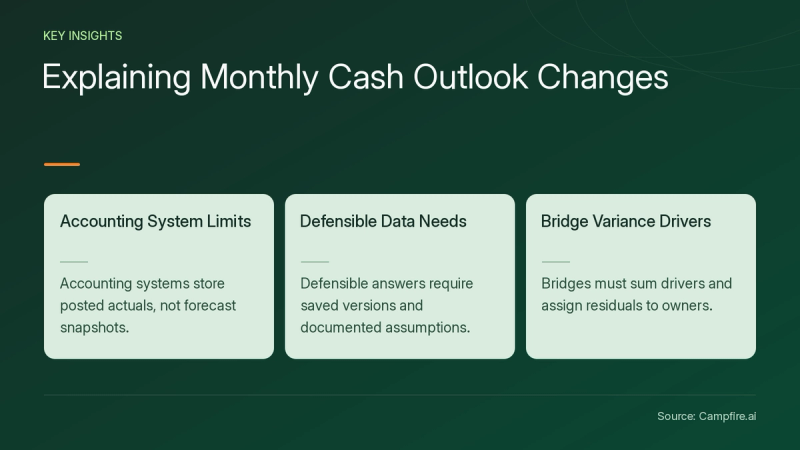
- An accounting system holds posted actuals and static dates, not weekly forecast snapshots.
- A defensible answer needs saved versions, stable IDs, source timestamps and documented assumptions.
- A bridge should sum every driver to the total change and assign any residual to an owner.
- Timing shifts, amount changes, stale data and scope or currency effects need different tests.
- Test explainability before buying software. A controlled spreadsheet is a valid starting point.
Why Can't an Accounting System Explain Weekly Outlook Changes Alone?
An accounting system cannot explain weekly outlook changes alone because it is built for historical reporting. Per Tesorio's 2026 review of cash flow forecasting software, accounting systems are designed for accrual-based historical reporting, period closes and contractual static dates such as invoice due dates. Those records show what was booked, not how expectations moved.
Campfire's Core Accounting module supplies the general ledger, journal entries and month-end close checklists that hold posted actuals. A forecast bridge needs a second layer: the expected dates and amounts recorded in each weekly version.
| Item | General ledger records | Weekly bridge needs |
|---|---|---|
| Cash activity | General ledger recordsPosted transactions after booking | Weekly bridge needsExpected receipts and payments with dates |
| Timing | General ledger recordsPeriod close and invoice due dates | Weekly bridge needsExpected dates updated each week |
| History | General ledger recordsFinal balances after close | Weekly bridge needsSaved forecast snapshots for each week |
| Reasons | General ledger recordsJournal entry references | Weekly bridge needsAssumptions, owners and source records |
What Evidence Does a Week-Over-Week Cash Bridge Require?
A week-over-week cash bridge requires saved forecast versions, stable transaction identifiers and documented assumptions. Without preserved snapshots, a system may describe a change that reflects a revised scope rather than a real cash movement. CTM File's report on treasury forecasting expectations notes that 68% of organizations reported higher management expectations regarding cash outlooks.
- Forecast snapshots: timestamped versions for last week and this week.
- Stable IDs: each receipt and payment keeps the same identifier across versions.
- Source timestamps: the last refresh time for each bank feed and subledger.
- Assumption log: changed payment dates, collection rates and new commitments.
- Scope definition: fixed month-end date, accounts, entities and currency.
How Do You Build a Weekly Cash Outlook Bridge?
To build the bridge, add and subtract each driver between two saved forecasts, then assign any unexplained residual to an owner. Follow these steps:


- Fix the month-end date, included accounts, currency and cutoff.
- Save timestamped snapshots of last week and this week.
- Match each line by stable ID and compare expected dates and amounts.
- Record each driver with its owner and source record.
- Replace forecasts with actuals once, so the same cash is not counted twice.
- Reconcile the sum of drivers to the total movement and investigate any residual.
The table below uses hypothetical figures to show the logic.
| Bridge line | Amount (hypothetical) | Driver owner | Evidence |
|---|---|---|---|
| Last week's month-end outlook | Amount (hypothetical)$500,000 | Driver ownerTreasury | EvidenceSaved snapshot |
| Customer receipt moved to next month | Amount (hypothetical)-$80,000 | Driver ownerAR lead | EvidenceInvoice record and revised date |
| Supplier payment moved out of this month | Amount (hypothetical)+$30,000 | Driver ownerAP lead | EvidencePayment run record |
| Newly expected payroll | Amount (hypothetical)-$20,000 | Driver ownerPayroll lead | EvidencePayroll calendar |
| This week's month-end outlook | Amount (hypothetical)$430,000 | Driver ownerTreasury | EvidenceSaved snapshot |
How Is a Forecast-to-Forecast Bridge Different From a Variance Review?
A forecast-to-forecast bridge explains why this week's expectation differs from last week's for the same month-end. A forecast-to-actual review measures forecast accuracy after cash has moved, so it answers a different question.
How Do You Separate Real Changes From Data Problems?
Classify each driver before accepting it, because each type needs a different test. Timing shifts, amount changes, stale data and scope or currency effects can all change the total without changing underlying cash.


| Change type | Example | Test |
|---|---|---|
| Timing shift | ExampleReceipt moves to next month | TestCompare expected dates across versions |
| Amount change | ExampleInvoice revised downward | TestCheck the source record and approval |
| Stale data | ExampleBank feed not refreshed | TestCompare source timestamps |
| Scope change | ExampleAccount added to the forecast | TestConfirm the account list in both snapshots |
| Currency effect | ExampleRate applied on a different date | TestCheck the rate date and currency basis |
Campfire's Accounting Intelligence page describes bank matching, duplicate detection and review trails. Those controls help confirm whether a bank item was already counted before it appears as a driver.
What Should a Buyer Test Before Choosing a Tool?
A buyer should test whether the system can reproduce last week's forecast and explain each change at the transaction level. BusinessChief's article on real-time cash visibility argues that a standard ERP or general ledger alone cannot automatically explain week-over-week outlook changes.
- Retains prior forecast versions and shows them side by side.
- Links each change to a source transaction or assumption.
- Records manual overrides, approvals and the user who made them.
- Flags stale feeds separately from economic changes.
- Exports an auditable bridge that sums to the total movement.
Start with a controlled spreadsheet when volume is low. Move to connected forecasting software when snapshots and approvals become hard to maintain by hand.
Conclusion
A general ledger alone cannot explain why this month's cash outlook changed since last week. Explaining the change requires saved forecast versions, stable identifiers, documented assumptions and a bridge that reconciles to the total movement. The hypothetical move from $500,000 to $430,000 shows how each driver can have an owner and evidence.
Start by saving this week's snapshot and comparing it with last week's, then assign an owner to every driver and every residual. To see how a controlled bridge fits your close process, you can get started with Campfire.
FAQ
Can a spreadsheet explain a weekly cash forecast change?
Yes, a controlled spreadsheet can explain a weekly change if it keeps dated snapshots, stable line IDs, documented assumptions and a reconciling total. The method works best at low volume, because rebuilding the bridge by hand each week takes time and invites errors.
Does a timing shift change cash even when revenue is unchanged?
Yes, a timing shift can change cash without changing annual revenue. A customer payment that moves from this month to next can leave revenue unchanged while reducing the cash available for payroll, debt service or suppliers this month.
Do I need connected forecasting software to explain changes?
No, connected software is not always required. It helps when bank data, snapshots and approvals are hard to maintain manually, but any tool must retain prior versions and show a reconciling bridge before its explanations can be trusted.
Sources
- [c1] transformance.ai — transformance.ai. Accessed November 28, 2026.
- [c2] tesorio.com — tesorio.com. Accessed November 28, 2026.
- [c3] ctmfile.com — ctmfile.com. Accessed November 28, 2026.
- [c4] businesschief.com — businesschief.com. Accessed November 28, 2026.