Can Accounting Systems Forecast Prepaids and Depreciation From Subledgers?
Listen to article
7:00
Yes, an accounting system can forecast future prepaid expense and depreciation from existing subledgers, if it can read or recalculate the remaining schedule lines for each item. The output is a baseline for items already recorded, not a full prediction of future spending. Results depend on the product, its configuration and the quality of the source records.
Wall Street Prep describes prepaid and fixed-asset subledgers as maintaining forward-looking amortization and depreciation waterfalls. Campfire's Accounting Intelligence page describes prepaid amortization with review and audit trails, the kind of schedule data a forecast would rely on.

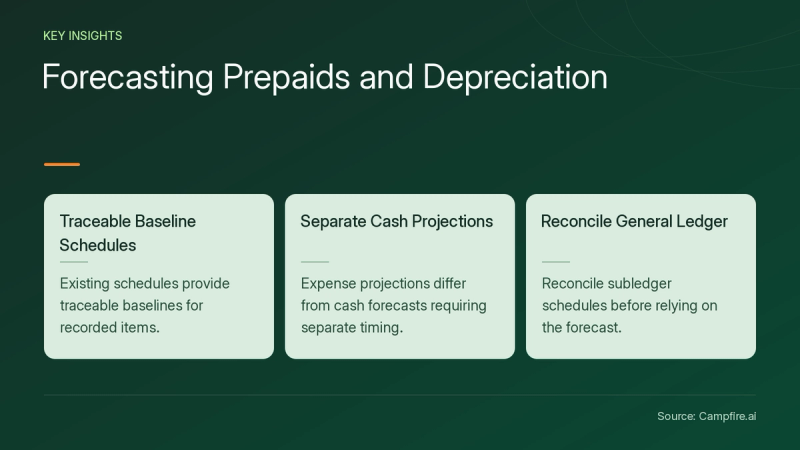
Key Takeaways
- Existing prepaid and fixed-asset schedules produce a traceable baseline for items already recorded.
- Expense projections are not cash forecasts. Payment timing needs its own assumption.
- Renewals, purchases and disposals stay assumptions until a source record exists.
- Reconcile schedules to the general ledger at a closed period before trusting the forecast.
- Test source access, refresh behavior, actual replacement and lease duplication before buying.
What can existing schedules predict?
Existing schedules predict the remaining expense and depreciation for each recorded prepaid and fixed asset, provided the schedules are complete and current. A prepaid schedule uses the remaining balance, benefit period, method and expense account. A fixed-asset schedule uses cost, accumulated depreciation, in-service date, useful life and residual value.
Two simple examples show the mechanics:
- A $12,000 insurance policy recognized evenly over 12 months produces $1,000 of expense per month. After three months, $9,000 remains, supporting nine more $1,000 amounts.
- An asset costing $60,000 with a $0 residual value and a five-year straight-line life produces $1,000 of depreciation per month, assuming a full-month convention.
| Schedule | Inputs the forecast needs | Example monthly expense | Cash timing |
|---|---|---|---|
| Prepaid insurance | Inputs the forecast needsRemaining balance, benefit period, method, expense account | Example monthly expense$1,000 for the nine remaining months | Cash timingPayment usually precedes expense and is not a new outflow |
| Fixed asset | Inputs the forecast needsCost, accumulated depreciation, in-service date, useful life, residual value | Example monthly expense$1,000 for the remaining months of useful life | Cash timingDepreciation is noncash |
Book and tax depreciation can differ. Select the book that matches the forecast's purpose.


What can't the baseline predict?
The baseline cannot predict renewals, new purchases, disposals or payment timing unless those events already appear in source records. Keep three layers separate: existing scheduled expense, modeled future activity and approved adjustments. This prevents a renewal or new asset from being counted twice.
Adoption of automated forecasting remains limited. The FP&A Trends Survey reported that only 9% of respondents used automated driver-based forecasting. Data preparation also consumes effort, as the FP&A Trends Survey data cited by Thredfi showed 47% of FP&A effort went to data wrangling.


How do you test a forecasting vendor's claim?
Test the claim with a reconciled sample of real records, a 12-month forecast and a sandbox change, rather than a dashboard demo. Work through these steps in order:
- Establish the source. Determine whether the tool reads future schedule lines, recalculates from item attributes or extrapolates historical GL expense.
- Reconcile the starting point. At a closed month, compare schedule balances and accumulated depreciation with the GL by entity and account. A Ledge finance operations benchmark cited by Checkflow reported 20 to 50 hours per month lost to multi-system reconciliations, so budget time for this step. Campfire's Core Accounting module includes month-end close checklists that can structure this comparison.
- Reperform a 12-month sample. Include a partial-month item, a fully amortized prepaid, an asset with residual value, an asset near end of life and a disposed or revised asset.
- Test refresh and change controls. Change an end date or useful life in a sandbox. Confirm the effective period, audit trail and permissions. A forecast should not post journals merely because it calculated.
- Separate assumptions. Add a labeled renewal and a planned purchase. Confirm they are removed or linked when actual records post.
Campfire's Forecast illustrates this workflow. Its Committed layer combines posted actuals with amounts already scheduled in subledgers, including prepaid amortization and depreciation. To test that handoff, pick a future month and match the scheduled portion of each expense to the rows in the corresponding subledger.
How do lease schedules create duplicate risk?
Lease amounts can appear in both a lease schedule and a fixed-asset register, so trace each linked right-of-use asset by ID. Under U.S. GAAP, an operating lease generally produces a single lease cost, while a finance lease separates asset amortization from interest. Importing both sources without a matching rule can double-count the same expense.
Conclusion
Existing prepaid and fixed-asset schedules can support a forecast, but only as a baseline for recorded items. Use the forecast to show scheduled expense, label assumptions separately and reconcile the source to the general ledger before relying on it. Confirm that the vendor reads or recalculates source lines, handles changes through controlled workflows and avoids duplicate lease amounts. To check your own schedules against the books, you can get started with Campfire.
FAQ
Does existing depreciation include assets not yet purchased?
No. Existing depreciation covers only assets already in the fixed-asset register, so planned purchases need a separate, labeled assumption. Some systems offer budget features for planned assets, but those figures should not be mixed with actual depreciation for assets already owned.
Should lease expense be added to depreciation in the forecast?
No. Under U.S. GAAP, operating lease cost is a single lease expense, while finance leases separate right-of-use amortization from interest. Include each lease amount once, using the classification in the source records.
Is a subledger-based forecast the same as a budget?
No. A subledger-based forecast projects amounts already scheduled in the records, while a budget also includes planned activity such as renewals, purchases and disposals. Keep the two layers separate so reviewers can see which amounts are recorded and which are assumed.
Sources
- [c1] wallstreetprep.com — wallstreetprep.com. Accessed November 28, 2026.
- [c2] fpa-trends.com — fpa-trends.com. Accessed November 28, 2026.
- [c3] thredfi.com — thredfi.com. Accessed November 28, 2026.
- [c4] checkflow.io — checkflow.io. Accessed November 28, 2026.