Account Reconciliation Aging Policy: Clock Rules and Escalation Steps
Listen to article
7:43
An account reconciliation aging policy sets which open reconciling items are aged, when the clock starts, who owns each item, and when it escalates or closes. This guide gives you an adaptable version. It builds on our account reconciliation procedures guide.

Key Takeaways
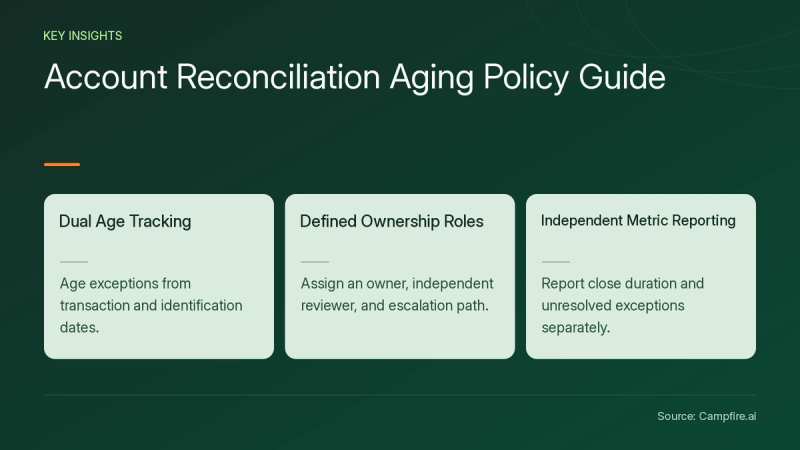
- Age each exception from two dates: the transaction date and the date the exception was identified.
- Assign one named owner, one independent reviewer and one escalation path to every aged item.
- Pauses and reopenings need written approval and must keep the original age history.
- Report close duration and unresolved exceptions as separate metrics.
What does an account reconciliation aging policy cover?
An aging policy covers scope, clock rules, ownership, approvals, escalation and closure evidence. Missing any one of these lets items age without anyone acting on them.
| Policy component | Question it answers | Example rule |
|---|---|---|
| Scope | Question it answersWhich items are aged? | Example ruleCash, intercompany, clearing and subledger reconciling items above a set amount |
| Clock start | Question it answersFrom when is age counted? | Example ruleTransaction date for timing items; identification date for newly found errors |
| Ownership | Question it answersWho acts? | Example ruleA named preparer per account, reviewed by someone else |
| Escalation | Question it answersWho is told, and when? | Example ruleTiers set by age and dollar value |
| Closure | Question it answersWhat proves resolution? | Example ruleClearing against source evidence, approved by a reviewer |
Exception aging tracks open reconciling items in the general ledger. AR invoice aging tracks customer balances by due date, so the two need separate rules.
How should the aging clock start?
The aging clock should start from the transaction date for timing differences and from the identification date for newly found errors. Record both dates so the policy can report either measure.
How does a two-clock example work?
Hypothetical example: a $48,000 unmatched bank receipt is dated March 3 and is identified on March 20 during bank reconciliation. On March 31, transaction age is 28 days and exception age is 11 days. Reporting only one clock hides either the item's history or how long the team has actively worked it.
How should reopened items keep their history?
A reopened item keeps its original transaction date and original identification date, and the reopening is logged as a new event. Resetting the clock hides the item's real age from management review.


Which aging buckets and escalation tiers work?
Accounting policy documentation often uses buckets of 0 to 30, 31 to 60, 61 to 90 and over 90 days, as shown in common accounts receivable aging bucket guidance. These ranges are starting points, not universal thresholds. Use an account reconciliation risk ranking to set tiers by both age and dollar value.
| Tier | Example trigger | Example owner | Example action |
|---|---|---|---|
| 1 | Example trigger0 to 30 days, below set amount | Example ownerPreparer | Example actionResolve in the next cycle |
| 2 | Example trigger31 to 60 days or above set amount | Example ownerAccounting Manager | Example actionDocument root cause and a dated plan |
| 3 | Example trigger61 to 90 days | Example ownerController | Example actionReview, then approve or reserve |
| 4 | Example triggerOver 90 days | Example ownerController and designated reviewer | Example actionFormal escalation with documented disposition |
These tiers are company-selected examples, not regulatory rules. Adjust them to your volume and reviewer capacity.
Who can pause an aging clock or close an item?
Only a reviewer who did not prepare the reconciliation should approve an aging pause or a closure. Record the reason, approver, approval date and expected resolution date for every pause.
- The preparer documents the operational root cause and expected resolution date.
- The reviewer approves or rejects the pause in writing.
- The original age and supporting evidence stay attached to the item.
- Closure requires source evidence and reviewer sign-off.
Use the account reconciliation reviewer checklist before approving any pause. Attach the files described in account reconciliation supporting documentation.
How do multi-system closes and metrics change the policy?
Confirm that every source population is complete at a common cutoff before aging any item. Otherwise the same exception can appear in two systems with different ages. In the same SAPinsider 2025 report, 24% of respondents cited integrating multiple financial systems and ERP instances as an influence on their close approach.


Track close duration separately from the exception backlog. Planful's 2025 global finance survey reported that 68% of finance teams closed within five days, and reconciliations can remain outside the ERP after that point.
| Metric | What it measures | Source |
|---|---|---|
| Close duration | What it measuresDays to finalize the period | SourceClose calendar |
| Open exceptions by age | What it measuresCount of items in each tier | SourceException log |
| Gross item value | What it measuresTotal amount of open items | SourceItem-level detail |
| Net difference | What it measuresBalance variance after reconciling items | SourceReconciliation sign-off |
Bank items should follow the steps in our guide to bank reconciliation unmatched transactions.
How do you move from manual aging to automation?
Run the manual log for at least one full close before automating any step. Automation should follow a process that reviewers already trust.
- Run the manual exception log for one close, with named owners and dates.
- Compare gross item values and net differences against source populations.
- Test alerts against known aged items before relying on them.
- Automate matching only where reviewers accept the output.
Campfire's Accounting Intelligence offers bank matching with review and audit trails, which fits this step-by-step rollout.
Conclusion
Set the scope, clock, owner and approver for each item before adding tiers. Keep the original age and evidence on every reopened or paused item. Once the manual log runs cleanly, you can get started with Campfire.
FAQ
How is exception aging different from AR aging?
Exception aging measures how long open reconciling items in the general ledger have been unresolved. AR aging measures how long customer invoices have been past due, so the two need separate buckets, owners and escalation rules.
Should a paused item keep its original age?
Yes. A paused item should keep its original transaction date, identification date and approval record, with the pause reason and expected resolution date logged alongside them. Resetting the age removes the history that reviewers need to judge the item.
How many aging tiers should a policy have?
A four-tier structure, like the example in this guide, is a workable starting point for most teams. Set the number based on item volume, dollar exposure and reviewer capacity.
Sources
- [c1] bgmaccounting.com — bgmaccounting.com. Accessed November 29, 2026.