Account Reconciliation Procedures: Steps, Examples and Controls
Listen to article
9:18
Account reconciliation compares a ledger balance with independent supporting records, explains every difference, and keeps evidence for review. A Minnesota CPA Society guide describes it as an internal control that confirms ending balances agree and transaction details match.
This guide covers the procedure steps, a worked bank example, an exception register, and controls for automated matching.

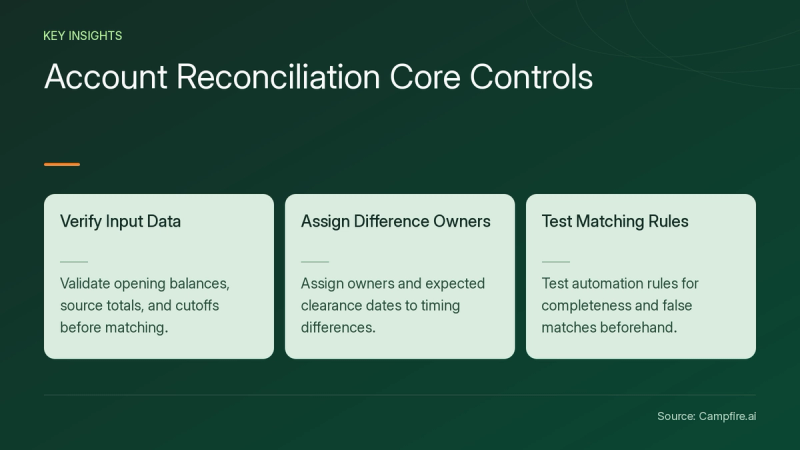
Key Takeaways
- Reconciliation compares a ledger balance with independent support, then clears or explains every difference.
- Validate opening balances, source totals and cutoff before matching begins.
- Supported timing differences can stay open with an owner and expected clearance date. Unsupported differences stay unresolved.
- Book-side errors need journal entries. Bank-side timing items are tracked until they clear.
- Test automated matching rules for false matches and source completeness before relying on them.
What are the steps in an account reconciliation procedure?
The procedure has seven steps: validate the starting point, gather support, compare, investigate, correct, document, and carry open items forward. Each step produces evidence that a reviewer can test.
- Validate the starting point. Confirm the opening balance, period cutoff and source totals before matching.
- Gather support. Collect the bank statement, subledger report or third-party confirmation. A balance sheet reconciliation checklist helps confirm which accounts need support each period.
- Compare. Match items by amount, date, reference and counterparty.
- Investigate differences. Assign each difference a cause and an owner.
- Post justified corrections. Record book-side errors with a journal entry that includes support.
- Document and review. Retain evidence, record preparer sign-off, and obtain independent review. Link each source to its item using account reconciliation supporting documentation standards.
- Carry open items forward. Track supported timing items until they clear, and keep unsupported items open.
What causes reconciliation differences?
Most differences come from timing, data entry errors, cutoff mistakes, duplicate postings or missing entries. Timing items usually clear in the next period, while errors require correction.
- Timing: deposits in transit and outstanding checks
- Recording: transposed amounts or wrong accounts
- Cutoff: entries posted to the wrong period
- Duplicates: the same transaction posted twice
- Omissions: bank fees or interest not yet recorded
How does a worked bank reconciliation separate timing items from adjustments?
A bank reconciliation adjusts the bank balance for timing items and the book balance for items the books have not recorded. The hypothetical example below uses a $48,000 bank balance at month-end.
| Line | Amount ($) |
|---|---|
| Bank statement balance | Amount ($)48,000 |
| Add: deposit in transit | Amount ($)6,000 |
| Less: outstanding check | Amount ($)(2,500) |
| Adjusted bank balance | Amount ($)51,500 |
| Book balance before adjustments | Amount ($)51,800 |
| Less: unrecorded bank service fee | Amount ($)(300) |
| Adjusted book balance | Amount ($)51,500 |
| Unexplained difference | Amount ($)0 |
Figures are hypothetical and shown for illustration only.
Which bank items need a journal entry?
Only book-side items, such as the $300 bank service fee, need a journal entry. The deposit in transit and outstanding check are timing differences that stay on the reconciliation until the bank records them.
Items that fail to match should follow the steps in bank reconciliation unmatched transactions guidance before sign-off.


What belongs in an exception register?
An exception register records each open difference with its account, period, amount, cause, owner, age, expected clearance, escalation path and evidence. An explained difference can stay open, but an unsupported difference should not be treated as resolved.
| Field | Example entry (hypothetical) |
|---|---|
| Account and period | Example entry (hypothetical)Operating cash, March 2026 |
| Amount and cause | Example entry (hypothetical)$1,250, deposit recorded in books, bank posting expected next day |
| Owner | Example entry (hypothetical)Staff accountant |
| Age | Example entry (hypothetical)3 business days |
| Expected clearance | Example entry (hypothetical)Next bank statement |
| Escalation | Example entry (hypothetical)Controller review if open past the policy threshold |
| Evidence | Example entry (hypothetical)Deposit slip and bank statement page |
| Journal entry reference | Example entry (hypothetical)None required (timing item) |
| Preparer and reviewer | Example entry (hypothetical)Initials and dates for each |
Set escalation rules in an account reconciliation aging policy. Define the handoffs in an account reconciliation exception workflow.
How should a reviewer check the reconciliation?
A reviewer confirms that adjusted balances agree, each reconciling item has support, and posted corrections are approved. The review should be performed by someone other than the preparer.
- Adjusted balance equals the supported ledger balance
- Every reconciling item has evidence and an owner
- Journal entries are approved and posted in the correct period
- Open items have an expected clearance date
An account reconciliation reviewer checklist standardizes these checks across accounts.
How do automated matching rules change the procedure?
Automated matching speeds comparison, but each rule needs testing for false matches, source completeness and change control. Automation shifts the reviewer's work toward rule design and exception review.


CFO.com reported Ledge benchmark data showing that 50% of finance teams take six or more days to close. Faster matching matters most when the close is already long.
Accounting Intelligence offers bank matching and duplicate detection with review and audit trails. Ember proposes transaction matching, and accountants review and approve proposed actions.
What should an automation test plan cover?
A test plan should cover source completeness, false matches, rule changes and exception review before automated matches replace manual tick marks. Each test needs a method and retained evidence.
| Test | Method | Evidence |
|---|---|---|
| Source completeness | MethodCompare record counts and control totals to the source system | EvidenceSigned tie-out |
| False matches | MethodSample auto-matched items and re-perform the match | EvidenceSample results and error rate |
| Tolerance thresholds | MethodConfirm amount and date tolerances against written policy | EvidencePolicy reference and approval |
| Rule changes | MethodLog and approve each change to matching logic | EvidenceChange ticket and approver |
| Exception review | MethodReview every unmatched item within the policy window | EvidenceException register extract |
Set amount and date limits using account reconciliation tolerance thresholds. Map each test to the account reconciliation automation controls that govern the rule.
Conclusion
Strong reconciliation procedures combine a fixed sequence, a complete exception register, and independent review. Timing items and book adjustments need different treatment, and automated matching should follow passing tests.
APQC benchmarks put top-quartile teams at 4.8 to 5.0 business days for close and consolidation, compared with a median of 6.0 to 6.4 days. Track close duration and unresolved exceptions as separate measures so each shows its own trend. To turn this procedure into a repeatable routine, get started with Campfire.
FAQ
What is the difference between account reconciliation and analytical review?
Account reconciliation compares a balance with supporting records item by item, while analytical review tests whether a balance is reasonable against expectations. Reconciliation provides direct evidence for specific balances, which analytical review alone cannot supply.
Can an account stay open with timing differences at sign-off?
Yes, a supported timing difference can remain open if it has an owner, evidence and an expected clearance date. An unsupported difference should stay unresolved until someone explains it and the evidence is reviewed.
How often should accounts be reconciled?
Frequency should follow each account's risk, transaction volume and balance materiality. Supplied sources describe risk-based frequency but give no universal deadline, so set it through written policy.
Sources
- [c1] mncpa.org — mncpa.org. Accessed November 29, 2026.