Campfire vs Rillet: AI-Native ERP Comparison and Decision Rubric
Listen to article
18:57
Campfire vs Rillet comes down to how your contracts change, how your entities roll up, and which controls govern what posts to the ledger. Both are AI-native ERPs for growing finance teams. Campfire publishes this guide, so we disclose that perspective and apply the same criteria and evidence standard to both vendors.
Evaluate Campfire first if you need one platform for usage, milestone and hybrid revenue, dimensional reporting, budget vs actuals and a general ledger with real-time multi-entity consolidation, with AI approvals you can tune by activity. Evaluate Rillet first if you want a continuous-close ledger that posts CRM-driven contracts as they sync, with materiality-tiered approval routing and a publicly dated SOC 1 Type II examination. For a Series B company, funding stage settles nothing. Your contract complexity, entity structure, audit timeline and migration capacity decide it.

Key Takeaways
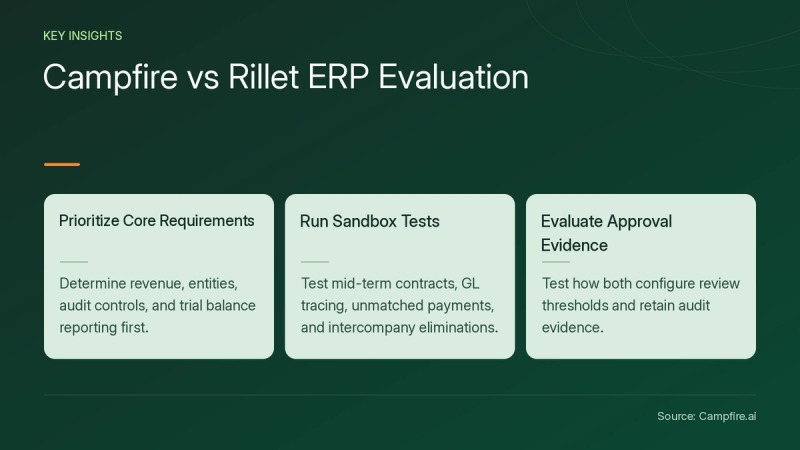
- Decide on four requirements first: revenue complexity, entity and currency structure, control evidence for auditors, and reporting that ties to the trial balance.
- Run one shared sandbox script on both products: amend a contract mid-term, trace an invoice to the GL, resolve an unmatched payment and eliminate an intercompany balance.
- Both vendors document human review of AI-proposed entries. The distinction to test is how each lets you configure thresholds and what evidence the approval leaves behind.
- Neither vendor publishes pricing in the sources reviewed, so request written quotes covering entities, migration, connectors, support and renewal terms.
- Treat vendor comparison pages, including Campfire's, as positioning. Verify each claim against product documentation and your own data.
Campfire

Campfire · https://campfire.ai/
When is Campfire a good fit?
Campfire is best for:
- Teams with subscription, usage, milestone or transaction revenue, including contract modifications and standalone selling price allocation, that want contract-to-journal-entry automation in the ledger.
- Multi-entity, multi-currency companies that need a consolidated view without separate instances or spreadsheet merges.
- Finance teams that rely on dimensional reporting, budget vs actuals and drill-down from reports to source transactions.
- Controllers who want AI suggestions with configurable automatic approval thresholds, or full manual review.
- Buyers who want to load their own historical journal entries into a sandbox before signing.
Core accounting and consolidation. Campfire's Core Accounting page documents real-time consolidation of entities and currencies into one view, subledgers from prepaids to lease accounting, and close checklists that agents create and track. The homepage cites 180+ currencies and unlimited entities. Practical effect: a controller can review a group P&L and switch to a single subsidiary without exports.
Revenue automation. The revenue automation product page documents ASC 606 allocations, performance obligations and journal entries based on your revenue policy, plus automatic handling of contract modifications, upsells, downsells and standalone selling price. It tracks deferred revenue by customer, contract and product, logs every change to terms, pricing and dates with timestamps and user attribution, and lets Ember audit contracts against an uploaded revenue policy.
Accounting Intelligence and Ember. Campfire's Accounting Intelligence model is trained on accounting transactions to propose coding, match bank transactions to GL entries, flag duplicates including intercompany transfers, and suggest accruals that you review and post. The same page says you can set automatic approval thresholds for any activity or keep manual review. Campfire's Forecast page separates posted Actuals, Committed subledger amounts and Ember Estimates, so forward visibility stays distinct from posted books.
Tradeoffs and commercial context. Campfire's Rillet comparison page cites a go-live of 8 to 12 weeks, while its migration page says most teams are live by their next close. Ask which milestones each timeframe covers. Pricing is not documented in the supplied sources. Campfire's comparison page describes platform pricing without module gating, which you should confirm in a written quote.
Rillet

Rillet · https://www.rillet.com/
When is Rillet a good fit?
Rillet is best for:
- Teams that want contracts, invoices and payments to post as they sync, with schedules populated continuously rather than at month-end.
- SaaS companies that sync closed-won contracts from Salesforce or HubSpot and want recognition patterns generated from product and service periods.
- Controllers who need approval routing tied to materiality, period locks and entity-level subledger locks for staged close.
- Buyers who want a large connector catalog spanning billing, tax, payroll, FP&A and data warehouse tools.
- Teams that value a dedicated Slack channel with CPA-led customer success.
Rillet positions itself as the home of continuous close. Its Continuous Close ledger page documents native schedules for revenue waterfall, deferred revenue, prepaid expenses and fixed assets, plus bulk file upload and APIs. Its homepage states that 99.7% of transactions post automatically; the page does not specify which entry types, plans or customers that rate covers.
Revenue recognition. Rillet's Advanced Revenue Recognition page documents CRM-synced contracts, review and approval of contract details before posting, ASC 606 allocations based on your revenue policy, contract amendments that flow into the GL, and marketplace revenue sync. Its SaaS solution page says upgrades, downgrades and usage true-ups run through the same engine prospectively, with an audit trail tracing each entry to its contract.
Controls. Rillet's Audit & Compliance page documents a propose-and-approve rule ("Nothing posts without approval" for agent actions), approval tiers by dollar threshold, immutable approval logs, period locking, view-only access and model change management through ITGCs. It reports a SOC 1 Type II examined by PwC for July 1, 2025 to May 31, 2026, and a SOC 2 Type II examined by Sensiba.


Consolidation, integrations and support. The SaaS solution page documents consolidated and entity-level views, intercompany eliminations and currency translation in the system, plus 100+ in-house native integrations alongside 12,000+ connectors. The integrations directory lists Zip, Snowflake and VAT/GST tax partners such as Sphere. Rillet's own comparison note describes secondary adjustment books, native budget vs actuals and CPA-led implementations of typically 4 to 6 weeks. Pricing is not documented in the supplied sources; Rillet's note says pricing reflects features used and business complexity, including entity count.
Customer evidence. On Rillet's ledger page, Emily Frey, Director of Finance at Smartcar, says the automations "have shaved at least two days off our month-end close." That is one attributed result, not a typical outcome.
How do Campfire and Rillet compare side by side?
Campfire and Rillet document overlapping capabilities in most categories, so the useful differences show up in workflow tests rather than checkmarks. The table uses the ten categories on Campfire's Rillet page, corrected against Rillet's own documentation where they conflict.
| Category | Campfire | Rillet | Test in both demos |
|---|---|---|---|
| AI approach | CampfireProprietary foundation model for categorization, matching, duplicates, accruals; Ember agents and Forecast | RilletAura AI domain-scoped agents; asks the GL with traceable sources | Test in both demosAsk each AI to explain one coding decision and show its source |
| Accounting complexity | CampfireSubscription, usage, milestone, transaction revenue; SSP and contract modifications | RilletFlexible pricing models, amendments, usage true-ups, marketplace revenue | Test in both demosAmend a contract mid-term; inspect schedule and entries |
| Controls | Campfire1,200+ permissions, approval workflows, configurable auto-approval thresholds | RilletOwner/Admin/Accountant roles, materiality-tiered approvals, period and entity subledger locks | Test in both demosRoute a large entry; export the approval evidence |
| Close management | CampfireAgent-built checklists, flux analysis, reconciliations | RilletChecklists, reconciliations and flux drafts run continuously | Test in both demosResolve one unmatched item with owner, evidence, approval |
| Lease accounting | CampfireSubledgers include lease accounting | RilletNot verified from the supplied sources | Test in both demosLoad a lease; review ROU asset and liability schedule |
| Multi-book | CampfireSide-by-side books per Campfire's comparison page | RilletSecondary adjustment books per Rillet's comparison note | Test in both demosPost a GAAP-to-IFRS adjustment; compare trial balances |
| Integrations | Campfire100+ native integrations, API and MCP | Rillet100+ native integrations plus 12,000+ connectors; MCP | Test in both demosForce a failed sync; show retry and mapping ownership |
| Implementation and migration | CampfireMigration agent, line-level history, account reconciliation workbook | RilletCPA-led implementation, typically 4 to 6 weeks per Rillet | Test in both demosDefine who owns open AR/AP, schedules and cutover sign-off |
| Support | CampfireIn-house accountants, Slack-based support | RilletCPA-led CSMs, dedicated Slack channel, same-day responses | Test in both demosAsk for post-go-live support terms in writing |
| Team | CampfireCPAs and ex-auditors on implementation team | RilletCPAs, Big 4 alumni on customer success | Test in both demosAsk who staffs your project after signing |
Note: Campfire's comparison page states Rillet lacks Zip and Snowflake integrations, multi-book support and human approval before posting. Rillet's integrations directory, comparison note and Audit & Compliance page, retrieved the same day, document those items. Use Rillet's documentation for Rillet and verify in a demo.
How do audit trails and approvals compare?
Both vendors document a path from source transaction to approved journal entry to reportable balance, so test the evidence each step leaves rather than whether the step exists. The flow below is an illustrative evaluation script built from each vendor's documented steps.
| Step | Campfire | Rillet |
|---|---|---|
| 1. Source transaction | CampfireBank feeds, billing and expense tools flow in | RilletCRM contracts, Stripe invoices and payments sync |
| 2. Proposed entry | CampfireModel proposes account, vendor, department, class | RilletContract generates recognition pattern and entries |
| 3. Approval | CampfireOne-click review with audit trail, or configured auto-approval threshold | RilletApproval routed by materiality; approvals and rejections logged immutably |
| 4. General ledger | CampfireApproved entry posts; revenue contract changes timestamped with user | RilletApproved entry posts; closed periods lockable by entity |
| 5. Reporting and drill-through | CampfireCustom reports drill down to source data | RilletAudit trail traces entries back to the originating contract |
Demo question for both: if a team enables automatic approval below a threshold, which entries post without review, and what does the auditor see for those entries?


How should a Series B finance team decide?
A Series B team should score both products against its own must-pass requirements before weighing convenience. Apply the pass/fail gates first, then the weighted score. The weights are illustrative; adjust them to your business, and leave any criterion unscored until you verify it.
| Criterion | Must-pass gate | Illustrative weight |
|---|---|---|
| Revenue complexity | Must-pass gateYour hardest contract amendment produces correct schedules and entries | Illustrative weight25% |
| Entity structure | Must-pass gateIntercompany balance eliminates and FX translates in the system | Illustrative weight20% |
| Controls and audit evidence | Must-pass gateApproval evidence exports in a form your auditor accepts | Illustrative weight20% |
| Reporting and budget vs actuals | Must-pass gateEntity and dimension report ties to the trial balance | Illustrative weight15% |
| Migration effort | Must-pass gateMigrated balances reconcile by account and month | Illustrative weight10% |
| Integrations and AI | Must-pass gateBilling, CRM and bank syncs handle a failed record cleanly | Illustrative weight10% |
Use one hypothetical scenario in both sandboxes: a US parent with a UK subsidiary, a customer that upgrades mid-term from flat-rate to usage pricing, and a $60K payment that arrives without an invoice reference. Record manual steps, who approved what, and whether the final consolidated P&L ties.
Before switching, list what you give up: familiar reports, historical evidence access, built integrations and tested controls. Campfire's migration and implementation page documents transaction-level history import and an account-by-account reconciliation workbook. Ask both vendors who owns open AR and AP, revenue schedules, attachments and cutover approval.
When is the other product the better choice?
Choose Rillet if your revenue starts in Salesforce or HubSpot and you want closed-won contracts to generate schedules and post continuously, if your audit committee wants materiality-tiered approvals with entity-level subledger locks and a dated PwC SOC 1 Type II, or if your stack depends on a connector outside Campfire's catalog. Rillet's continuous close also suits teams that prefer future periods populated as data syncs. Stay on your current platform if your contracts are simple and your existing close already ties cleanly.
When should you choose Campfire?
Choose Campfire if your contracts mix usage, milestone and subscription billing with frequent modifications, if you need dimensional reporting and budget vs actuals on the same ledger, or if you want AI approvals configurable by activity. Klarity offers one attributed example. In Campfire's Klarity case study, Klarity had run Rillet for contracts and revenue waterfall inside an outsourced, fragmented stack, then centralized revenue recognition and GL in Campfire. VP Finance and Accounting Libby Francke said, "We had outgrown everything, what felt like at once." Campfire reports a 4+ day close reduction at go-live for that team. The story reflects Klarity's setup, not a Rillet limitation.
What methodology and sources does this comparison use?
This comparison uses the ten criteria above, evaluated from each vendor's official public pages retrieved on November 20, 2026: Campfire's homepage, Core Accounting, Revenue Automation, Accounting Intelligence, Forecast, Implementation and Migration, Rillet comparison and Klarity case study; and Rillet's homepage, Advanced Revenue Recognition, SaaS solution, integrations directory, Audit & Compliance, Continuous Close ledger, Customer Success and Rillet vs Campfire pages. Retrieval dates are not independent product tests. Re-verify claims before relying on them and monthly thereafter.
Conclusion
Campfire and Rillet both document ASC 606 automation, multi-entity consolidation, human review of AI proposals and CPA-led onboarding. The decision rests on your hardest contract, your entity map, the approval evidence your auditor needs, and how much migration effort your team can absorb. Run the same sandbox script on both, score only what you verify, and request written quotes. If contract-level revenue automation, dimensional reporting and configurable AI review match your must-pass list, load your own data into a sandbox and get started with Campfire.
FAQ
Is Rillet or Campfire better for a Series B company?
Neither is better by funding stage alone; the right choice depends on revenue complexity, entity structure, audit timeline and migration capacity. Score both against must-pass gates such as a mid-term contract amendment, an intercompany elimination and a report that ties to the trial balance, then compare written quotes.
Does either product let AI post entries without approval?
Rillet's Audit & Compliance page states that agent actions are proposed to a human and nothing posts without approval, with materiality-tiered routing. Campfire's Accounting Intelligence page documents review and approval with an option to set automatic approval thresholds for any activity. Ask both vendors which entries post automatically under your configuration and what audit evidence remains.
Do Campfire and Rillet both handle ASC 606 contract modifications?
Both vendors document contract modification handling: Campfire's revenue automation page covers modifications, upsells, downsells and standalone selling price, and Rillet's revenue pages cover amendments and prospective upgrades, downgrades and usage true-ups. Test your own hardest contract in each sandbox before deciding.
How long does implementation take for each?
Campfire's comparison page cites 8 to 12 weeks to go live, while its migration page says most teams are live by their next close; Rillet's comparison note cites CPA-led implementations of typically 4 to 6 weeks. Ask each vendor what data import, sandbox, first close and full go-live each timeframe includes.
How do Campfire and Rillet price their platforms?
Pricing is not documented in the supplied sources for either vendor. Campfire's comparison page describes platform pricing without module gating, and Rillet's comparison note says pricing reflects features used and business complexity, including entity count; request comparable written quotes covering migration, connectors, support and renewals.
Sources
- Rillet | The AI-Native ERP | Zero-day close starts here — rillet.com. Accessed November 20, 2026.