NetSuite Alternatives: 5 ERP Options Compared for Finance Teams (2026)
Listen to article
27:14
NetSuite alternatives are ERP or finance platforms that replace some or all of what NetSuite runs: the general ledger, subledgers, consolidation, revenue recognition and, for some companies, inventory and operations. Choosing one starts with a single question. Is NetSuite your finance system or your operating system? If finance is the main job, evaluate Campfire, Rillet, DualEntry and Sage Intacct. If NetSuite also runs inventory, warehouse or manufacturing, shortlist Acumatica or keep NetSuite.
Campfire publishes this guide and lists itself first as an editorial choice. That order is not the result of independent testing. Every profile uses the same criteria: accounting depth, revenue complexity, consolidation, controls and transaction lineage, reporting, and migration effort. Campfire suits SaaS and multi-entity teams that need complex revenue recognition and real-time consolidation in its AI-powered general ledger, where, according to its Accounting Intelligence page, AI-proposed actions go to a person for review unless the team sets automatic approval thresholds.

Key Takeaways
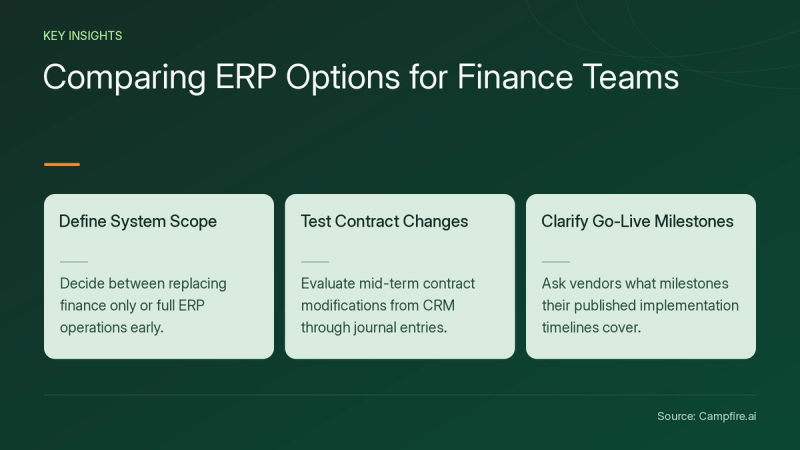
- Decide whether you are replacing finance only or the full ERP. That choice removes most vendors from your list before any demo.
- For SaaS revenue, test a mid-term contract modification from CRM through the journal entry. A feature list will not show you how the system handles it.
- Compare where consolidation actually runs, which entries post automatically, and what lands in a review queue.
- Published go-live claims mix different milestones: data import, sandbox, first close and full go-live. Ask each vendor what its timeframe covers.
- Keep NetSuite if you depend on its operational modules, Multi-Book setup or custom SuiteScript workflows.
How should SaaS finance teams shortlist NetSuite alternatives?
Shortlist by the accounting work each vendor must prove in a demo, not by how it describes its AI. Apply six criteria to every candidate:
- Revenue complexity: ASC 606 allocations, usage and milestone billing, contract modifications and deferred revenue by contract.
- Consolidation: per-entity ledgers, native intercompany eliminations, FX translation, and multi-book reporting.
- Controls and lineage: what posts automatically, what waits for approval, and whether a balance traces to its source transaction.
- Reporting: dimensional budget vs. actuals without exporting to spreadsheets.
- Migration: transaction-level history or opening balances only, and who reconciles the result.
- Operational scope: inventory, warehouse, manufacturing and CRM, if NetSuite runs them today.
| Product | Best for | Supported differentiator | Tradeoff | Price |
|---|---|---|---|---|
| Campfire | Best forSaaS and multi-entity finance teams with complex revenue | Supported differentiatorRevenue automation from contract to journal entry; AI proposals that a person approves, with configurable thresholds | TradeoffGo-live guidance differs between Campfire pages (next close vs. 8-12 weeks). Verification note: ask how inventory, warehouse or manufacturing would be handled | PricePricing not documented in supplied sources |
| Sage Intacct | Best forAccounting-led mid-market organizations | Supported differentiatorDimensional GL, multiple books, AI agents that require human approval | TradeoffImplementation typically takes 3-6 months; sandbox and Platform Services developer subscription are add-ons | PriceQuote required |
| Acumatica | Best forOperations-heavy mid-market companies | Supported differentiatorPricing based on applications, usage and resources, and deployment rather than user seats; Acumatica says resource levels and data storage adjust as users and transactions grow | TradeoffAcumatica advises confirming modules, release and configuration for each workflow | PriceQuote required |
| Rillet | Best forSaaS and marketplace revenue teams | Supported differentiatorCRM contracts generate revenue schedules, which are reviewed before posting; contract amendments flow to the GL | TradeoffVerification note: pricing, lease accounting and multi-book not covered in pages reviewed | PricePricing not documented in supplied sources |
| DualEntry | Best forTeams that want to test their own data before signing | Supported differentiatorFree sandbox with migrated data; $0 implementation fees | TradeoffIts own guide says manufacturing and complex inventory are not its focus; go-live claims vary | PricePricing not documented in supplied sources |
Campfire

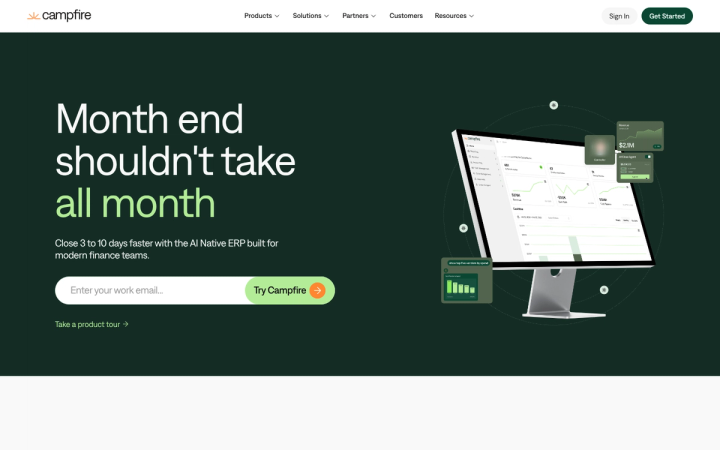
Campfire · https://campfire.ai/
Campfire is best for:
- SaaS and AI companies with subscription, usage, milestone, transaction or hybrid revenue that need contract modifications and SSP handled from contract to journal entry
- Multi-entity groups that want all entities and currencies consolidated in one real-time view
- Controllers who want AI to propose categorizations, bank matches and accruals for a person to review, with auto-approval thresholds they set
- Finance leaders who need budget vs. actuals dashboards and reports that drill to source data
Campfire is a finance-focused ERP covering the general ledger, subledgers, consolidation, revenue, close management and reporting. The pages reviewed do not cover inventory, warehouse or manufacturing. If NetSuite runs those today, ask Campfire how they would be handled.
What does Campfire do in the workflows that matter?
- Revenue: According to the revenue automation page, Campfire handles ASC 606 allocations, performance obligations and journal entries based on your revenue policy. It handles contract modifications, upsells, downsells and standalone selling price automatically. It tracks deferred revenue by customer, contract and product, and records every contract change with a timestamp and the user who made it.
- Consolidation: Entities and currencies roll up into one view in real time, and Campfire's homepage lists 180+ currencies and unlimited entities. Its core accounting page lists sub-ledgers "from prepaids to lease accounting." Multi-book reporting (GAAP/IFRS side by side) and native ASC 842 lease calculations are described on Campfire's Rillet comparison page, not on the product pages reviewed. Verification note: ask Campfire to demonstrate a parallel IFRS book and an ASC 842 lease schedule on your own data.
- Accounting Intelligence and Ember: Accounting Intelligence is Campfire's own model, trained on accounting transactions. It matches bank transactions to GL entries, proposes coding, flags duplicates, suggests accruals and amortizes prepaids. You review and approve each action, or set automatic approval thresholds. Ember, the assistant, drafts entries and runs flux analysis.
- Controls and reporting: Campfire lists 1,200+ granular permissions, approval workflows and SOC 1 and SOC 2 certification, and says it has the controls and audit trails needed for SOX compliance. Whether your configuration meets SOX is for your auditor to determine. Campfire's Forecast page describes three layers: Actuals (amounts posted to the general ledger), Committed (Actuals plus amounts subledgers have already scheduled for future months), and Estimates, where Ember adds its estimate of the rest and shows the assumption behind each number.
What are the tradeoffs and commercial terms?
Switching means retraining your team and rebuilding approval routes and integrations. NetSuite has a SuiteApp marketplace and an add-on Connector module. Campfire's homepage lists 100+ native integrations (its own count), and its Rillet comparison page cites an open API and MCP. That comparison page also describes platform pricing with no module gating. This is Campfire's own claim, and no price appears in the sources reviewed, so confirm what is included in a written quote. Timelines differ by page. The migration page says most teams are live by their next close, with the data migration itself taking 15 minutes. The Rillet comparison page says live in 8-12 weeks. Ask which milestones each figure covers.
What does the customer evidence show?
Klarity evaluated legacy ERPs and Rillet before moving to Campfire. Its starting point was a QuickBooks GL plus Rillet for revenue, not NetSuite. Campfire's Klarity case study reports a 4+ day reduction in close time at go-live and 80+ hours saved monthly for a two-person team. Libby Francke, VP Finance and Accounting at Klarity, said: "The ERP is the center of gravity for Finance, so that’s where we had to start." These are one company's reported results, not a benchmark.
Sage Intacct

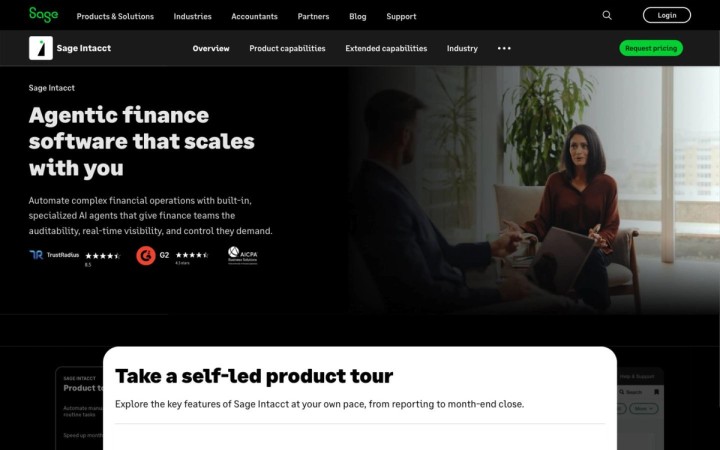
Sage Intacct · https://www.sage.com/en-us/sage-business-cloud/intacct/
Sage Intacct is best for:
- Growing or mid-sized accounting-led organizations, which Sage's FAQ describes as "typically with over $4 million in annual revenue or more than 20 employees"
- Multi-entity groups that want automated intercompany eliminations and side-by-side GAAP, IFRS, tax and cash-basis books
- Salesforce-centric companies that want a connector built and supported by Sage
- Teams that want AI agents that need human approval and log who authorized each action
Sage Intacct is a cloud financial management suite. It also offers planning, HR and payroll extensions. Its main strengths:
- Dimensional ledger: The general ledger page describes dimensions that replace a sprawling chart of accounts, user-defined transaction steps and approvals, and drill-down from dashboards to source transactions.
- Multi-entity: You can add entities and hierarchies without a new implementation. Inter-entity instructions are centralized, currency rate tables are automated, and consolidation is continuous.
- Agents: The Close agent tracks close tasks. The Financial Assurance agent flags unusual entries by comparing them to historical patterns and materiality thresholds. The AP agent codes and matches bills. Sage states that agents work within your controls and require human approval.
- Ecosystem: 350+ marketplace integrations (Sage's count), open APIs and Data Flows.
The tradeoffs are time and add-ons. Sage's FAQ says implementation typically takes 3-6 months and recommends using its expert team. A sandbox and a Platform Services developer subscription are add-ons. Sage states that Intacct does not have a native CRM module and integrates with Salesforce and other CRMs. The Sage Intacct pricing page says plans are tailored and priced by the modules you include, sold on an annual subscription.
Acumatica

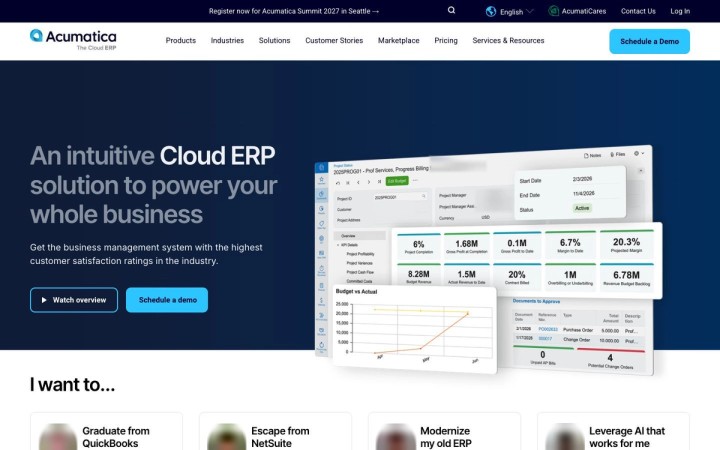
Acumatica · https://www.acumatica.com/
Acumatica is best for:
- Distributors, manufacturers, construction firms and retailers whose ERP must run operations alongside finance
- Companies with many system users that prefer pricing not tied to seats. Acumatica's pricing page says resource levels and data storage adjust as you add users and increase transactions, so costs can still scale with users and volume
- Ecommerce sellers that need native Amazon, Shopify and BigCommerce connectors
- Buyers who want a choice of cloud, on-premises or hybrid deployment, which Acumatica's business-lead page lists, with deployment license costs explained by an Acumatica partner, as its pricing page states
Acumatica documents operational modules, including inventory, warehouse, manufacturing and distribution, that overlap NetSuite's operational scope. Its financial management pages document:


- Core accounting: GL and period management, multi-entity, multi-currency, multi-national and multi-book accounting, with drill-down through Generic Inquiries.
- Revenue: Recurring billing, deferral schedules, contracts and project accounting tied to financial records.
- Controls: Configured approvals, AI anomaly detection, and a 2026 R2 option to require approval before new or updated vendors can be used.
- Planning: Budget vs. actuals across products, jobs and projects.
Pricing depends on three factors, as the Acumatica pricing page explains: applications, usage and resources, and deployment license. Partners explain the differences in license cost. Acumatica's own FAQ tells buyers to confirm the modules, release, configuration and service availability for each workflow. Some workflows rely on connected providers, such as AP payments through BILL or AvidXchange. The pages reviewed do not give an implementation timeline.
Rillet

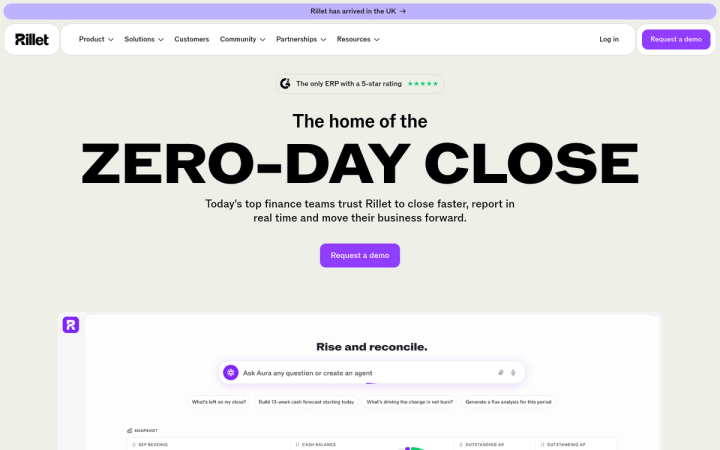
Rillet · https://www.rillet.com/
Rillet is best for:
- SaaS companies that want closed-won CRM contracts to generate revenue schedules for review before posting
- Marketplace sellers that need invoices, refunds, usage and fees synced to the GL
- Multi-entity teams that need intercompany eliminations and translation adjustments
- Teams that want a dedicated Slack channel with a customer success team that Rillet describes as CPAs, ex-auditors and Big 4 alumni (ask Rillet which plans include it)
Rillet describes itself as a continuous-close ERP. Documented capabilities:
- Revenue: Its revenue recognition page covers deferred revenue schedules, ASC 606 allocations posted according to your revenue policy, revenue waterfalls, and in-flight contract amendments that flow to the GL.
- Close: Checklists, reconciliations and flux drafts run continuously. Its enterprise page describes built-in controls and approval workflows.
- Integrations: Rillet claims 12,000+ connectors, a vendor-defined count that is not comparable across vendors, so confirm the specific integrations you need. These include tax engines such as Avalara and Sphere (for VAT and GST), plus an API.
- AI: Aura AI answers ledger questions and shows traceable sources.
Rillet's homepage reports that 99.7% of transactions post automatically, and its enterprise page repeats the figure. Neither page defines which entry types, plans or approval settings it covers. The homepage also says ingested data is "served for approval where needed," so ask Rillet which entries bypass review and which thresholds you can configure. Pricing and implementation timelines are not documented in the sources reviewed. Campfire's own comparison page makes claims about Rillet's lease accounting and multi-book support. Treat those as Campfire positioning and test them in a demo.
DualEntry

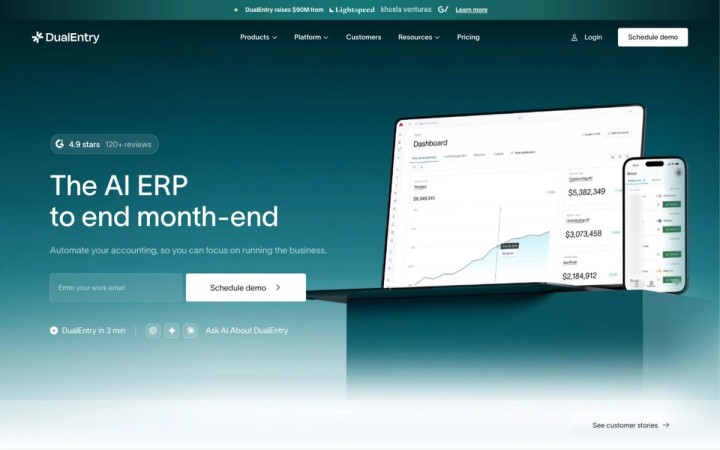
DualEntry · https://www.dualentry.com/
DualEntry is best for:
- Teams that want to see their own migrated data in a free sandbox before signing
- Buyers who want implementation included, with no separate fees
- Multi-entity groups that report in GAAP, IFRS, tax or cash-basis books side by side
- Controllers who want an append-only ledger and rule-based approvals, such as two approvers above $10,000
DualEntry covers the core financial stack: GL, AP, AR, revenue recognition, subscription billing, fixed assets, purchase orders, planning and treasury. Its general ledger page documents:
- AI anomaly detection on transactions before approval
- Bulk import of transactions
- Automatic reconciliation
- Reusable allocation templates
- Real-time consolidation across entities
DualEntry claims 13,000+ integrations, a vendor-defined count that is not comparable across vendors, so confirm the specific integrations you need. Its API page describes a partner form through which integration partners request API keys, and the site also lists a DualEntry API for building your own automations, so ask DualEntry how customers get API access. Its implementation page promises migration in 24 hours, $0 implementation fees, and "live in 4-6 weeks." The same site's navigation says "go live in 24 hours." Confirm which milestone is meant. There is no free trial. DualEntry's own NetSuite comparison says manufacturing, warehouse and complex inventory are not its focus, and that its partner ecosystem is smaller. Pricing is not documented in the supplied sources.
What does switching from NetSuite really cost?
The true cost is a three-year sum of licensing, implementation, parallel running and internal staff time. No vendor in this review published enough to calculate it. Build the worksheet below with quotes from each vendor. Assume a three-year horizon and include contract overlap with NetSuite.
| Cost component | What to price | Public evidence reviewed |
|---|---|---|
| Base subscription | What to priceAnnual fee and renewal caps | Public evidence reviewedNetSuite: annual license (core platform, optional modules and users). Sage and Acumatica: quote required. |
| Users and entities | What to priceSeat counts, entity limits | Public evidence reviewedAcumatica: not priced by seat, but resource levels and data storage adjust as users and transactions grow. Campfire homepage: unlimited entities. |
| Modules | What to priceConsolidation, multi-book, revenue | Public evidence reviewedNetSuite: consolidation capabilities are available with the OneWorld and Multi-Book modules. Sage: priced by module. |
| Implementation and migration | What to priceFees, history depth, who reconciles | Public evidence reviewedNetSuite: one-time implementation fee. DualEntry: $0 fees. Others: confirm. |
| Integrations | What to priceConnectors, middleware, maintenance owner | Public evidence reviewedNetSuite Connector is an add-on module. |
| Internal administration | What to priceAdmin hours, parallel close, retraining | Public evidence reviewedNot published by any vendor; estimate internally. |
Separate the onboarding stages when you compare timelines:


- Data import: chart of accounts, vendors, entities and historical journal entries.
- Sandbox: your own data, tied out against NetSuite balances.
- First parallel close: trial balance and statements compared line by line.
- Full go-live: integrations cut over and NetSuite archived for read access.
Campfire's Migration Agent brings journal entries over at transaction-level detail. It runs balance checks before anything is written, and nothing posts until a person approves it. It produces a reconciliation workbook comparing old and new balance sheets account by account. The Campfire stories supplied for this guide started from QuickBooks, not NetSuite: Campfire's Replit case study reports revenue close falling from 8 hours to 30 minutes for a 4-person accounting team, and its TwelveLabs case study reports a 50% shorter close for a 3-person team. Those were individual results, so ask every vendor for a reference customer who migrated from NetSuite.
Which demo script separates the finalists?
Run one shared script with each vendor and score only what you see demonstrated. Hypothetical example: a US parent sells a 12-month subscription for $120,000. In month five, the customer adds usage-based seats, and the UK subsidiary books a reciprocal intercompany charge in GBP.
- Amend the contract. Show the reallocation and the journal entry it generates.
- Match the reciprocal intercompany balances. Show the remaining difference split into posting period, FX translation and account mapping.
- Post the elimination and the translation adjustment.
- Open budget vs. actuals by department. Drill from the variance to the source transaction and its approver.
- Show which steps posted automatically, which waited for review, and who can change those thresholds.
What did we review, and when?
Every vendor was assessed against the six criteria above, using only official product, solution, integration, pricing and implementation pages, plus Campfire customer case studies. All snapshots were retrieved on 2026-11-16. These are retrieval dates, not independent product tests. Re-verify every claim before publication and monthly after that. We found three conflicts in the sources:
- Campfire's timeline: "next close" on the migration page vs. 8-12 weeks on the Rillet comparison page.
- DualEntry's go-live: 24 hours in site navigation vs. 4-6 weeks on its implementation page.
- Campfire's integration count: 100+ on its homepage vs. 200+ in the TwelveLabs case study.
When is the other product the better choice?
Another product is the better choice when your requirement falls outside finance, or when switching would cost more than the problem it solves. Specific cases:
- Keep NetSuite if it runs your inventory, warehouse, order management or CRM. Keep it too if you depend on its documented intercompany automation: tagging purchase requisitions and sales orders as intercompany so elimination entries post automatically when orders are invoiced. Custom SuiteScript workflows and a renewal that is still years away also favor staying put.
- Choose Sage Intacct if you want a dimensional ledger with multiple books, the Salesforce connector Sage builds and supports, and AI agents that Sage says require human approval, and a 3-6 month implementation fits your plans.
- Choose Acumatica if warehouse staff, project managers or field teams need system access, and you need native Amazon, Shopify or BigCommerce connectors or an on-premises or hybrid deployment option, which Acumatica's business-lead page lists. Acumatica's pricing page says your Acumatica partner explains the cost differences between deployment options, so confirm deployment licensing with an Acumatica partner.
- Choose Rillet if marketplace revenue sync and CRM-driven revenue schedules are your top priority, and its posting model passes your controls review. Test which entries post automatically and which are served for approval.
- Choose DualEntry if proving the migration on your own data before you sign matters most, and you need neither manufacturing nor complex inventory.
When is Campfire the better choice?
Campfire is the better choice when NetSuite mainly serves as your finance system and revenue complexity is the bottleneck. Typical conditions:
- Usage, milestone or hybrid contracts with frequent modifications
- Multiple entities and currencies that you need to see in one live view
- Audit or SOX controls that require choosing which AI-proposed entries go to review and setting auto-approval thresholds, with your auditor confirming the design
- Board reporting that still depends on exported spreadsheets
The trade is retraining your team, rebuilding integrations around 100+ native connectors and an API, and confirming how any operational processes NetSuite runs today would be handled. Switch if your entities, currencies and revenue models fall within Campfire's documented consolidation and revenue workflows and you want reporting and approvals in the same finance system. If you rely on parallel GAAP/IFRS books or ASC 842 schedules, confirm those in the demo, because they appear on Campfire's comparison page rather than its product pages. Stay on NetSuite if it owns operational processes or the intercompany automation your team depends on. In both demos, run the contract amendment and intercompany elimination from the script, and compare which entries post automatically, which go to review, and which thresholds each system lets you configure.
Conclusion
The best NetSuite alternative is the one that passes your own demo script on your own data. Start by deciding whether you are replacing finance or the whole ERP. Then price every component over three years, and treat each published timeline as a question about what milestone it covers. Acumatica and NetSuite remain strong choices when operations drive the system. Sage Intacct, Rillet and DualEntry each suit specific finance-led buyers. If complex revenue and multi-entity consolidation with configurable review of AI entries are your priorities, run the contract-modification script on your own books and get started with Campfire.
FAQ
What is the best NetSuite alternative for SaaS companies?
For SaaS companies replacing finance only, the strongest candidates are Campfire, Rillet, DualEntry and Sage Intacct, because each documents revenue recognition and multi-entity accounting; confirm ASC 606 handling for your contracts with the demo script. Campfire fits usage, milestone and hybrid contracts where teams want AI proposals routed to review or auto-approved under thresholds they set. Rillet fits CRM-driven and marketplace revenue. DualEntry fits teams that want a free sandbox on their own data. Sage Intacct fits teams that want a dimensional ledger with multiple books.
Can I migrate full transaction history out of NetSuite?
Some vendors migrate full transaction-level history rather than opening balances only. Campfire's Migration Agent page says every journal entry comes across at transaction-level detail, and DualEntry's implementation page describes full transaction-level historical migration and lists NetSuite among the systems customers can switch from. Neither page documents how NetSuite-specific records, subsidiaries or custom fields map. Ask each vendor to run a test export from your own NetSuite account, reconciled account by account, and plan read-only archive access to NetSuite for audit support.
Do NetSuite alternatives handle multi-book accounting and local statutory requirements?
Sage Intacct, Acumatica and DualEntry document multi-book accounting on their product pages. For Campfire, GAAP and IFRS books side by side are described on its Rillet comparison page rather than its product pages, so ask Campfire to demonstrate a parallel book in a demo. Country-specific statutory reporting and VAT or GST handling were not verified for most vendors in the sources reviewed. Test each country you operate in, and do not assume multi-currency support means tax localization.
How long does it take to switch from NetSuite?
Published timelines range from one day to six months, but they measure different milestones. Sage Intacct's FAQ cites 3-6 months for implementation. DualEntry's pages give two figures: its site navigation says "go live in 24 hours," while its homepage says data is ingested in 24 hours and its implementation page says migration in 24 hours, with both saying "live in 4-6 weeks." Campfire's pages cite both "next close" and 8-12 weeks. Ask each vendor which milestone each figure covers: data import, sandbox, first parallel close or full cutover.
Sources
- NetSuite ERP: AI-Powered Cloud Accounting and Financial Management Software — netsuite.com. Accessed November 16, 2026.
- Sage Intacct: AI-Powered Accounting & Financial Management Software | Sage US — sage.com. Accessed November 16, 2026.
- Sage Intacct Pricing | Custom Plans Based on Your Needs | Sage US — sage.com. Accessed November 16, 2026.
- Acumatica | Cloud ERP Business Management System — acumatica.com. Accessed November 16, 2026.
- Acumatica Pricing | ERP Software Cost & Subscription Plans — acumatica.com. Accessed November 16, 2026.
- Rillet | The AI-Native ERP | Zero-day close starts here — rillet.com. Accessed November 16, 2026.
- The Agentic AI ERP | DualEntry — dualentry.com. Accessed November 16, 2026.