Introducing Accounting Intelligence



There's a moment every controller knows well. It's the last week of the month, the close is looming, and someone on your team is manually sorting through hundreds of uncategorized transactions, cross-referencing bank feeds, hunting for the duplicate that's throwing off the reconciliation. Again.
It's not that your team isn't good. It's that this work was never a good use of their time.
That's why we built Accounting Intelligence.
What it actually does
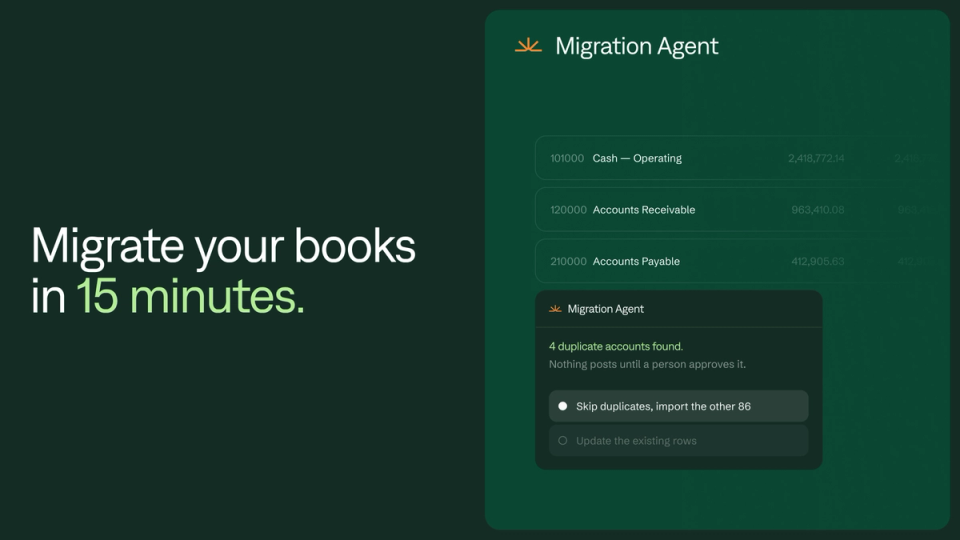
Accounting Intelligence connects to your bank feeds, billing systems, and expense tools — wherever your transactions live — and gets to work automatically. It categorizes transactions against your chart of accounts, matches bank entries to GL records, catches duplicates, and flags discrepancies before they become problems.
By the time your team opens their queue, the heavy lifting is already done. They review, they approve, they move on.
One click. Full audit trail. Next.
Why we didn't just use ChatGPT
This is the question we knew people would ask, so let's address it directly.
General-purpose language models are impressive. They're also trained on text — articles, documentation, code, conversations. They weren't trained on accounting. When you ask one to categorize a transaction or match a bank entry, it's making educated guesses based on language patterns, not accounting logic.
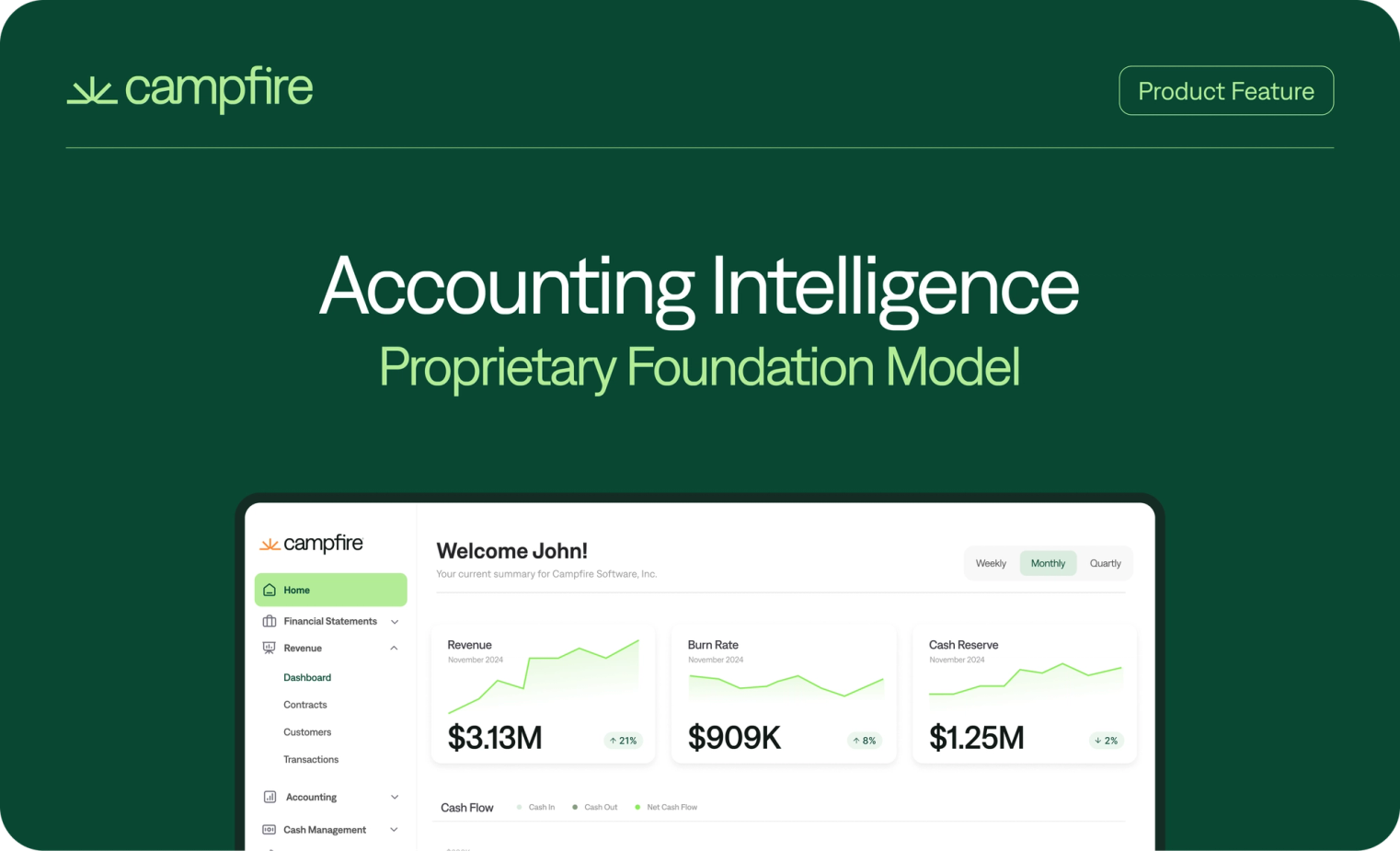
We took a different approach. We built a foundation model from scratch, trained on millions of real accounting transactions. The result is accuracy around 95% on structured accounting tasks, compared to roughly 80% for general-purpose models. That 15-point gap sounds modest until you're closing the books and it's not.
There's also the auditability question. Every suggestion Accounting Intelligence makes comes with full attribution — you can see exactly why a transaction was categorized the way it was. That matters for your auditors. It matters for your team. And it means you're not just trusting a black box.
Your data stays in Campfire, too. No third-party processing. No sending your financials to an external model.
It learns how you work
The model starts with a broad accounting foundation. Then it's fine-tuned for your company specifically.
It learns your chart of accounts, your vendor patterns, your departmental splits. It adapts to your interpretation of GAAP or IFRS — whatever standards your business runs on. You can upload your accounting policies directly: materiality thresholds, auditor specifications, how you handle the edge cases that come up every quarter.
The more it works with your data, the more accurate it gets. And it gets smarter either way — whether you approve a suggestion or correct it.
You're still in charge
This is worth saying plainly: Accounting Intelligence suggests. You decide.
You set the approval thresholds. You can make any activity fully manual. You can start with complete oversight and expand automation gradually as you build confidence in the system. Think of it like onboarding a new team member — one who handles the tedious, repetitive work so your existing team can focus on the analysis and judgment calls that actually require them.
The system shows its work and builds supporting documentation as it goes. So when your auditors come knocking, everything is already there.
What this looks like in practice
Fora Travel processes over $2 billion in bookings with a nine-person accounting team. Before Campfire, that team was handling hundreds of thousands of transactions through a combination of manual work and disconnected tools. After implementing Accounting Intelligence, they became 33% more efficient and cut two days off their monthly close.
Their controller, Adam Schneider, put it this way: Campfire transformed their startup accounting function into something genuinely enterprise-ready.
TwelveLabs had a different problem — transaction categorization that used to take an hour per line item. With Accounting Intelligence, they clear the entire list in 10 minutes. They also eliminated 80% of the time their team spent on bank reconciliation.
That's not a minor efficiency gain. That's hours back every week, every month, compounded across a full year.
The bigger picture
Accounting has always required smart people doing a lot of work that isn't particularly smart. Data entry, matching, reconciliation — the kind of tasks that drain energy without building anything.
Accounting Intelligence is designed to change that ratio. Not to replace your accounting team, but to give them back the time and headspace to do the work that actually matters: analysis, planning, the judgment calls that require real expertise.
If you've been running your close the same way for years because it works well enough — we'd like to show you what well enough actually looks like when the tedious parts disappear.
Want to see it in action? Get a demo and we'll walk you through it.