Finance Engineer vs Financial Engineer: Differences and How to Choose
Listen to article
6:07
A financial engineer usually models prices, hedging and market risk, while a finance engineer usually builds automated workflows inside corporate finance and accounting. The titles overlap and are not standardized, so the actual responsibilities matter more than the label.
For the broader role, read our finance engineer guide. The distinction affects hiring, tooling and controls.

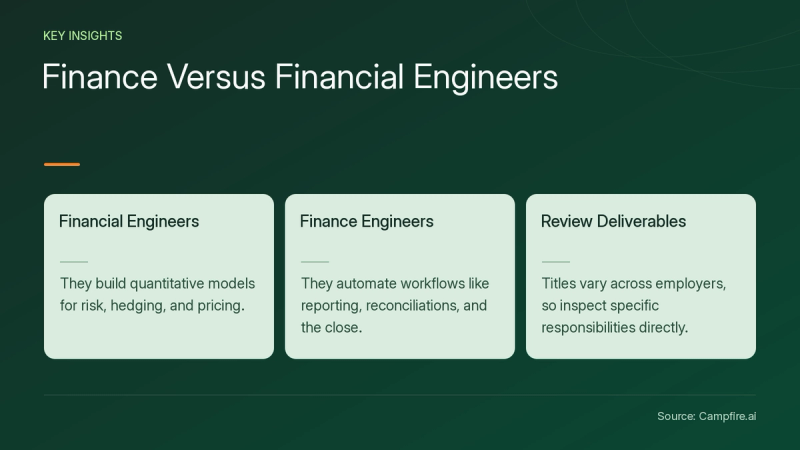
Key Takeaways
- Financial engineers usually build quantitative models for derivatives pricing, hedging and portfolio risk.
- Finance engineers usually automate finance workflows such as reconciliations, reporting and the close.
- Titles vary by employer, so review deliverables and responsibilities, not just the job name.
- Begin any automation with one bounded pilot that has baselines, named reviewers and a rollback path.
What is the core difference between the two roles?
The core difference is the problem each role solves: financial engineers model instruments and risk, while finance engineers automate how finance work gets done. In its finance engineer analysis, CFO Connect treats the two terms as distinct disciplines.
| Dimension | Finance engineer | Financial engineer |
|---|---|---|
| Core problem | Finance engineerAutomating finance operations and data flows | Financial engineerPricing instruments and managing market risk |
| Typical work | Finance engineerData pipelines, close automation, workflow design | Financial engineerDerivatives pricing, portfolio optimization, hedging models |
| Core tools | Finance engineerSQL, workflow automation, LLMs | Financial engineerStochastic calculus, statistical modeling, algorithmic programming |
| Main stakeholders | Finance engineerControllers, FP&A, RevOps | Financial engineerTraders, risk managers, quantitative researchers |
| Typical output | Finance engineerAutomated, controlled finance processes | Financial engineerValidated pricing and risk models |
CFO Brew describes a finance engineer as an operator in corporate finance, FP&A, accounting or RevOps who applies SQL and workflow automation. ILW India describes financial engineering as the quantitative discipline behind derivatives pricing and portfolio risk.
What does a finance engineer do day to day?
A finance engineer connects finance systems, data and approvals so routine accounting work runs with less manual effort. Typical tasks include:


- Designing data pipelines between ledgers, billing and planning tools
- Automating close tasks and recurring journal workflows
- Adding LLM-based steps for classification and exception triage, with human review
Adoption remains uneven. A BDF Experts analysis reports that 56% of finance executives used AI tools daily, but only 17% had deployed automated AI into core workflows such as month-end close or ERP reconciliations.
How do you pilot automated reconciliation safely?
Start with one bounded reconciliation, record a baseline, and assign a named reviewer before granting any write access. Use this sequence:
- Map source transactions to general ledger accounts.
- Define matching rules and tolerance thresholds.
- Route each exception to a named owner.
- Require reviewer approval and retain the evidence.
- Restrict write access with IT and security sign-off.
- Document a rollback path before go-live.
- Compare pilot results with the baseline, then subtract build, maintenance and review costs.
Tools such as Accounting Intelligence provide bank matching, duplicate detection and audit trails. Your team still sets the tolerances and approval rules.


| Measure | Baseline | Pilot |
|---|---|---|
| Reconciliation hours per close | BaselineRecord before launch | PilotRecord after one close cycle |
| Exception error rate | BaselineRecord before launch | PilotRecord after one close cycle |
| Net return | BaselineNot applicable | PilotPilot savings minus build, maintenance and review costs |
How should a finance leader choose between them?
Choose by problem: finance engineers fit workflow and data gaps, while financial engineers fit pricing, hedging and model-risk gaps. Confirm the deliverables in each job posting before writing the hiring brief.
| Situation | Better fit | Deliverable |
|---|---|---|
| Automate accounts payable or close tasks | Better fitFinance engineer | DeliverableTested workflow with approval logs |
| Price derivatives or model hedging exposure | Better fitFinancial engineer | DeliverableValidated pricing or risk model |
| Add light automation to an existing team | Better fitUpskilled controller or FP&A analyst | DeliverableDocumented process with a pilot |
If you are weighing an FP&A analyst for this work, compare the paths in our finance engineer vs FP&A analyst guide.
Conclusion
Finance engineers automate workflows, financial engineers model risk, and the job description should settle which one you need. Map one reconciliation this quarter, and get started with Campfire to test the workflow.
FAQ
Is a finance engineer the same as a financial engineer?
No, the titles usually describe different work. A finance engineer typically automates finance operations, while a financial engineer typically models pricing and risk, although some employers use the labels loosely.
Do financial engineers need programming skills?
Yes, the quantitative discipline relies on algorithmic programming and statistical modeling, as described earlier in this article. The specific languages and tools depend on the employer and team.
Can a controller become a finance engineer?
Yes, a controller can move into the role by learning workflow automation, SQL and controls design. Our guide to becoming a finance engineer outlines that path.
Sources
- [c1] CFO Connect | What Is a Finance Engineer? The Emerging Finance Role for 2026 — cfoconnect.eu. Accessed November 28, 2026.
- [c2] cfobrew.com — cfobrew.com. Accessed November 28, 2026.
- [c3] ilwindia.com — ilwindia.com. Accessed November 28, 2026.
- [c4] bdfexperts.de — bdfexperts.de. Accessed November 28, 2026.