Finance Engineer vs FP&A Analyst: Roles, Workflows and Staffing
Listen to article
8:36
A finance engineer builds and maintains the data pipelines, account mappings and automated workflows that feed financial reporting. An FP&A analyst uses those outputs to plan, forecast and explain variances. The roles overlap, and in smaller teams one person may hold both. For the broader role, see our finance engineer guide.

Key Takeaways
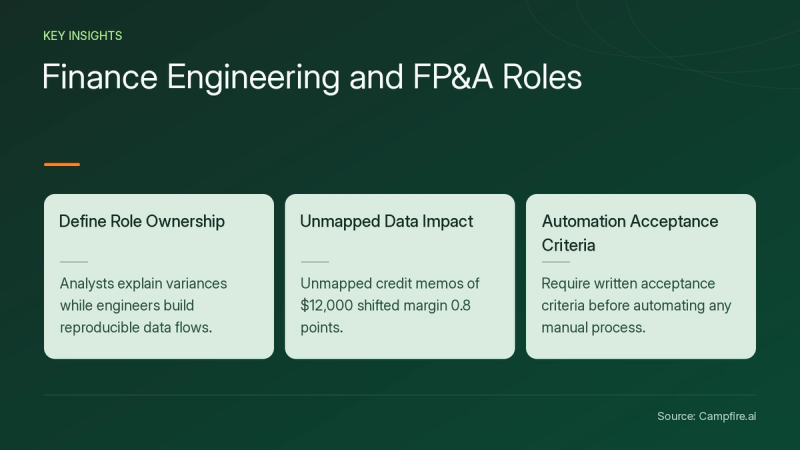
- FP&A analysts own forecasts and variance explanations. Finance engineers own the data flows and mapping rules that make those explanations reproducible.
- Spreadsheets remain standard in FP&A. The control question is who owns source data, mapping rules and version history.
- In an illustrative March close, $12,000 of unmapped credit memos moved gross margin by 0.8 points.
- Pick a staffing model by comparing setup hours, monthly upkeep and the cost of errors, not by job title alone.
- Require written acceptance criteria before an automated process replaces a manual one.
What is the difference between a finance engineer and an FP&A analyst?
An FP&A analyst owns the plan, the forecast and the explanation of results for leadership. A finance engineer owns the systems that deliver trustworthy inputs to that work, including refresh jobs, mappings and reconciliation logic.
The Pluvo comparison frames this as recurring workflow ownership, which clarifies who responds when a monthly report breaks. The split below is a practical starting point, not a standardized job taxonomy.
| Responsibility | FP&A analyst | Finance engineer |
|---|---|---|
| Forecasts and scenario models | FP&A analystOwns | Finance engineerSupports version control |
| Variance explanations | FP&A analystOwns | Finance engineerProvides traceable data |
| GL-to-management mapping | FP&A analystReviews | Finance engineerOwns rules and tests |
| Data pipelines and refresh jobs | FP&A analystRequests | Finance engineerOwns |
| Accounting approval | FP&A analystConsults | Finance engineerImplements; accounting approves |
Controlled spreadsheets remain a realistic option. The AFP 2025 FP&A benchmarking survey of 362 practitioners found that 96% used spreadsheets for planning.
Does finance engineer mean a quantitative financial engineer?
In corporate finance, no. In quantitative markets, financial engineering refers to valuation and risk modeling, such as derivatives pricing, as shown in Columbia's financial engineering curriculum.
The corporate meaning centers on workflow and systems work, and the title is not standardized. Define the term in each job description, and compare it with finance engineer versus financial engineer to avoid hiring mismatches.


How does a reconciled gross-margin close divide the work?
Each role owns a distinct step in the same close. The figures below are illustrative assumptions, not benchmark data.
| Step | Illustrative amount | Owner |
|---|---|---|
| 1. GL revenue, accounts 4000 to 4190 | Illustrative amount$1,000,000 | OwnerAccounting |
| 2. Management-report revenue | Illustrative amount$988,000 | OwnerFinance engineer |
| 3. Difference: credit memos in account 4190, not in mapping | Illustrative amount$12,000 | OwnerFinance engineer finds; controller approves fix |
| 4. COGS (GL and management) | Illustrative amount$620,000 | OwnerAccounting |
| 5. Gross margin, GL basis | Illustrative amount38.0% | OwnerAccounting |
| 6. Gross margin, corrected management basis | Illustrative amount37.2% | OwnerFP&A analyst |
The engineer adds account 4190 to the contra-revenue mapping and reruns the report. The FP&A analyst explains the 0.8-point decline as credit-memo timing and signs the forecast update.
Map each account to planning dimensions before automating the report, using guidance on mapping actuals to planning dimensions. Campfire's Core Accounting product covers the general ledger and month-end close checklists that anchor this reconciliation.
Who signs off on each step?
The controller approves mapping changes, while the engineer implements and tests them. The FP&A analyst owns the variance narrative and forecast version.
| Activity | FP&A analyst | Finance engineer | Controller |
|---|---|---|---|
| Mapping rule change | FP&A analystC | Finance engineerR | ControllerA |
| Reconciliation test | FP&A analystI | Finance engineerR | ControllerA |
| Variance explanation | FP&A analystR | Finance engineerI | ControllerC |
| Forecast version release | FP&A analystA | Finance engineerC | ControllerI |
R = responsible, A = accountable, C = consulted, I = informed. Ember AI can prepare flux analysis and close items, but accountants review and approve proposed actions.


Which ownership model fits your team?
Use controlled spreadsheets for low volume, shared engineering support for a few recurring pipelines, and a dedicated hire when upkeep exceeds one role's capacity. The table uses illustrative hours, not market averages.
| Model | Setup hours | Monthly upkeep hours | Best fit |
|---|---|---|---|
| Controlled spreadsheet with review checklist | Setup hours40 | Monthly upkeep hours12 | Best fitFew entities, stable chart of accounts |
| FP&A analyst plus shared engineering support | Setup hours80 | Monthly upkeep hours4 | Best fitRecurring mappings, several data sources |
| Dedicated finance engineer | Setup hoursRecruiting and onboarding | Monthly upkeep hoursFully owned in role | Best fitFrequent system changes, many entities |
Assume a $90 loaded hourly cost for the shared-support option. Setup costs $7,200 (80 hours), and cutting upkeep from 20 to 4 hours saves $1,440 monthly, for a payback of about five months before counting error reduction. Review the staffing path in how to become a finance engineer if you plan to build the capability internally.
What should a pilot pass before production?
A pilot should meet written acceptance criteria for accuracy, control coverage and ownership before it replaces a manual step. Gartner reported that 25% of finance organizations were uncertain how to move from planning to piloting AI.
- Source-to-GL reconciliation shows no unexplained difference for two consecutive closes.
- Every mapping change has a test case and a named approver.
- Each forecast carries a version ID, assumptions log and scenario owner.
- Exceptions route to a named owner within one business day.
- Access rights limit who can change mappings and forecast inputs.
Build test cases using financial planning model validation tests. In KPMG's 2026 global survey, 33% of assurance-ready organizations reported significant error reduction, versus 6% of less-ready peers, which is an association rather than proof of cause.
Conclusion
Finance engineers own the data and mapping systems, while FP&A analysts own the forecast and the explanation. A reconciled close, a written staffing model and clear pilot gates make the division of work testable. Document each owner before automating a single report.
Start by assigning one recurring variance to a named owner and tracking its reconciliation for two closes. To test this model on your own month-end workflow, get started with Campfire.
FAQ
Can an FP&A analyst become a finance engineer?
Yes, if the analyst builds skills in SQL, Python, data modeling and reconciliation logic while keeping forecasting responsibilities. Many teams start by automating one recurring mapping or refresh job before changing the role's scope.
Does a small company need a dedicated finance engineer?
Not always. A controlled spreadsheet with review checklists or shared engineering support can cover a small number of entities and stable mappings. Hire a dedicated role when upkeep consistently exceeds one person's available time.
Is a finance engineer the same as a quant?
No. A quant in markets typically builds pricing and risk models for financial products, while a corporate finance engineer builds workflows and systems for reporting and planning. The two titles can share mathematics, but their daily deliverables differ.
How do you measure whether the finance engineering work is effective?
Track unexplained reconciliation differences, days to close, exception resolution time and the hours spent on manual data preparation before and after the change. Compare these metrics across at least two closes before concluding that the process has improved.
Sources
- [c1] financialprofessionals.org — financialprofessionals.org. Accessed November 28, 2026.