Finance Engineer Role: Duties, Skills and Automated Finance Workflows
Listen to article
8:41
A finance engineer is a corporate finance professional who designs, builds and operates automated data pipelines and software workflows behind accounting and planning, as Concourse describes the role. The job combines accounting judgment with software practice, and it differs from the quantitative financial engineer who prices derivatives.

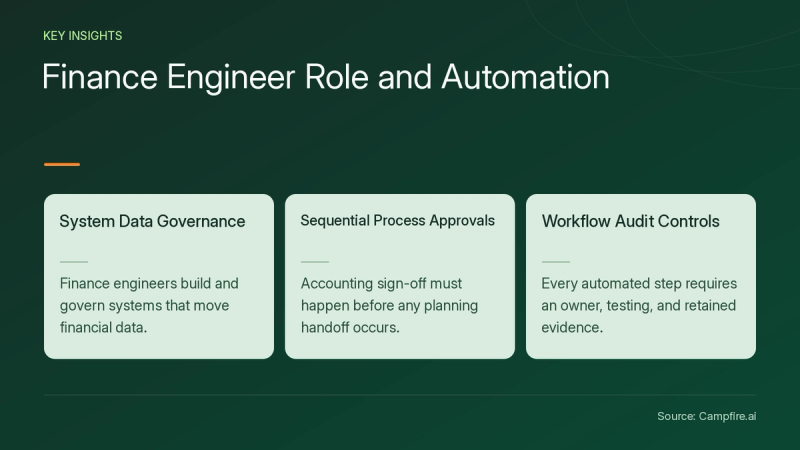
Key Takeaways
- A finance engineer builds and governs the systems that move financial data, not only the reports.
- Accounting sign-off should come before any planning handoff.
- Each automated step needs a named owner, a test and retained evidence.
- Measure a pilot against a baseline taken before launch.
- The quantitative financial engineer is a separate career with a different job.
What Does a Finance Engineer Do?
A finance engineer automates finance data flows and keeps them reliable and reviewable. The work happens at the systems level, unlike manual spreadsheet reconciliation, according to CFO Connect's explanation of the role.
- Build pipelines from banking, billing and ERP sources into the ledger or planning model.
- Write matching and validation logic for reconciliations and close tasks.
- Maintain integrations, access settings and change logs with IT.
- Write runbooks and keep evidence that reviewers can test.
Ask whether the role reports to finance systems, the controller or IT. That answer determines who approves changes and who owns failures.
What Skills Does a Finance Engineer Need?
A finance engineer needs accounting knowledge, data skills, software practice and controls judgment. Job postings show this mix; one financial systems engineer listing names SQL, Python, APIs and dbt for general ledger automation and revenue recognition under ASC 606 and IFRS 15.
| Skill area | What it covers | Evaluation check |
|---|---|---|
| Accounting | What it coversDouble entry, reconciliation and close procedures | Evaluation checkCan the candidate explain a balanced entry for one event? |
| Data | What it coversQuerying ledgers, source extracts and identifiers | Evaluation checkCan they find a missing event ID in a sample extract? |
| Software practice | What it coversScripting, APIs, version control and scheduled jobs | Evaluation checkCan they show a tested change and its rollback? |
| Controls | What it coversAccess approval, segregation of duties and change control | Evaluation checkWho approves a change the builder made? |
| Communication | What it coversExplaining exceptions to controllers and FP&A | Evaluation checkCan they write a clear exception note? |
For a skills path into the role, read how to become a finance engineer.
How Is a Finance Engineer Different From Related Roles?
How does a finance engineer differ from a financial engineer?
A finance engineer works on corporate accounting and planning systems, while a financial engineer usually models derivatives and risk. A quantitative financial engineer typically applies stochastic calculus to price structured products for banks and funds, as an Indeed career guide describes.
The two terms overlap in search, so compare the two meanings before choosing a career path.


How does a finance engineer compare with an FP&A analyst?
A finance engineer builds and tests the data flow, while an FP&A analyst owns the plan and its assumptions. The finance engineer vs FP&A analyst guide covers the overlapping tasks in more depth.
| Role | Primary focus | Typical output |
|---|---|---|
| Finance engineer | Primary focusPipelines, integrations and controls | Typical outputTested workflows and runbooks |
| Accountant | Primary focusLedger accuracy and judgment | Typical outputEntries, reconciliations and sign-offs |
| FP&A analyst | Primary focusPlans, forecasts and assumptions | Typical outputForecasts and variance commentary |
| Quantitative financial engineer | Primary focusPricing and risk models | Typical outputDerivative and risk models |
Titles vary by employer, so treat this table as a working distinction.
How Does a Finance Engineer Handle a Planning Handoff?
A finance engineer starts after accounting sign-off and checks that the reconciled actual is valid before it reaches the planning model. The example below is hypothetical, and its event, amount and ownership are sample choices rather than accounting rules.
Sample event PAYOUT-1042 settles USD 1,250 of an approved payable for Entity A, Operations cost center. Accounting debits accounts payable and credits cash for USD 1,250, creating one balanced entry; the accounting engineer guide covers that ledger side.
- Confirm the accounting sign-off on the reconciled cash outflow.
- Map the actual to planning dimensions, following mapping actuals to planning dimensions.
- Run validation tests on dimensions and totals, using financial planning model validation tests as the pattern.
- Hand the USD 1,250 outflow to FP&A, which owns assumptions and the forecast.
- Retain the event ID, source extract, reconciliation and reviewer sign-off.
| Check | Expected result for PAYOUT-1042 | Evidence to retain |
|---|---|---|
| Event ID present | Expected result for PAYOUT-1042PAYOUT-1042 appears once in the planning load | Evidence to retainLoad log with event ID |
| Totals tie | Expected result for PAYOUT-1042USD 1,250 outflow matches the reconciled actual | Evidence to retainReconciliation record |
| Dimensions valid | Expected result for PAYOUT-1042Entity A and Operations map to valid planning codes | Evidence to retainMapping validation output |
| Owner sign-off | Expected result for PAYOUT-1042FP&A confirms receipt before forecast changes | Evidence to retainApproval record |
Use this as a demo check: load PAYOUT-1042 into a test environment and confirm the validation log records the event ID. Route data errors to the source owner and mapping errors to the finance engineer, and do not release the handoff until the totals tie.


Ownership sits in three places: accounting owns the entry, the finance engineer owns validation, and FP&A owns assumptions. Driver rules are covered in financial planning driver data ownership, and extract age checks follow forecast input freshness monitoring.
How Do You Measure a Finance Engineering Pilot?
Measure a pilot against a baseline taken before launch, using reviewer time, accuracy and exception rates. Record the same metrics after launch for the same cycle type.
| Metric | Baseline to record | Post-launch check |
|---|---|---|
| Reviewer time | Baseline to recordHours per close or handoff | Post-launch checkSame task, same reviewer group |
| Accuracy | Baseline to recordErrors found in review | Post-launch checkErrors per sampled batch |
| Exception rate | Baseline to recordItems routed to manual handling | Post-launch checkItems per cycle |
| Maintenance | Baseline to recordHours spent fixing pipelines | Post-launch checkHours per month |
| Control incidents | Baseline to recordUnapproved changes or access exceptions | Post-launch checkCount per quarter |
Rossum's document automation trends report found that 54.2% of corporate finance teams were stuck in partial automation. Track manual intervention as a core metric for that reason.
Set rollback triggers before launch, such as any unreconciled difference or any change deployed without approval. Give IT ownership of production access and change control, and keep the builder out of approving their own change.
Conclusion
A finance engineer builds and tests the systems behind finance data, so start with one workflow, assign owners and measure a baseline before automating it. When you are ready to test that workflow on a platform, get started with Campfire.
FAQ
What is a finance engineer?
A finance engineer is a corporate finance professional who designs, builds and operates automated data pipelines, integrations and software workflows across finance systems. The role combines accounting knowledge with software practice, and it differs from a quantitative financial engineer.
Is finance engineer a standard job title?
No, the title is not standardized, and employers describe the scope differently. Confirm the duties, tools and sign-off authority in each job description before comparing roles.
Does a finance engineer need to know how to code?
Job listings describe SQL, Python, APIs and orchestration tools as part of the work, so coding skills are often expected. Requirements differ by employer, so check the specific tools named in the role.
How much does a finance engineer earn?
Compensation is not documented in the supplied sources. Use current, location-specific and seniority-specific salary data for the role before making a decision.
Sources
- [c1] concourse.ai — concourse.ai. Accessed November 28, 2026.
- [c2] CFO Connect | What Is a Finance Engineer? The Emerging Finance Role for 2026 — cfoconnect.eu. Accessed November 28, 2026.
- [c3] openai.com — openai.com. Accessed November 28, 2026.
- [c4] indeed.com — au.indeed.com. Accessed November 28, 2026.
- [c5] rossum.ai — rossum.ai. Accessed November 28, 2026.