Financial Planning Driver Data Ownership: A Practical Playbook
Listen to article
6:52
Financial planning driver data ownership means naming one accountable owner for each input that feeds a forecast. Ownership runs from the source record to the approved assumption.
This playbook shows how to build that structure as part of your finance engineer work. It covers a driver register, a reconciliation to closed actuals and a driver-level error review.

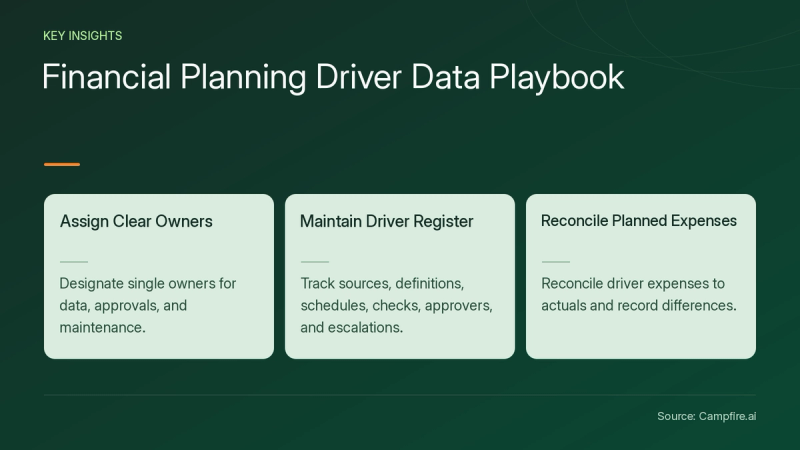
Key Takeaways
- Assign one owner each for source data, assumption approval and model maintenance.
- Keep a driver register that records source, definition, cadence, checks, approver and escalation path.
- Reconcile planned driver expense to closed actuals, and log every timing and classification difference.
- Measure forecast error by driver over matching periods before changing an assumption.
- Test each automated feed with one record before relying on it for forecasts.
Who Owns Each Planning Driver?
Each planning driver needs one owner for source data, one approver for its assumption and one maintainer for model logic. Keep these roles separate so no one both sets and checks the same number.
| Register field | Hypothetical headcount entry |
|---|---|
| Driver name | Hypothetical headcount entryOpen headcount hires |
| Definition | Hypothetical headcount entryApproved requisitions with a planned start date |
| Source system and owner | Hypothetical headcount entryApplicant tracking system, HR operations lead |
| Assumption approver | Hypothetical headcount entryFinance Lead |
| Model maintainer | Hypothetical headcount entryFinance Systems Manager |
| Refresh cadence | Hypothetical headcount entryWeekly until close, then monthly |
| Quality check | Hypothetical headcount entryRequisition count ties to the source report |
| Escalation path | Hypothetical headcount entryFinance Lead decides within two business days |
AFP's 2025 technology survey reported that 61% of FP&A respondents cited unreliable data and 60% cited inaccessible data as obstacles, and it identified data governance as the biggest barrier. Deloitte notes that ERP and planning migrations routinely fail to deliver ROI when master data and operational drivers lack defined ownership.
For the role boundaries between finance engineering and planning analysis, see finance engineer vs FP&A analyst.
Who decides when the source and forecast disagree?
The Finance Lead decides which value the forecast uses, and the source owner corrects the record within an agreed window. Set this rule before the first close, not during a dispute.


How Do You Reconcile Driver Inputs to Closed Actuals?
Reconcile by tracing each driver's planned amount into the forecast, then matching the recognized amount in closed actuals and logging every difference. The steps below use hypothetical figures.
- Plan: one hypothetical hire with a $120,000 base salary and a planned March 1 start. Planned monthly expense is $10,000.
- Source: HR confirms an actual start date of March 16.
- Forecast: FP&A updates the start date and keeps the approved salary.
- Actuals: after close, March payroll expense posts at about $5,161 (16 of 31 days).
- Difference: the $4,839 gap is a timing difference, logged with owner, reason and evidence.
| Difference type | Hypothetical example | Owner | Evidence to keep |
|---|---|---|---|
| Timing | Hypothetical exampleStart date moves from March 1 to March 16 | OwnerHR source owner, FP&A | Evidence to keepChange record, forecast version |
| Classification | Hypothetical exampleRecruiting fee coded to G&A instead of payroll | OwnerAccounting | Evidence to keepJournal entry, mapping rule |
| Cutoff | Hypothetical exampleOffer accepted in February, first payroll in March | OwnerAccounting | Evidence to keepOffer letter date, payroll calendar |
Campfire lists native payroll connections, including ADP, Rippling and Gusto, that journalize payroll runs. Confirm your provider appears on the integrations page and check which data objects sync.
Use mapping actuals to planning dimensions to set classification rules before the reconciliation runs. The month-end steps can be tracked in Core Accounting.
How Do You Measure Driver-Level Forecast Error?
Measure driver-level error by comparing each forecast version with the actual driver value for the same period. Investigate any variance above a threshold the Finance Lead agrees in advance.


FP&A Trends' 2025 survey found that 15% of organizations use fully driver-based models, and its survey data shows most others rely on partial or basic models. Gartner reports that only 3% of companies have strategic, operational and financial planning fully aligned and integrated.
Hypothetical example: the forecast assumed 12 Q1 hires, and 9 were made. The error is (9 - 12) / 12, or -25%, which exceeds an illustrative 10% threshold.
| Step | Action | Evidence retained |
|---|---|---|
| Preserve | ActionSave forecast version with driver values | Evidence retainedVersioned file or model snapshot |
| Compare | ActionForecast 12 hires vs actual 9 | Evidence retainedVariance calculation |
| Investigate | ActionTwo declined offers, one reopened requisition | Evidence retainedRequisition log, HR export |
| Remediate | ActionAdd offer-status field to driver register | Evidence retainedRegister change with approver sign-off |
| Retest | ActionRerun the Q1 comparison on the next version | Evidence retainedRetest results |
Design the retest with financial planning model validation tests. Before relying on any automated feed, follow one record through mapping, duplicate handling, errors and replay.
Conclusion
Driver data ownership works when each input has a source owner, an approver and a reconciliation path to actuals. Start with one high-impact driver, such as headcount, and run it through one full close. Keep the register, reconciliation log and error review as the evidence trail. To see how these steps fit your close, get started with Campfire.
FAQ
Who should own the source data for a planning driver?
The owner of the operational system that creates the record should own its source data, while FP&A owns the forecast logic that uses it. This split keeps data corrections separate from model changes.
How often should driver data be refreshed?
Set the cadence by how fast the driver changes and when the close occurs. A hypothetical headcount driver might refresh weekly until close and monthly afterward, with the rule written into the register.
What is the difference between an assumption approver and a model maintainer?
The approver, often the CFO or Finance Lead, accepts a change to an assumption's value or logic. The model maintainer, such as a Finance Systems Manager, implements the approved change and keeps an audit trail of who changed what.
Sources
- [c1] fpa-trends.com — fpa-trends.com. Accessed November 28, 2026.